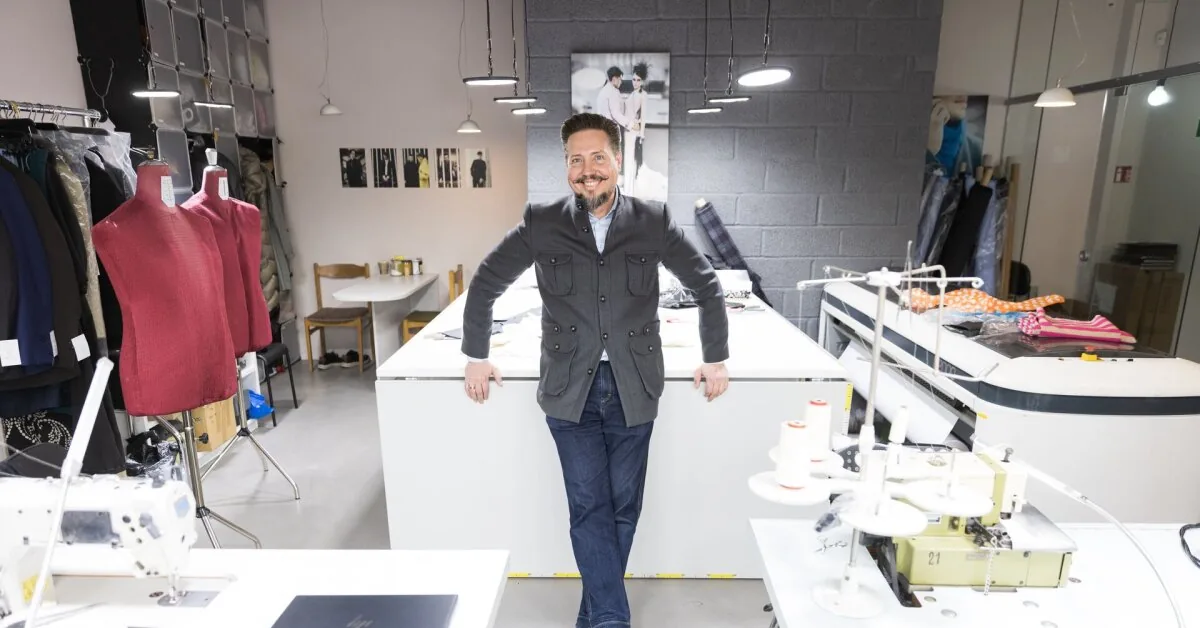
Classics, as a refined sensation
The laureate of the “French Fashion Award”, “A’ Design Award & Competition” and other prestigious competitions – Dr. Kęstutis Lekeckas, associate professor at the Faculty of Arts and Education of Kaunas College, notes: although classic clothing does not lose its relevance, it is also being rewritten by recent realities – technological innovations, sustainability ideas, and the thinking of a new generation of designers.
According to the interviewee, on the one hand, the design of classic clothing is established and changes minimally – it seems to exist alongside fashion, so radical style trends do not affect it.
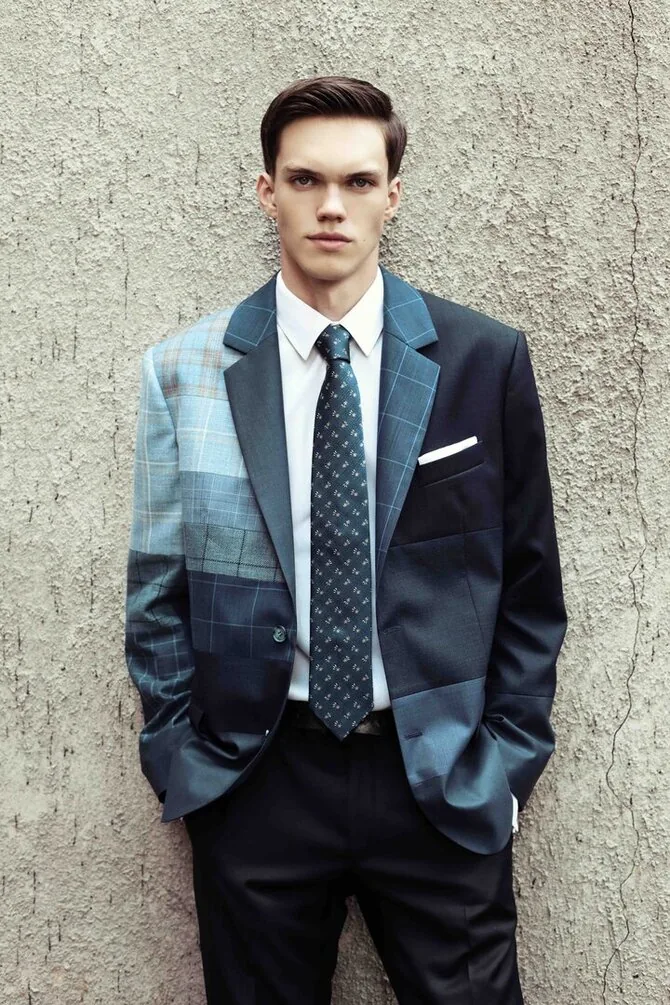
However, visual stability does not mean stagnation. Innovations here hide, figuratively speaking, under the lining, in the fabric structure, functionality, and wearing comfort.
Thus, a traditional wool jacket, sewn a hundred years ago, and a modern creation may look almost identical, but their nature will fundamentally differ. Accordingly, we now value clothing not only as an aesthetic but also as a complex technological object.
“Materials become better processed, softer, lighter. Today’s technologies allow achieving such fabric softness and elasticity that masters of the early 20th century could not even dream of. So, classics today are more than just an image – it’s also a feeling,” says the interviewee.
Fashion “from a test tube”
It is precisely fabrics and textures that are the area where perhaps the most significant transformations are recorded, and future clothing is increasingly associated with fibers born in laboratories. Dr. K. Lekeckas notes that the fashion world is boldly experimenting with biodegradable materials, for example, substitutes for traditional natural leather made from mushrooms, cellulose, or pineapple waste.
“Today we already have examples where jackets or classic silhouette blazers are created from materials ‘grown’ from tea fungus (kombucha) or other microorganisms. Of course, for now, this is more a part of experiential fashion or performance, as such materials are often not entirely sustainable, and still require synthetics for stabilization. However, technologies are rapidly developing, and similar materials may replace traditional ones in the future,” shares the interviewee.
In recent years, in the increasingly relevant search for sustainability, the classic suit inherently gains an advantage. Such clothing is durable, versatile, and easily adaptable to different situations.
“For a modern designer who focuses on short-term trends, being sustainable is much more difficult,” admits Dr. K. Lekeckas. “And conversely – by nurturing traditional tailoring and quality, we are already on a sustainable path. A high-quality classic suit can be re-sewn, updated, and serve for decades – this is sustainable or slow fashion; circularity still lacks final recycling, which is complex in this case, but progress is being made towards it.”
Where the undercurrents lie
Some of the creator’s own collections – examples of modern classics – are born from production residues, forming a material that is already pre-oriented to a specific pattern shape. Thus, the designer, who has gained international recognition for circular design and zero-waste (angl. zero-waste) production solutions, also testifies that today, sustainability is inseparable not only from creativity but also from engineering precision.
Read more Champion was frightened: «I almost died this week»
Dr. K. Lekeckas, who works with the younger generation of designers, admits that the modern fashion industry is generally inseparable from the influence of digitalization. Virtual collections, 3D visualizations, and artificial intelligence have already become the new reality.
“Today, virtually anyone with an artificial intelligence tool and a verbal query can create a clothing visualization. This opens up enormous opportunities for co-creation with the client, but it also harbors certain dangers,” warns the interviewee. “The biggest threat is limiting one’s creativity by entrusting everything to algorithms. If we stop generating ideas ourselves and only adapt what artificial intelligence offers, we will become lazy and lose our artistic identity. Innovations must be an assistant, not a substitute for the creator.”
In his opinion, only a balance between modern tools and traditional handcraft is capable of not overshadowing creativity and the romance of the designer’s profession.
Union of innovation and identity
Dr. K. Lekeckas also admits that no matter how wide the opportunities technological progress opens up, it alone will not solve the most pressing challenges of the fashion industry.
“This is a complex problem – not only sustainable materials and more sustainable processes are important, but also local solutions, good working conditions, and fair wages. After all, one of the reasons why fast fashion emerged was that consumers wanted cheap, rapidly changing trends without investing in longevity,” reminds the interviewee. “Only when the consumer, designer, and manufacturer move in one direction will we be able to get as close as possible to sustainability.”
When asked what kind of clothing he envisions in 20 or 30 years, the creator answers ambiguously.
“We will certainly have a lot of interactive fashion, where clothing will be able to change color, adapt, warm, or cool. 3D printing technologies will also become more accessible and widespread,” predicts the interviewee.
At the same time, he highlights fundamental things that create value due to their authenticity, handcraft, and “immortality.” “I also believe in another path – a return to traditions, heritage, and national identity. I would very much like to believe that both of these directions – technological and traditional – will find their place and develop in parallel,” says the founder of the fashion house “leKeckas”.
Read more Lukas Uleckas – about emotions, Kurtinaitis’s attention and the fight with Žalgiris