









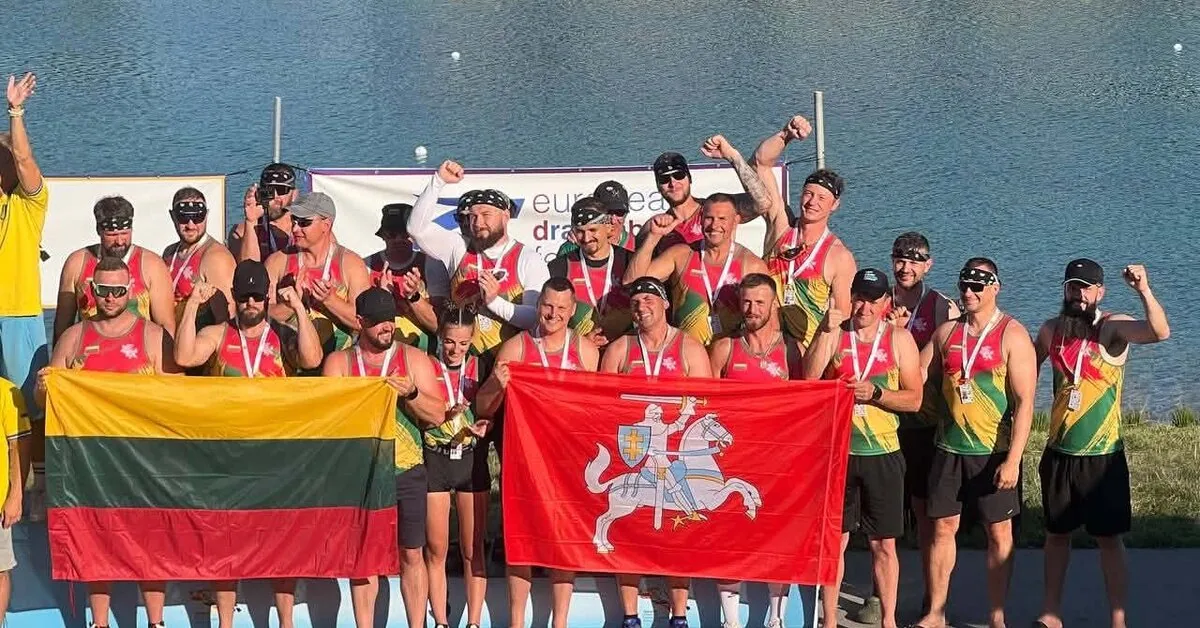
Dragon boats are a team rowing sport. Usually, a boat is rowed by a team of 12 or 22 people. This sport originated in China, where it developed from traditional boat races that have been held for thousands of years. It requires not only physical preparation but also teamwork.
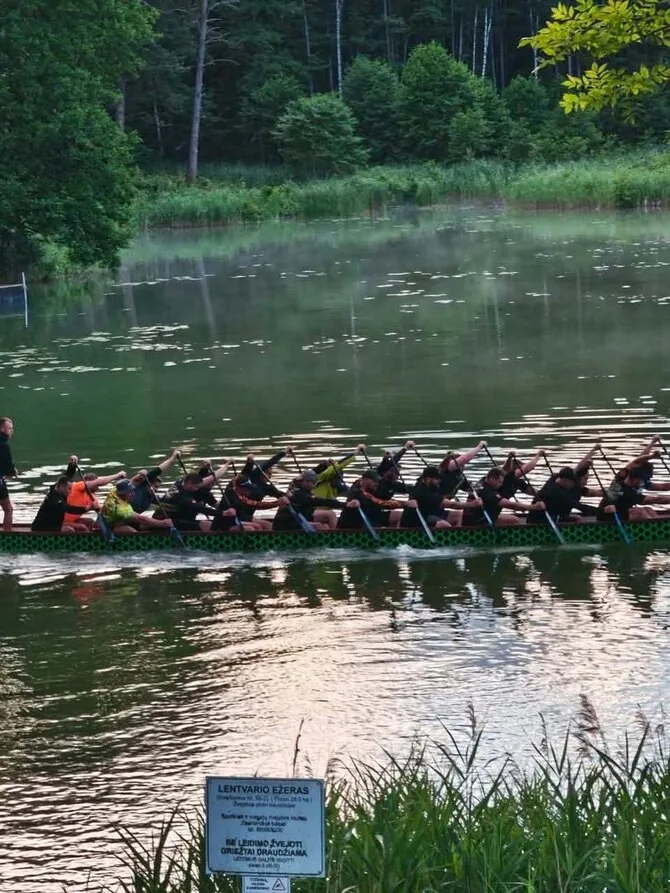
The captain of the Lentvaris dragon boat club, Vaidas Kurganas, not only told more about this sport but also shared impressions about the European Championship, where his team represented Lithuania.
– How would you describe dragon boat sport to people who have never heard of it?
– In my opinion, it is a team sport that requires not only physical preparation but also a feel for the water. Teamwork is the greatest achievement in this sport.
We have to maintain unity and synchronization. If one team member is already rowing while another is just starting, an imbalance occurs because one is pushing the boat while the other is holding it back.
You can give a lot of effort, but without team identity, there will be no good results.
– How many people make up a dragon boat team and what roles do its members perform?
– Our team consists of about thirty people. Of course, everyone has their own life, we are all working people, so not everyone can train or participate in competitions.
In this sport, there is the possibility to row a twenty- or ten-seat boat. Each boat also has a drummer and a steerer. The team consists of either twenty-two or twelve members.
The drummer is mandatory and maintains the team’s rhythm so that everyone rows synchronously. The steerer is responsible for keeping the boat straight and on course.
The team members sitting on the first benches set the pace, and everyone else rows according to them.
– When did dragon boat sport arrive in Lithuania?
– Dragon boat sport came from China. Worldwide, this sport appeared quite a long time ago, but it was more recreational. Various festivals were held, and the boats had much larger and more ornate dragon heads and tails. The main thing was to decorate and look beautiful.
Nowadays, it has become more of a sport. Our boats are no longer so impressive; the dragon heads are very small, remaining only as an accent.
In Lithuania, this sport appeared about fifteen years ago. It was brought and developed in our country by the late Jevgenijus Šuklinas.
At first, it was also a way to unite communities for fun. Over time, it grew into a sport – into what we have now.
Of course, this is not the peak; it is just a transitional stage from recreation to sport.
– What skills are needed to start rowing dragon boats?
– This sport is very similar to rowing. You could say it is a mix of kayaking and canoeing. In this sport, you row with a canoe paddle but sit on a bench like in a kayak.
Professional rowers quickly grasp the whole system and do not find it difficult. A newcomer needs to remember that good physical preparation is essential.
Although it seems easy to row a 200 m distance, it requires a lot of strength.
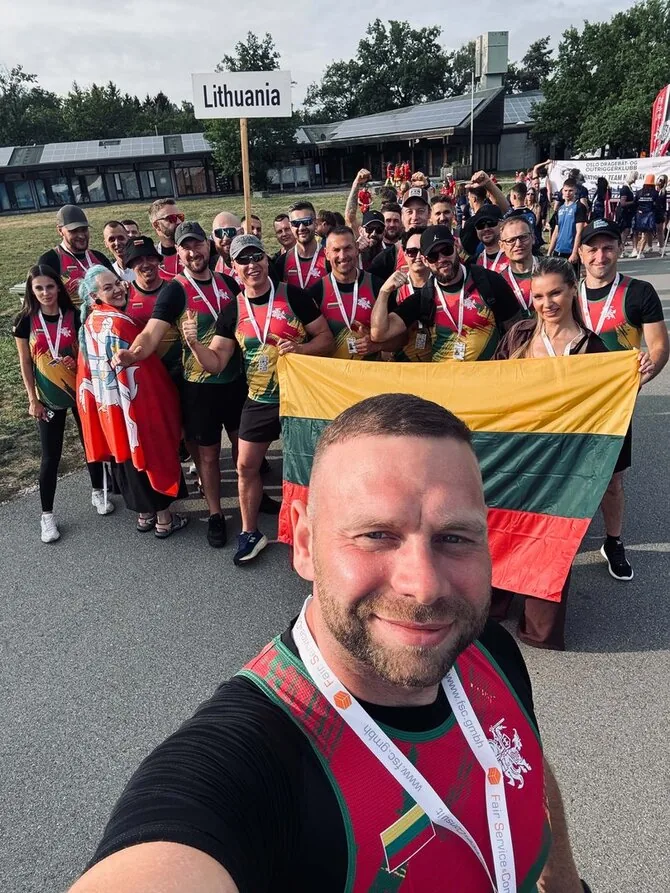
– When did you start being interested in this sport?
– I started being interested in this sport five years ago. At that time, a festival was held in Vievis, to which the late J. Šuklinas invited me to participate.
At that time, it was new to me; I thought it would be something like Viking boats. We performed very well then, won first place, and felt the pleasure of rowing.
Of course, it ended quickly because we did not have a boat. We formed this team two years ago when a dragon boat festival was held in Lentvaris.
We really wanted to and managed to gather a team from local residents. After this festival, we started considering buying a boat. At first, it was a joke, but I started looking for a boat, and that’s how we began our career.
– What does a typical training session for your team look like?
– We start training with a discussion. We have a coach, former canoe paddler Ovidijus Jonas Stalnionis. He prepares a plan for each training session, we agree on it in advance, and when we arrive, we immediately start working.
First, we do a short warm-up, then we get into the boat and row a couple of kilometers. After such a warm-up, we do various exercises.
For example, we attach a car tire and pull it with great resistance to feel the strength of the stroke and increase our explosive power.
Read more Lithuanian 18-year-olds suffered their first defeat – lost to the Austrians
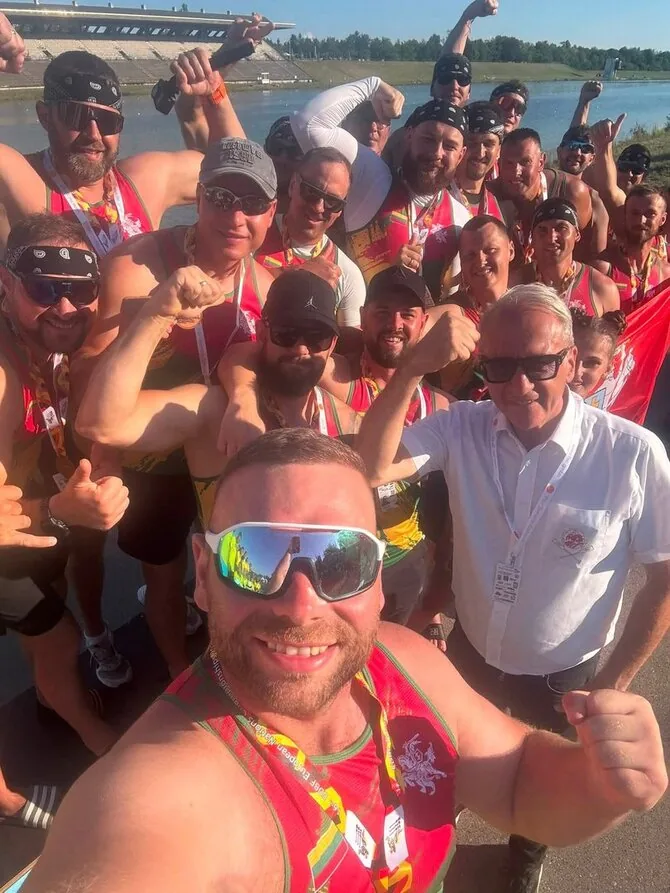
– You represented Lithuania at the European Dragon Boat Championship and won three bronze medals. What does this achievement mean to you?
– This achievement means a lot to me; it is like a dream come true. Quietly, the team dreamed about winning in Europe, how nice it would be to beat other teams.
We were the first team from Lithuania. We were even congratulated by the European federation for daring to participate. Everyone was happy that Lithuania as a country participated in the championship and that this sport is also becoming popular in our country.
No one expected great results from us, but we were showered with attention. When receiving the medals, I heard that such results were not expected, and we pleasantly surprised everyone.
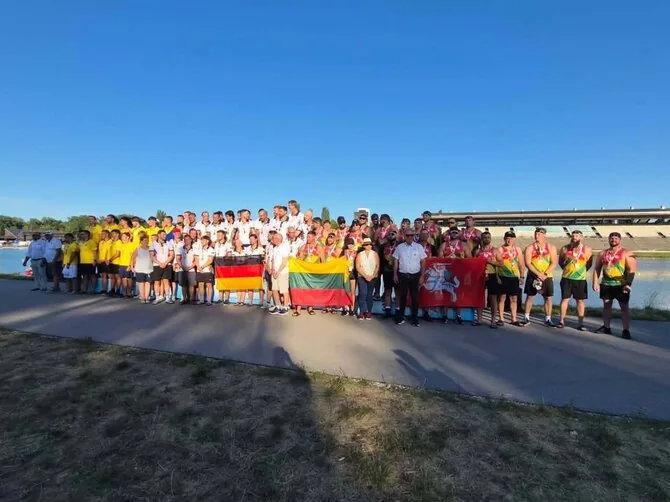
– How long did you prepare for these competitions?
– We prepare all season for one or another competition. We started in February with CrossFit training, and in March we already got into the boat and started rowing on the water. The training plan was very different.
For the European Championship, we chose four distances: 200 m, 500 m, 1000 m, and 2000 m. Preparing for four different distances is very difficult.
Probably, our team was the only one at the championship whose same members participated in all distances. Arriving in Munich, we had two days of intensive training, then four days of competition.
The competition was very tough; we gave 110% of ourselves and were completely exhausted. Both physically and emotionally, it was a very hard process.
– How was your team selected to participate in the European Championship?
– When the opportunity arose, we gathered with leaders of other club teams and talked about the upcoming championship. There were senior and women’s teams interested in participating.
In our group in Lithuania, we don’t have many competitors; we are well rowed. There were thoughts about organizing a camp, but that requires funding, which is hard to get. We are very happy that the Trakai district municipality administration and mayor Andrius Šatevičius support and sponsor our team. Finally, it was decided that one club would go to represent Lithuania.
We planned to hold competitions to determine which club would go, but some teams refused to participate and suggested our Lentvaris team go to Munich.
Teams from other countries consisted of professional athletes. For example, in Poland, there is a camp where the strongest athletes are selected. The Ukrainian national team consisted of Olympians, and the Germans were also professionals.
Our team was mainly made up of Lentvaris club members, but we had a few rowers from Visaginas. Rower Mindaugas Talačka and world champion Raimundas Labuckas joined us. He has participated in the Olympic Games and set several records, so his experience meant a lot to us.
– Do you plan to participate in international championships in the future?
– Appetite comes with eating. We still plan to participate this year in the European Club Cup, which will be held in Georgia from September 11–13. We received an invitation and are actively considering it.
The only nuance is that the competition will be in a ten-seat boat, so we will have to select who from our team will go. I really hope that this year we will sing the victory song.
– Has there been any memorable or funny incident during training or competitions?
– We have such events that we remember. This year, at the first competition in Poland, one such incident happened. We were rowing a ten-seat boat, showing a great result, and leading.
In the final race, we literally fell apart. The drummer fell into the boat, so he had to give up the first two benches.
Somehow, we managed to finish third, but it probably cost us a higher place. At first, it was very frustrating, but now we just laugh about this incident.
– Do you think interest in this sport will grow in the future?
– I think it can definitely grow strongly at the amateur level. Dragon boat festivals are held in many cities, and there is no shortage of competitions in Lithuania. The problem is that few people take it seriously.
If every city had its own team, it might be realistic to popularize this sport, but now Kaunas and Vilnius do not gather their teams. Until this sport becomes popular in big cities, it is very difficult to talk about greater development.
I would really like there to be a league in Lithuania where we could represent our region. I hope that will happen someday, but with the current involvement, it certainly won’t happen soon.
In Poland, there is a huge federation of this sport that includes many clubs. Competitions are constantly held there, and ranking points are counted. These are not amateurs; usually, professionals, former rowers, and experienced people gather.
In Poland, this sport is financially supported, and they have much better conditions. I hope that Lithuania will reach such a level too.
Read more Austėja Landsbergienė’s life – a huge news: «At first, I didn’t even tell my family…»