- Good news for Putin? The US in Europe abandons measures that deterred him the most
- Has the war turned against the Kremlin? “The Washington Post” assessed Putin’s situation
- Hegseth promised: The US will find a way to help Ukraine defend itself
- “It’s time to wake up”: after the strike in Romania, an expert calls for drastic action
All news about Russia’s invasion of Ukraine can be found HERE.
Officials warn about Belarus being used as a springboard for a new Russian offensive in Ukraine
10:02
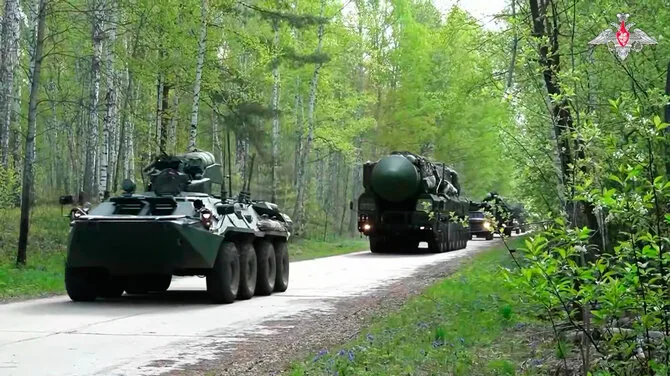
More than four years ago, the authoritarian Belarusian president Alexander Lukashenko allowed his longtime ally Russia to use the country’s territory for the invasion of Ukraine. Now Kyiv officials warn that A. Lukashenko may again allow his country to become a springboard for new Kremlin forces’ attacks.
Read more Astrological forecast for June: for one Zodiac sign, feelings will overflow
Although Belarus did not send its troops into battle, A. Lukashenko supported President Vladimir Putin’s war actions by hosting Russian nuclear weapons and military infrastructure and producing components for Moscow’s military industry. Earlier this month, the countries held joint nuclear forces exercises using Russian weapons deployed in Belarus.
A. Lukashenko, who has ruled for more than three decades, governs the country of 9.5 million people with an iron fist, ruthlessly suppressing opposition and relying on close ties with Russia and subsidies from the Kremlin’s treasury to offset ongoing Western sanctions.
Moscow and Minsk’s military cooperation increasingly worries Ukraine’s allies.
Belarus’s role in Ukraine
When V. Putin launched a large-scale invasion of Ukraine on February 24, 2022, Russian forces concentrated in Belarus under the guise of exercises moved toward Kyiv, located just about 90 km south of the border.
V. Putin’s hope to quickly capture Kyiv was thwarted by Ukraine’s stubborn resistance, and Russian tank columns stretched along narrow roads became easy prey.
Just over a month after the invasion began, Russian forces, having suffered heavy losses and struggling to maintain supply lines, withdrew from Kyiv and other occupied territories in northeastern Ukraine, which the Kremlin called a “gesture of goodwill.”
When Moscow tried to negotiate a quick end to the war a few weeks after the large-scale conflict began, the first talks between Russian and Ukrainian delegations took place in Belarus. Later, negotiations moved to Istanbul, but no agreement was reached.
As the conflict turned into a grinding war, Belarus began playing an important role in supporting Moscow’s war efforts. Belarusian factories produced critical components, including microchips and other electronics, optical targeting systems, artillery shells, and heavy trucks transporting Russian ballistic missiles.
Ukraine’s presidential envoy on sanctions policy Vladyslav Vlasiuk said that microchips from Belarus were found in the debris of the “Oreshnik” ballistic missile Russia launched at Ukraine on May 24. He urged Western allies to tighten sanctions on Belarus.
Belarus also provided training grounds for Moscow’s troops, conducted joint exercises, and allowed its hospitals to be used to treat wounded Russian soldiers.
A group of former military and law enforcement officers opposing A. Lukashenko, BELPOL, stated that Belarusian industry has been effectively integrated into the Kremlin’s war machine. According to them, more than 500 Belarusian industrial enterprises are involved in producing weapons and ammunition, repairing military equipment, and providing logistics services.
“The Lukashenko regime is very seriously involved in the war,” BELPOL head Uladzimir Zhihar told the AP news agency. “Lukashenko helps Russia in every possible way.”
Read more Andrius’s royal ribs on the grill: indescribable tenderness
A large training ground and barracks for a large number of soldiers have begun construction in the Gomel region bordering Ukraine, said U. Zhihar. He added that Ukraine was forced to keep a significant number of forces at the border with Belarus, which prevents their use in fighting Russian troops along the more than 1,000 km long front line.
“The Telegraph”: Drone strike in Romania raised Putin’s war with Europe to a new dangerous level
09:19
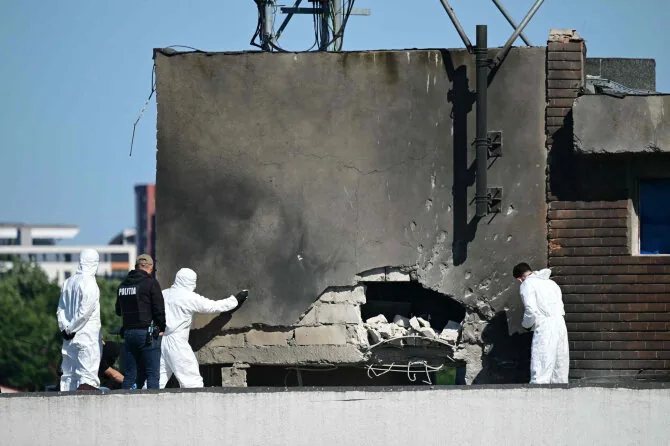
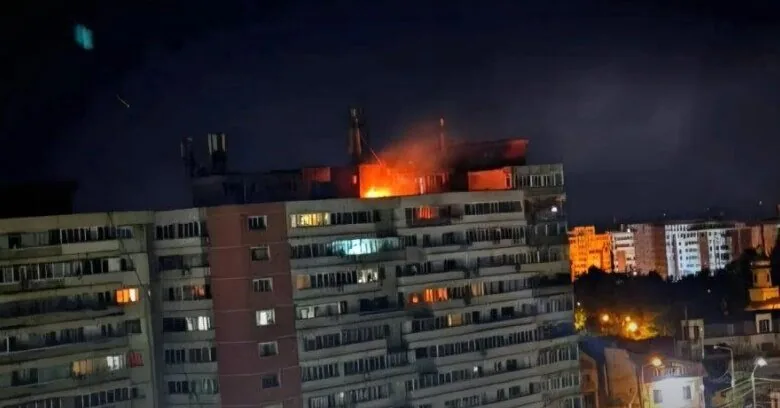
During the four years of conflict, Russian drones had not yet injured a single NATO citizen on Western territory, let alone caused chaos in a densely populated area. However, on Friday, the “Geran-2” drone crashed into a 10-story residential building in the Romanian city of Galați, raising Russia’s conflict with Europe to a new, much more dangerous level, writes “The Telegraph”.
It is unclear whether Moscow intended to strike NATO. Russian Foreign Ministry spokeswoman Maria Zakharova stated that claims linking the incident to Russia are “unfounded”.
“I don’t think it was done intentionally. However, I think the main conclusion is this: Russians simply don’t care whether they hit European targets because they don’t really care about the potential European reaction,” said Ed Arnold, senior research fellow at the London-based Royal United Services Institute.
Talks about applying NATO’s Article 5, which obliges collective response to an armed attack, took place only online. Romanian Foreign Minister Oana Țoiu only asked the alliance to accelerate the transfer of counter-drone technologies.
“Even if the attack was accidental, Moscow will learn from this reaction… Russia wants to create the impression that it remains dangerous, perhaps uncontrollable, as it appears increasingly stuck on the battlefield,” the publication notes.
The Kremlin’s poorly functioning NATO air defense system is an opportunity. Drones, planes, or missiles can enter any of the eight NATO member countries bordering Russia or Ukraine.
“This is complicated for NATO,” said E. Arnold, “because it means having to allocate its limited resources.”
At the same time, each incursion raises new questions about the limits of a “kinetic” response; each unresponded incident strengthens Moscow’s belief that it is worth delivering a repeated strike.
Earlier this week, reports emerged that Washington might withdraw a third of its aviation deployed on the continent, as well as warships and submarines. In that case, Moscow will become even more reckless.
At the same time, notes “The Telegraph,” the White House’s focus on other areas has somewhat freed Ukraine. In recent months, it has felt free to send long-range drones into Russia through NATO airspace over the Baltic states: “An unpleasant fact facing V. Putin is that hybrid war today has less potential power than before. Kyiv is no longer so heavily dependent on Western partner support.”
Read more Officers warn about Belarus being used as a springboard for a new Russian offensive in Ukraine