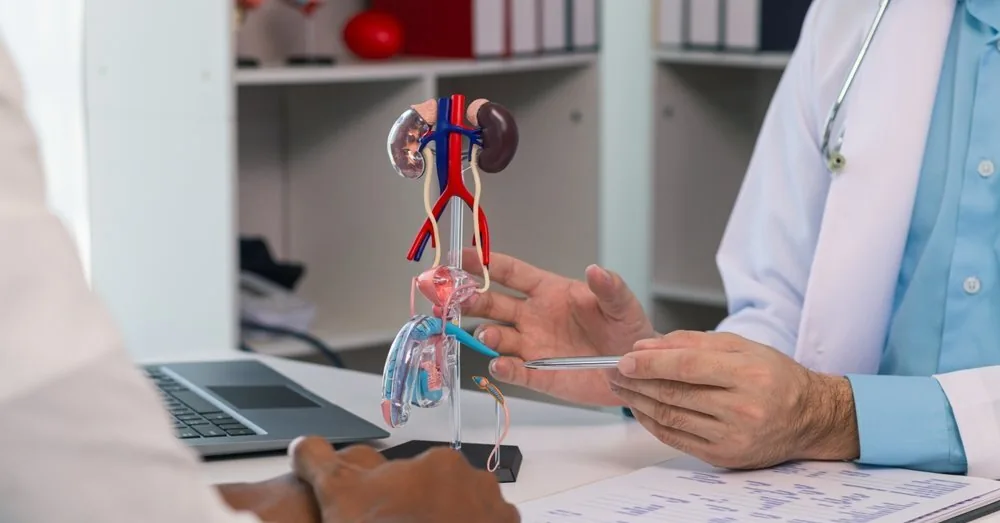
Viktorija Šakalienė, a family doctor at Kaunas City Polyclinic, emphasizes that prostate health is influenced not only by age or heredity but also by daily habits.
Read more Due to US attacks, Iran accuses Kuwait and Bahrain
“The risk of developing prostate diseases is increased by overweight, unbalanced diet, harmful habits, smoking, low physical activity, and stress,” says the doctor.
In Lithuania, there is a preventive program for prostate cancer for men. During this program, a PSA – prostate-specific antigen – blood test is performed. According to V. Šakalienė, this test is free for the patient.
“The healthcare facility invites the patient to undergo a PSA blood test or the patient can request it voluntarily. The prostate cancer preventive program is for men aged 50 to 69 inclusive, and if the father or brothers had this disease – from 45 years old,” explains the family doctor.

The prostate cancer preventive program is for men aged 50 to 69 inclusive, and if the father or brothers had this disease – from 45 years old.
She reminds that after the first check-up, the family doctor evaluates the results and tells when the next check should be done. If the PSA level in the blood is elevated, the patient is referred to a urologist for further examination.
Men tend to delay
Giedrius Skulčius, a urologist at the Kaunas City Polyclinic Center branch, says that men’s awareness is increasing, but some still delay getting checked.
“More and more men are getting PSA tests prophylactically, consulting urologists, and understanding the benefits of early diagnosis. On the other hand, some still delay – mostly due to fear of hearing a diagnosis, the mistaken belief that if there is no pain, everything is fine, or because of stereotypes related to men’s health,” says the doctor.
According to him, prostate cancer in its early stage often causes no symptoms.
“One of the most important points emphasized today by the European Association of Urology recommendations is that early prostate cancer is usually a silent disease. Localized, early-stage prostate cancer very often causes no symptoms and is detected prophylactically by performing a PSA test, magnetic resonance imaging, and prostate biopsy if indicated,” explains G. Skulčius.

Symptoms also reveal
However, there are symptoms that should not be ignored. V. Šakalienė states that it is necessary to see a doctor if there is difficulty urinating, frequent urination at night, weakened urine flow, straining during urination, pain in the pelvis or lower abdomen, blood in the urine, painful ejaculation, or erectile dysfunction.
Read more Due to the war in the Middle East, the OECD has cut its 2026 global economic growth forecasts
Urologist G. Skulčius emphasizes that certain symptoms do not necessarily mean cancer. “Symptoms are more often related not to cancer but to benign prostate enlargement or prostatitis. However, they are sufficient reason to get examined. The absence of symptoms also does not guarantee that there is no disease,” he says.
According to the doctor, modern prostate cancer diagnostics is becoming increasingly accurate. Previously, when elevated PSA was found, a so-called “blind” prostate biopsy was often performed. Now, prostate magnetic resonance imaging is more frequently recommended first.
“MRI allows a more precise assessment of whether there are clinically significant signs of disease and helps reduce the number of unnecessary biopsies. When MRI shows suspicious changes, biopsy is performed more accurately, targeting suspicious areas,” explains G. Skulčius.
Treatment is not always necessary
The doctor also emphasizes that a prostate cancer diagnosis does not always mean urgent aggressive treatment. “Not every prostate cancer needs immediate treatment. If a low-risk, slowly progressing disease is diagnosed, active surveillance is recommended – the patient is regularly monitored with PSA tests, doctor examinations, MRI, and other tests if necessary,” says the urologist.
The biggest myth about prostate cancer is that it is always aggressive and means a poor prognosis.
If the disease is of moderate risk, progressing, or advanced, surgical removal of the prostate, radiation therapy, hormone therapy, systemic drug treatment, or their combinations may be applied. According to G. Skulčius, the success of treatment mostly depends on whether the disease is detected in time, the aggressiveness of the tumor, and whether the treatment is individually tailored.
“The biggest myth about prostate cancer is that it is always aggressive and means a poor prognosis. In fact, some tumors progress very slowly and can be just monitored, but others behave aggressively and require active treatment,” emphasizes G. Skulčius.
Doctors emphasize that prostate screening is not a sign of weakness. It is a rational way of taking care of oneself. And most importantly – do not wait for symptoms, as early prostate cancer often has none.
Read more Terrace color can change the entire look of the house: architect advises which mistakes to avoid