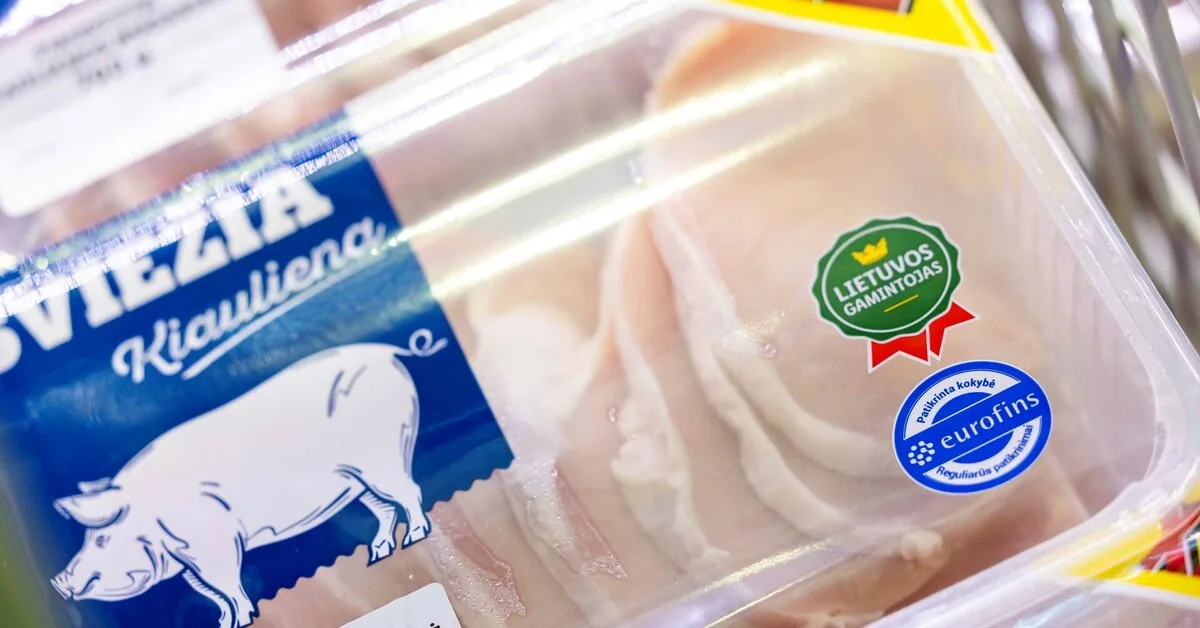
“Buyers need the meat brought home to be fresh, safe, and full of valuable nutrients. To ensure this, we have to do a lot of invisible work: we count every logistics minute to make sure products travel as briefly as possible, choose smart packaging solutions, and work only with suppliers who are strictly certified and constantly inspected,” says Karolis Lebednikas, Head of Quality and Sustainability Department at Lidl in Lithuania, Latvia, and Estonia.
Read more The Economist. How long will the war last: Zelensky named the numbers
The freshness and complete safety of Lidl’s meat and meat products are confirmed by the independent global laboratory Eurofins. According to Karolis Lebednikas, Head of Quality and Sustainability Department at Lidl in Lithuania, Latvia, and Estonia, such a high quality standard is unique in our country – meat products marked with the Eurofins seal can only be purchased in Lidl network stores. This mark is a strong proof for buyers that the products are constantly checked by independent experts and meet the highest safety requirements.
He states that quality meat on the everyday table should not be a luxury item. Instead of just talking about quality, the retail chain simply follows a simple rule: strict selection and modern solutions allow offering buyers fresh and reliable products at an affordable price. Lidl proves every day that high quality and low price go perfectly together.
Exceptional attention to logistics and storage
The quality and safety of fresh meat depend on proper temperature maintenance, so temperature control is the most important factor ensuring that meat remains fresh and does not change its properties. The temperature of products is checked during delivery. Temperature is also monitored throughout the journey to stores – temperature data loggers placed on pallets are used for this. Proper temperature for meat should also be ensured after purchase, which is especially relevant in summer if the meat is transported.
“If meat is kept at a temperature higher than 4 degrees, bacteria can start multiplying in just a few hours, so fresh meat must be stored and transported only at controlled temperatures. For example, our Lidl logistics center is equipped with airlocks to ensure an unbroken cold chain for delivered products – goods brought from the vehicle enter temperature-controlled airlocks and from there directly into the storage room, where the temperature is maintained at 0-4 degrees. It is also important for buyers not to forget that meat should be placed in the refrigerator within two hours of removal from the display,” says K. Lebednikas.
When planning shopping, take fresh meat, poultry, and sausages from refrigerators at the very end, just before going to the checkout. This way, you minimize the time the product spends at room temperature.
If you plan a longer trip to a cottage or nature, make sure to have a thermal bag, or better yet – a cooler bag with pre-frozen ice packs. This will help keep the temperature closer to the safe 0–4 degree range.
The specialist also points out that it is important to pay great attention to the purchased meat even after bringing it home. In this case, kitchen hygiene is especially important, as salmonella and other pathogens can get onto the meat from tools or contaminated surfaces where raw meat, eggs, or dirty hands were previously handled.
Read more WSJ: Putin may expand the war beyond Ukraine for 1 reason
Packaged products stay fresher
One of the most important factors ensuring meat freshness is product packaging. Packaged products are protected from direct contact with air, light, and moisture, which promote spoilage. Packaging helps keep meat fresh longer by limiting contact with the external environment, thus slowing oxidation and bacterial growth.
Moreover, tightly packaged meat solves not only the problem of longer freshness but also another very important issue – cross-contamination. When buying loose meat and putting it into a thin plastic bag, there is always a risk that meat juices will leak out. If these juices get onto other products in the shopping basket, reusable bag, or home refrigerator – especially those eaten raw, such as salads, vegetables, or fruits – there is a high risk of infection with dangerous bacteria. For these reasons, Lidl offers customers only safely packaged fresh meat and meat products.
“It is best to choose products packaged in controlled atmosphere packaging – vacuum or modified atmosphere. The latter are plastic containers in which the usual air is replaced with a natural gas mixture of carbon dioxide, nitrogen, and oxygen. Vacuum packaging stands out because the air is removed, so microorganisms causing spoilage can no longer multiply,” explains K. Lebednikas.
Lidl private label fresh meat packaging is not only more convenient for buyers but also more sustainable, as the packaging composition was updated some time ago. The packaging contains up to 70% less plastic than previously used. Also, compared to earlier versions, these packages feature special icons highlighting meat types, helping buyers instantly choose the desired meat products.
Fresh and quality meat at a low price can be purchased in 86 Lidl stores in 31 cities across the country: Vilnius, Kaunas, Klaipėda, Šiauliai, Alytus, Marijampolė, Kėdainiai, Telšiai, Kretinga, Mažeikiai, Tauragė, Jonava, Panevėžys, Ukmergė, Utena, Plungė, Palanga, Elektrėnai, Visaginas, Šilutė, Radviliškis, Vilkaviškis, Druskininkai, Rokiškis, Kaišiadorys, Nemenčinė, Gargždai, Molėtai, Raseiniai, Jurbarkas, and Garliava.