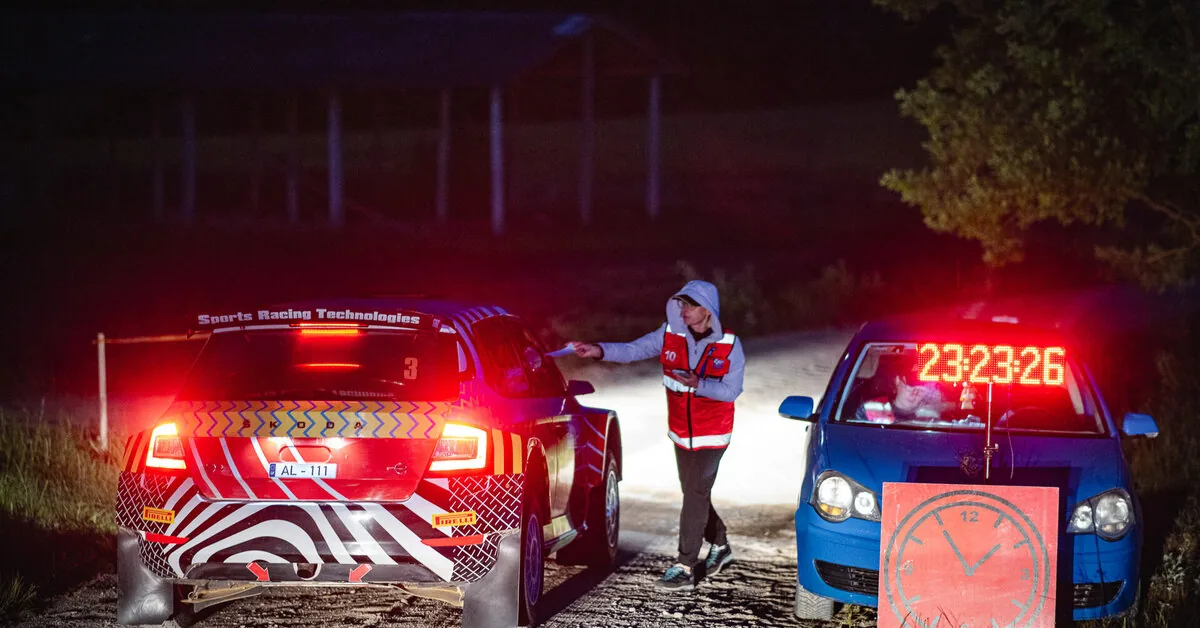
However, one symbol of the 21st century, rapidly spreading in all fields – artificial intelligence – will most likely surpass the world of racing.
Read more ECtHR condemned Serbia for banning protest against Chinese President Xi Jinping
Athletes preparing for the second stage of the Lithuanian rally championship “NEO Rally Žemaitija 2026” were asked about the possibility of starting with a lighter car (after all – the co-driver weighs at least 80 kilograms) and listening to their own voice-recorded notes, and they were completely unanimous: replacing the crew member sitting to the right of the driver with a computer is unrealistic.
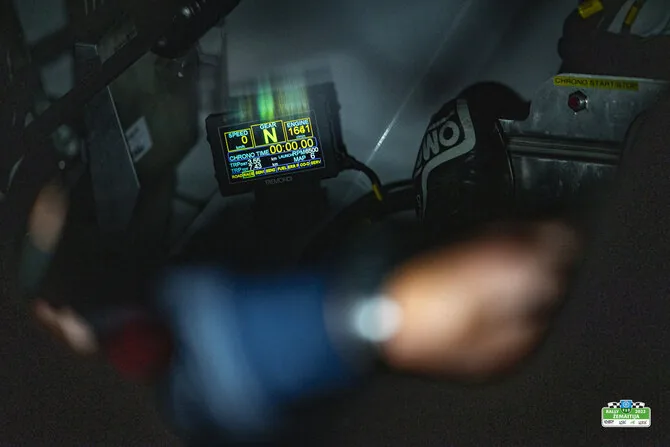
True, technically it is relatively simple. GPS has long been able to precisely record the car’s location and speed, and cross-referencing this information with the “soundtrack” containing the driver’s insights about the characteristics of upcoming turns is not difficult.
Many computer rally games or complex simulators that realistically simulate inertial forces experienced during driving successfully offer “co-driver robot” services…
Ramūnas Čapkauskas, one of the most versatile and experienced Lithuanian racers, admits he has a professional simulator at work, but he considers the time spent on it just as playing.
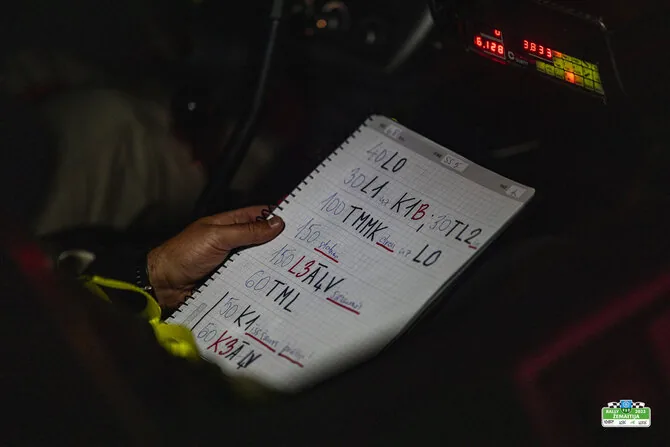
“The real rally world is incomparably more complex, having more dimensions and things that need to be felt, not just encoded in numbers. A good co-driver drives the driver even with the help of intonation, because the situation in the speed section changes constantly and what you see when writing the notes can be unrecognizably changed during the race. You have to react to all this here and now, so even a perfectly described combination of turns and an even more perfectly transmitted message to the driver’s headphones would likely be just an additional stimulus increasing the risk,” reflects R. Čapkauskas.
True, Ramūnas says he has heard about various attempts to “optimize” rally from signs hung on trees with directions where and how the road changes, to one universal note for all rally participants in America, thus trying to save time and equalize the opportunities of all competitors.
Read more «Crvena zvezda» gladly got a new head coach
“But if such solutions suit rally beginners still learning the basics, they are hardly imaginable in the professional league at least for now. In a classic speed section, the car often travels at 100–180 km/h, so even a few meters of GPS error or signal delay would most likely complicate everything significantly. In rally, even half a second delay in reading the notes means a lot, as it results in an incorrect car position. A good co-driver always reacts adequately to such things and adjusts the driving rhythm,” assures R. Čapkauskas.
Coach Jonas Dereškevičius, titled as a professor of motorsport, sharing insights on this topic also notes that although theoretically the content of the notes could be served to the driver by IT specialists during the rally, the role of the co-driver in the crew cannot be overestimated.
“The fastest crews constantly balance on the edge of their capabilities during the race, so there are no unimportant things here.
The emotional background is also not a trivial matter, and a good co-driver always senses the driver’s state and reacts accordingly by “coloring” important information in the speed section, adapting to the pace, repeating or skipping something if necessary, reacting to mistakes or dangers. Maybe I am wrong and don’t know something, but so far I can’t imagine how a robot could replace a human, or how some simulator could replace “live” training. The electronic imitation of fast driving is too far from reality and can do more harm than good,” reveals the Lithuanian motorsport legend.
Even factory teams with the largest budgets, having installed the most advanced telemetry, GPS tracking, and data systems in WRC cars, thus always knowing the exact coordinates and movement characteristics of their crew in real time, never entrust the reading of notes to a voice synthesizer.
The rally community is very conservative even about tablet computers, which theoretically could effectively replace traditional notebooks. Simply, paper does not break, it does not run out of battery, and software does not “freeze”.
“NEO Rally Žemaitija 2026” – the second stage of the Lithuanian rally championship – will take place in the Kelmė area on June 5-6. As in other rally races this season, the commissioners responsible for race safety will use “Dacia” cars.