
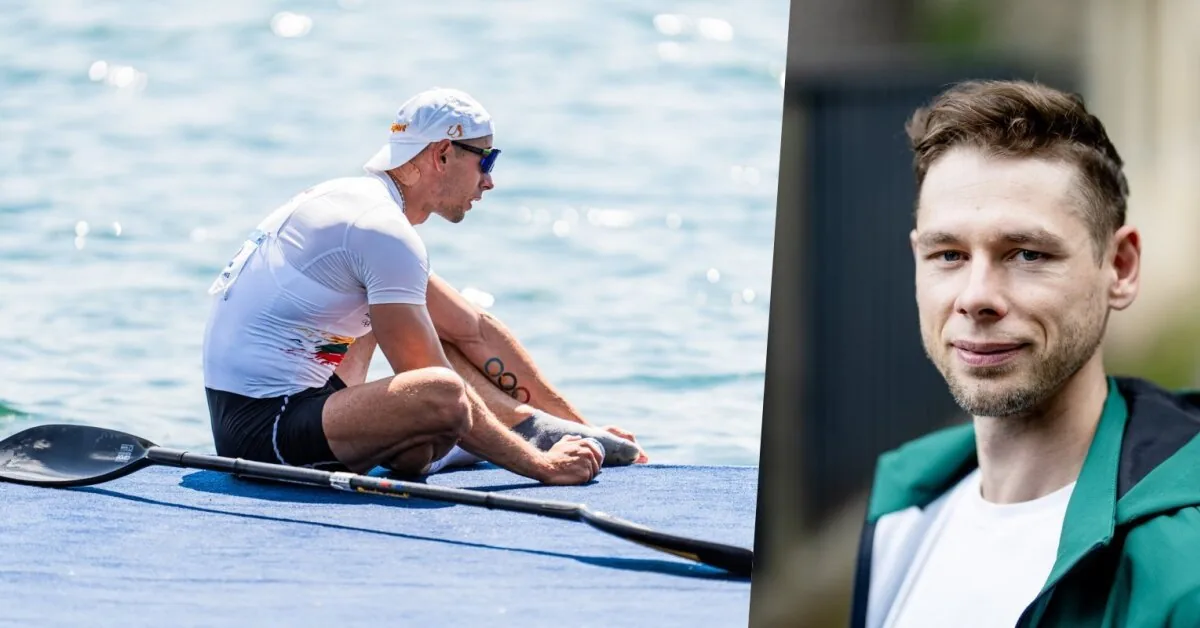
When in June Mindaugas Maldonis announced on his Facebook page that for the first time he would not attend important competitions where he had the right to compete, he did not explain much why he was missing the European Canoe Sprint Championships.
The 35-year-old kayaker, who has represented Lithuania in two Olympic Games and whose forearm is adorned with Olympic rings tattoos, is also not participating in other competitions where the fight for the right to participate in the 2028 Los Angeles Games is already heating up.
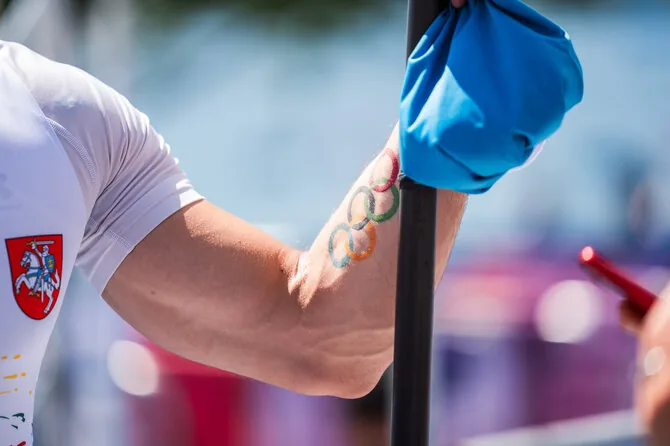
M. Maldonis has so far been reluctant to publicly talk about the health problem that struck him and caused him to miss the entire season.
“I never wanted it to be an excuse for a worse result, although sometimes that is the reason. I didn’t use that card, like ‘look, I took sixth place when maybe we could have fought for medals because something happened to me,’” said M. Maldonis. “It’s part of sport. I’m not unique; all athletes face this, no one is perfect, and probably sometimes when we won, someone else felt trauma.
I think trauma should not be an excuse for a poor performance because the body is quite generous in that we athletes can squeeze out a lot even in difficult circumstances. Sometimes it’s bad, sometimes uncomfortable, but once in a while – possible.”
- 35-year-old M. Maldonis is one of the most experienced and decorated Lithuanian kayakers, having participated twice in the Olympic Games;
- In 2021, he was the only one from his sport to qualify for the Games, finishing 10th in Tokyo.
- In 2024 in Paris, he finished fifth in the four-man 500 m event, and in the double with A. Olijnikas missed the semifinals by 0.01 seconds.
- Racing with A. Olijnikas in doubles, M. Maldonis has won a silver medal at the World Championships (2022) and two bronze medals at the European Championships (2022 and 2024).
- M. Maldonis has also won three World Cup stages: in single, double, and four-man events.
- A few years ago, M. Maldonis and A. Olijnikas were voted the best men’s sports team of the year in elections organized by LTOK.
Now, in an interview with 15min, the titled Olympian shared the story of his injury, which unfolded over different stages of his career.
“My back said: ‘If you don’t stop, I will’”
M. Maldonis had long felt problems with his back.
The rower from Daugai had experienced some back tension or locking sensations since he was 18, but even after getting out of the boat “a little twisted,” as he says, exercises helped him return to normal.
The first serious back pain was felt in 2021, before the Tokyo Olympic Games, where M. Maldonis was the only Lithuanian canoeist to qualify and finished 10th.
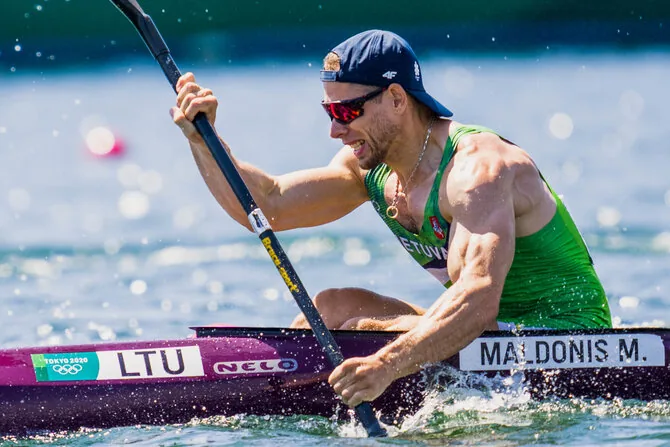
At that time, he managed to recover with the help of specialists, but before the Paris Olympic Games, his back again reminded him of itself.
There were difficult moments, but again – with the help of kinesiotherapy, he managed to control the situation.
At the 2024 Olympic Games, M. Maldonis competed in two events.
In 2024, in the four-man 500 m event, he finished fifth, and in the double with A. Olijnikas missed the semifinals by 0.01 seconds, trying to recover between two event heats with the help of a physiotherapist and in other stages.
“I felt like I had been working for eight years in just four. I needed rest,” recalled M. Maldonis.
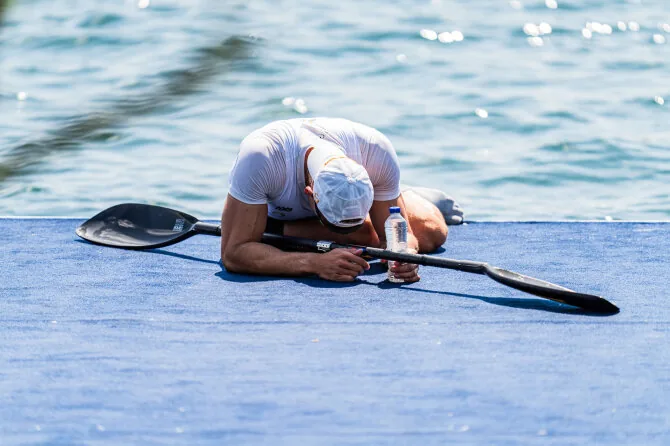
However, 2025 was also active, as internal competition again pushed the kayaker to train and compete with great effort.
After the season, it was felt. “It feels like you sit in the boat and paddle. It hurts, hurts, hurts, hurts, like a tight string running from the back. But after 20-30 minutes of paddling, the body warms up,” described M. Maldonis the pain radiating from his back to his left leg down to the calf. “One night there was no position in which I could fall asleep peacefully until I found one, but then I woke up with a completely numb part of my leg. Okay, I thought, this is something new.”
Then doctors found a hernia in the lower vertebra of M. Maldonis’s spine – a slipped disc pressing on a nerve.
“Last November, my back seemed to tell me: look, if you don’t stop, I will,” recalled M. Maldonis.
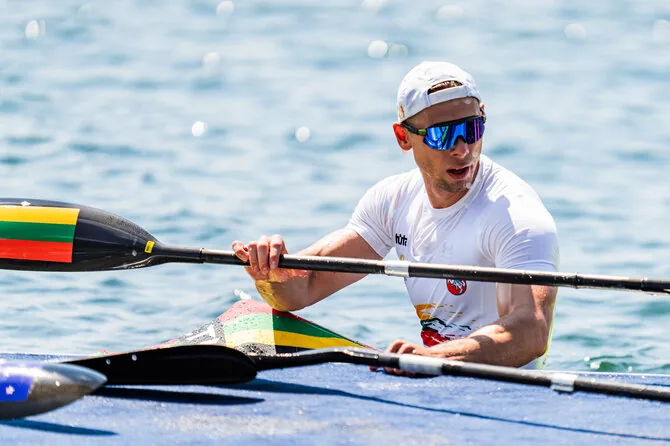
He still welcomed 2026 with new ambitions.
This season already counts for Olympic qualification, with ranking points collected over 10 competitions in two years, so all elite canoe and kayak masters have started serious preparation.
In December, camp in Turkey; January – Italy; February – Turkey again; March – South Africa; April – Croatia. “Can you rest?” asked himself M. Maldonis, who kept paddling until he felt his strength fading.
“I noticed it was getting harder to win among teammates. This year I didn’t surpass my brother, maybe we finished exactly together once,” said M. Maldonis, whose brother S. Maldonis is also an experienced kayaker who participated in the Paris Olympic Games.
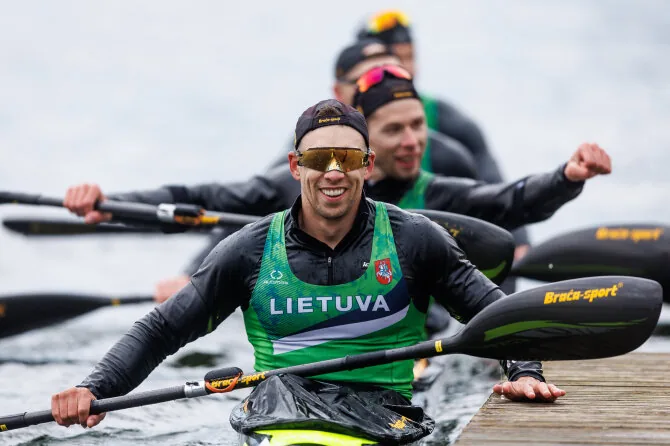
When M. Maldonis’s two-year-old daughter fell ill before the Lithuanian Championship, the illness caught the kayaker after the competition.
Ice water, wet clothes did not help; M. Maldonis was bedridden for a long time, tormented by a high fever.
He was diagnosed with early signs of pneumonia, prescribed medication, he coughed but decided to try to recover during a trip to the World Cup competitions.
While coughing, his back spasmed, but after taking medication, he started in Hungary and then moved to competitions in Germany. In Brandenburg, he felt great but again felt familiar pain in the hamstring area.
Deciding whether to have surgery
Due to a painful thigh muscle, he could no longer kick with his left leg during training after returning home. Even after taking painkillers, the training failed.
M. Maldonis underwent tests, feeling that the situation was out of control and worsening.
A visit to a neurologist and MRI scans showed that exercising while ill had completely worsened his back condition.
Read more Drunk man injured with a revolver in Joniškis district, another drunk man stabbed in Kaunas
“I realized the European Championship was lost,” admitted M. Maldonis. “In the mornings, I got up on one leg, in other words – on three limbs.
At one point it got so bad that I asked my wife to bring breakfast and painkillers because otherwise I wouldn’t go anywhere – I would stay bent over the bed. It was very bad.”
M. Maldonis did not go to the European Championship. He started treatment procedures and consultations with neurosurgeons about possible surgery.
Specialists suggested surgery would be needed, but with the help of an experienced neurosurgeon, the kayaker received a recommendation not to go under the knife.
“He assessed the condition, saying that I am gradually improving, the nerve is not so compressed, and surgery would have nuances: a harder scar would form on the spinal disc, which would interfere with sports for the next 2-3 years,” said M. Maldonis.
After hearing another specialist’s opinion, M. Maldonis was told that 6-8 months would help numb the hernia, and intervention was not necessary.
“That meant next year could be better without intervention, but the downside is that daily pain does not go away without surgery,” said the kayaker. “Now every day is better than the previous one – slightly, but the trend is favorable, even if in small steps.”
Instead of lifting weights, lifting his daughter
Now M. Maldonis rides a bike, does exercises, avoiding weightlifting.
“It’s hard because it’s a very long process. We are used to seeing results after weeks or months when doing two workouts a day and noticing the body getting stronger quickly.
Now I can’t rush, can’t overdo it. Neurosurgeons recommended enjoying the summer and life, better to lift my daughter than weights. That’s what I’m doing for now,” said M. Maldonis, speaking after a 25 km bike ride.
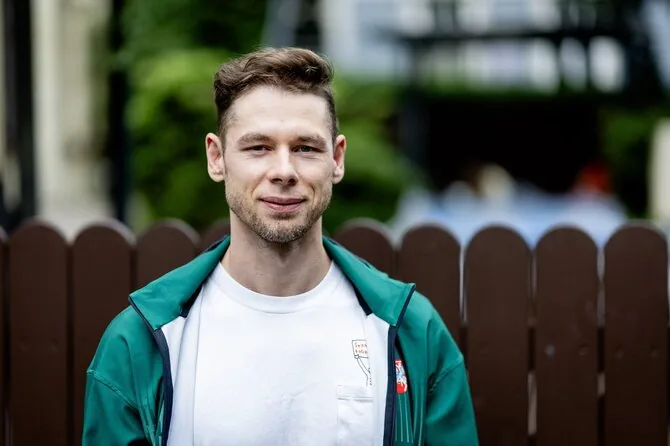
M. Maldonis had to be replaced by others in the Lithuanian canoe and kayak team.
In the double with A. Olijnikas now rows M. Maldonis’s younger brother S. Maldonis, who also remains in the four-man boat.
“I have to miss the paddling season but not fall out of the game. Do everything, just in a different context. My goal is next year’s competitions. And the guys are already working in the Olympic qualification and after four competitions get among the Olympic fours (the seven best in Europe by overall results),” said M. Maldonis. “I hope it’s possible to come back stronger next year than I have been so far.
I have lived and trained too long borrowing time. After the Olympic Games, I didn’t rest but kept going. So now the body is taking back time.”
Plans to do non-sport activities after career
While recovering, M. Maldonis deeply considered whether the injury would force him to end his career.
Watching others from the outside, he thought about what would happen if he had to get out of the kayak for good.
“When you do sports, sometimes it’s annoying, you think that without sports you could do this and that. Preparing for two workouts a day, you don’t have much time in life. But now, stepping back, I think: ‘No, this is not the end of the career yet.’ I don’t know how everything will turn out, but I tell myself: ‘Definitely not yet,’” said the kayaker aiming for his third Olympic Games.
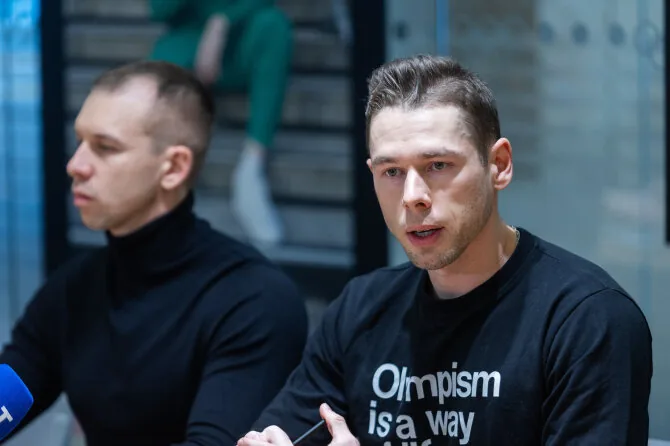
At 35, he does not feel the age numbers in the kayak, as there are more long-lived athletes in rowing.
“Andrej will turn 39 in the fall. Egidijus Balčiūnas was still competing in the London Games in singles at 37,” counted M. Maldonis. “We say you can go until 40 if the body holds. Our sport is grateful to older athletes because then experience, strength, speed, and better tactical choices come together.
Also, Lithuanian careers start later because we mature later than southerners, and we cannot train in winter (due to frozen lakes).
In our sport, exceptional talents emerge at 25-27, but the peak is more often reached after 30.”
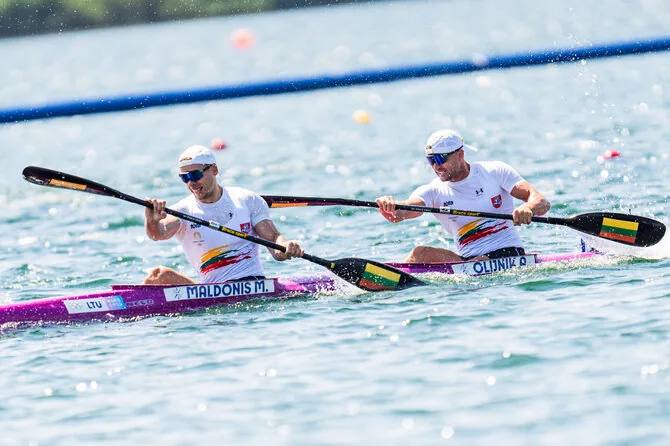
Despite plans to return to kayaking next year and compete in the 2028 Los Angeles Games, M. Maldonis often thinks about what else he could do in life.
After finishing economics studies at the then Pedagogical University, he and his brother defended master’s theses in sports industry management at Mykolas Romeris University.
M. Maldonis has been serving as the Secretary General of the Lithuanian National Athletes Association for several years.
To better understand future choices, this year he filled out a Japanese questionnaire that helps find common ground and organize thoughts by listing what you know, want, and what the world needs.
Interested in cars (especially old Japanese ones) and technology, the kayaker believes that after his career, other work fields, not sports, await him on the horizon.
“I probably won’t have anything to do with sports anymore. After so many years of sports, I want to think that in life you can do something else, use your head differently,” said M. Maldonis. “Of course, the knowledge gained is an advantage, but there are more interesting things in life than sports.
But I know that sport is good because it develops strong people. The qualities gained in sport often come in handy in business. I feel that in the future I will never have a boss over my head but will have decisions with my own victories and consequences. I want to use my energy for society and my own well-being and be responsible for the results myself.”