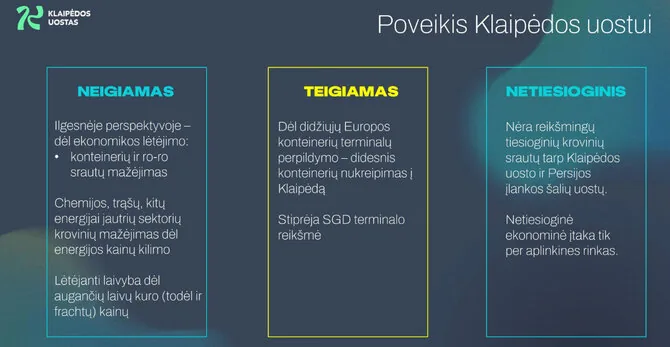
“Overall, I can say that shipping through the Strait of Hormuz has actually decreased by 95 percent. Instead of the 150 ships that used to pass through, today there are 8-10. Klaipėda is not directly connected to Hormuz, but in some cases, there is even a certain advantage for Lithuania,” said Algis Latakas, head of the Klaipėda port.
Freight prices have increased
Due to the crisis in the strait, ship freight (the fee for transporting cargo by ship or the ship charter agreement itself for cargo transport) prices have increased.
“Shipping lines, as their bunker costs increase, there are a whole range of factors that fall on the client, including bunker costs, insurance costs, operational resilience costs. And they pile everything on that ton for the client whose cargo they transport. But it must be said that the situation is not like during COVID, when the price per TEU (a conditional container measurement unit – editor’s note) reached 18 thousand euros. After the events in the Red Sea, shipping lines have more ships, have separate routes, so the price does not distort as much. The impact on the Klaipėda port is, of course, negative, because companies’ operating costs have risen, fuel has become more expensive. Well, the positive impact is that gas and oil products are transported to the Klaipėda port not from Hormuz. We will see in May – if the cargo decreases – then we will assess whether the cargo is decreasing or not,” said A. Latakas.
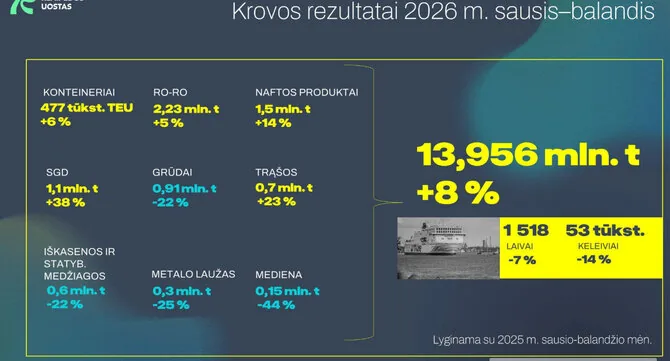
The first four months of the year recorded positive data at the Klaipėda port: cargo increased by 8 percent.
10 percent of the world’s tankers are stuck
Worldwide, according to the port head, there are nine such straits whose blockage can affect the entire international maritime trade.
The head of the company “KN Energies,” Darius Šilenskis, said that there is no direct impact due to the Strait of Hormuz. “In energy, all our supply chains cover from Finland to Poland,” said D. Šilenskis.
According to him, about 10 percent of all the world’s tankers are stuck at Hormuz. “However, the main flows of crude oil and liquefied natural gas to our region came not from the Middle East, not from the Persian Gulf. Our main two suppliers remain Norway and the United States,” said D. Šilenskis, head of “KN Energies,” which also operates the LNG terminal.
However, according to him, the threat arises due to a shortage of jet fuel, a significant portion of which was produced in Persian Gulf countries.
Cargo increased due to cold winter
D. Šilinskis recalled the fact: when the Russian invasion of Ukraine began, the price of natural gas was 250 euros per MWh; when the Strait of Hormuz crisis began, that price increased but only to 60 euros per MWh.
“What does this say? There is enough natural gas liquefaction capacity, especially America is moving strongly forward. Yes, some regions are tied to supply, especially from Qatar, they have problems, but for Europe this is not a fundamental problem. There is enough flow generated and liquefied in North America and, of course, we have Norway. The message is this: yes, there is certainly no panic, but the price is higher. In a balanced market, without supply disruptions, without some conflicts, it would be about 30 euros per MWh; today we have about 46,” explained D. Šilinskis.
At the Klaipėda port, LNG cargo increased by 38 percent in the first four months of this year and reached 1.1 million tons. However, according to D. Šilinskis, this is related not so much to the Strait of Hormuz crisis but to the cold winter and the relatively low amount of gas in storage facilities. It is forecasted that throughout the year, just due to the need to fill storage, gas cargo will be higher.
Currently, the Klaipėda port is one of the most filled terminals in Europe. Most natural gas – about 55 percent – is delivered to Klaipėda from Norway. The remaining part is from the USA.
Read more Six illegal migrants turned back at the border with Belarus