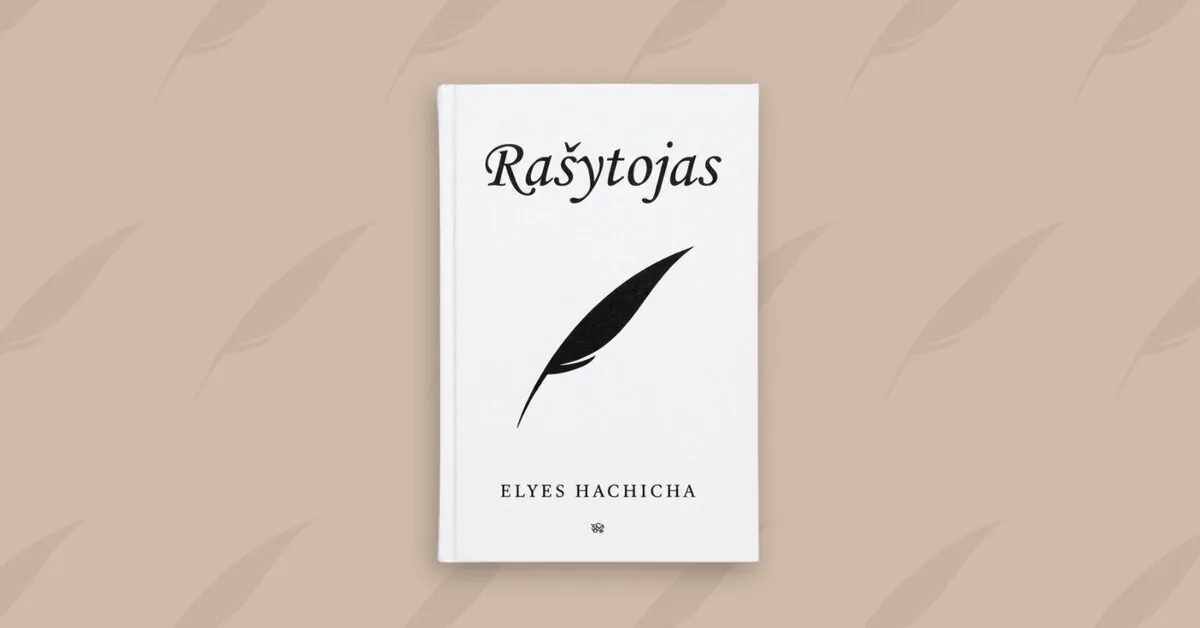
The editorial board of the publishing house VAGA, which published the book, invites you to read an interview with Elyes about his debut book “The Writer” and to get to know the author of the book more closely.
Read more “Thermo Fisher” profit fell by half last year to 206 million euros, will not pay dividends
– Tell us about yourself. When and how did you feel the desire to create?
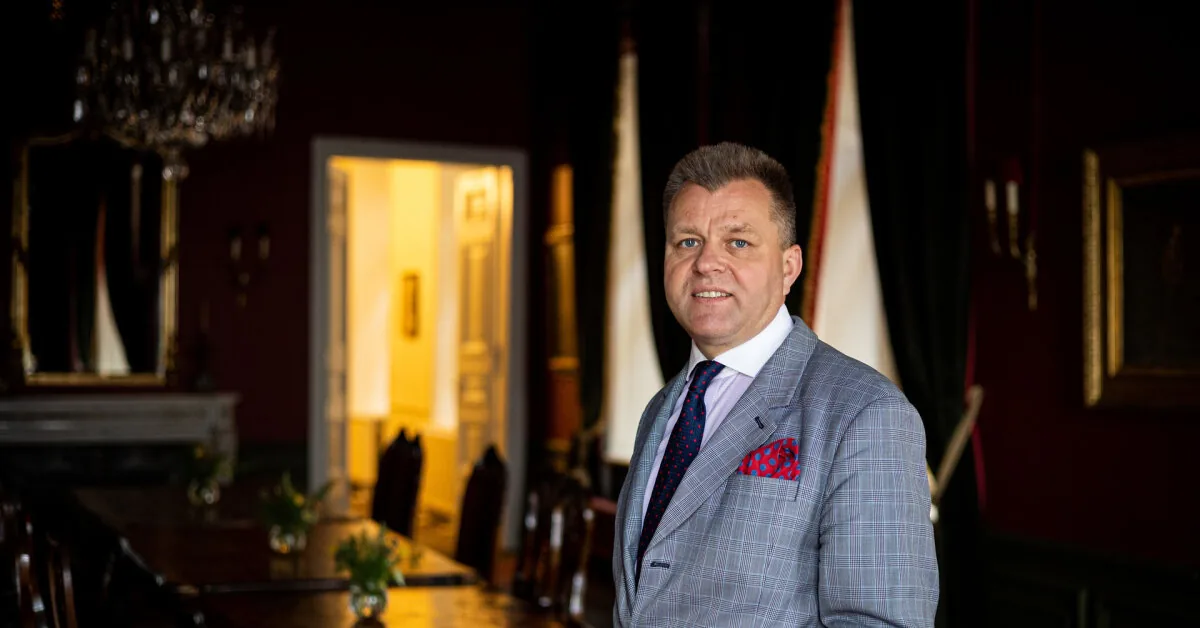
– My name is Elyes Hachicha. I am an airline pilot and flight instructor, living and working in Vilnius. I was born in Tunisia and grew up in southern France, near Nice.
Writing has always attracted me, even in simple forms. At first, I created lesson plans and training manuals for students – this taught me to clearly structure my thoughts. The crucial turning point happened during the COVID isolation, when writing became a way to explore silence. At that time, my first stories were born – one about encoded letters between a farmer and a princess, another about stages of mourning presented through a loop of space and time.
– What motivated you to translate the book specifically into Lithuanian?
– I have been living in Vilnius for several years now, and Lithuania has become more than just a workplace for me – it has become a place where I feel I belong. I have great respect for the Lithuanian people and their culture, so translating the book into Lithuanian seemed like a natural step. It is not a statement, rather a gesture – my way of sharing a part of myself with the country that has given me so much.
– In the book “The Writer” you talk about death and writing as a possibility to exist after it. Is this work an act of meaning-making for you personally?
– I think every person tries to understand the meaning of their life. For me, writing became a way to explore this question. In “The Writer,” existence after death is not a certainty, rather a hope – a very human hope that the story can continue to live in another person’s mind. It is not self-meaning, but rather a quiet discomfort with the thought of leaving no trace.
– You talk a lot about identity in the book. Do you think modern people have lost connection with themselves?
– I wouldn’t say they lost connection – rather they got lost. We live in a fast world, overloaded with information and idealized lives. This creates noise that drowns out the inner voice. The signal is still there, but around it – many disturbances. Perhaps today the search for identity is not about discovering a new self, but returning to what has always been.
– In the book you play with reality and fiction. Do you think there is a clear boundary between them?
– I think each of us carries an imagined version of ourselves – a dream or possibility that does not yet exist. In this book, I wanted to give space precisely to that part of us. In everyday life, it easily fades because we pay a lot of attention to duties. Fiction becomes a way to explore the inner world more freely.
Therefore, fiction is not completely separated from reality – it is rather its continuation. And where that boundary lies, I don’t want to define. Each reader draws it differently.
– Your narrative style is fragmentary, sometimes dreamlike. Why did you choose this form?
– I wanted to explore freedom, which we don’t always have in real life. The structure naturally arose from this idea. Each chapter is like a meeting between the writer and Celest, similar to a real conversation that is never completely linear. Such meetings become small moments of exploration that gradually create a deeper self-understanding.
– Can a writer completely detach from their life when creating fiction?
– In my case – not completely. Fiction allows stepping back from one’s life, imagining other worlds and different versions of oneself. But even the most invented stories arise from real emotions, experiences, and questions. I always start from something real, even if I later transform it.
– You talk a lot about loneliness in the book. Do you think creativity is inevitably a solitary process?
– For me – both yes and no. Writing is a solitary process because I have to be alone to express what usually remains inside. But creativity arises from the world – people, experiences, everything we live through. It is a balance: being alone to express, and being in the world to understand and be inspired.
– Do you have authors with whom you feel a creative kinship?
– I don’t follow a specific author, but I feel closeness to writers who explore inner dialogue and imagination. I feel a connection with Antoine de Saint-Exupéry – not only because of his work but also because he was a pilot too. I am close to authors who leave space for reflection rather than provide answers.
– What does it mean to you to be a writer today, in a world of information overload?
– Writing for me is a form of retreat from noise. When I write, the created world becomes very vivid and somehow real – it helps to focus on something quieter and more meaningful. I don’t want my book to become just another part of the noise. Rather, I see it as an invitation – a space to which the reader can return when they need a pause.
– What would you like the reader to take away after closing the last page of “The Writer”?
– Most of all, I would like the story to stay with the reader even after the last page. I don’t want to impose a specific thought or feeling – everyone brings their own experiences, so it is important that the reader is free to interpret it in their own way. It pleases me that people take away different things – it shows that the story resonates differently in each person.
– Do you intend to continue on the writer’s path?
– Yes. Each book for me is not only a story but also a unique concept. I am currently shaping another project – a story that can be read in two directions. Reading from the beginning, it flows naturally, like life. And upon reaching the end, the book invites reading backward – and then the endings start to look like beginnings.
We invite you to read an excerpt from the book:
Legacy
The afternoon sun poured its milky light through the window, as if hesitating whether to illuminate the strange action happening in my mind. I opened the notebook, took a pen, and felt Celest stir in the empty space of the page – he was waiting to be heard.
– Celest, – I said softly, – are you here? His voice sounded, quiet and thoughtful.
– Yes, here. But… something weighs on my mind.
I leaned forward, feeling his anxiety.
– Tell me.
He fell silent, as if trying to concentrate.
– How much longer will you keep me here? Am I real, or… will I one day just disappear?
The question weighed heavily on me.
– Yes, Celest, you exist thanks to my words, but more importantly, you exist because I believe in you. You will live as long as your story is told.
– And what if you stop writing? – he asked, a tremor of fear in his childish voice. – If you turn away from me, will I just… end?
I exhaled slowly, letting his anxiety seep into me.
– I don’t know, – I admitted. – For now, you live on these pages. And in my mind, you are very real. Maybe you will live as long as someone somewhere reads about you or remembers you.
A silence full of reflection hung between us, disturbed only by the gentle scratch of my pen on paper. Then Celest spoke again, his voice gloomy.
– And what about you? Are you eternal?
The word hung in the air like an echo. I swallowed saliva as my throat suddenly dried.
– No, Celest, I am not eternal. I am human, which means that one day I will no longer be here. All living things eventually die. It is part of our reality – a truth we cannot escape.
– Doesn’t that scare you? – Celest asked, and this simple question sounded astonishingly deep.
– Yes, – I said quietly, – death scares us because we know nothing about it and do not fully understand what happens afterward. We only know that this life ends someday.
– So how do you live knowing you will die one day? – his voice trembled with fear. For a moment, I put down the pen and ran my fingers along the edge of the notebook.
– I have come to terms with the idea that everything is temporary. I try to cherish the things I have –
friendships, small joys, the ability to create. That makes those moments more valuable.
Silence fell, accompanied by the gentle rustling of the afternoon. I imagined Celest’s wide-open, thoughtful eyes, showing the effort to grasp a thought that many adults do not understand.
– So… death is part of life, – he finally said, as if to himself. – And… what does it feel like… to be dead?
I pondered how I could answer this question.
– I think you feel nothing. At least that’s what I guess. I keep telling myself that before coming into this world, I also did not exist – in a way, I was dead. This thought encourages me.
Celest tilted his head, looking thoughtful.
– So you mean that at the beginning of life there is death, before becoming alive, and it ends with death too?
– Something like that, – I confirmed gently. – That’s why, while I am here, alive, before returning to nothingness, I want to share what I can – thoughts, dreams, emotions. He sighed quietly.
– I don’t like thinking about it. Such a thought makes me feel empty.
– I understand, – I whispered. – It scares me too. But remember, the fear of the unknown often makes people love more strongly, create more fiercely, strive to leave good memories behind.
Celest’s voice softened.
– Maybe life is special precisely
because it has an end?
– Exactly, – I answered, feeling a quiet blow of truth. – Nothing lasts forever, so we cherish every moment of what we have.
For a while, we both were silent. The shifting sunlight cast long shadows on the notebook. Finally, Celest broke the silence again, this time in a bolder tone than before.
– I don’t know if I am eternal or not, but maybe it doesn’t matter? If I can bring a little light or comfort into your world and if you share my story so that someday someone else could read it… maybe that will be enough.
I smiled, gently pressing the pen to the paper.
– You already did that, Celest. And you always will, as long as I continue telling your story. We silently reflected. After a while, Celest spoke again, this time with a note of childlike seriousness:
– And you? Have you ever thought about how you would like to die?
I felt my heart tighten. The question hit with unexpected force.
– I hope it won’t be too painful, – I began quietly. – But whatever it is, I want my death to affect others – not physically, but emotionally. I want them to feel sorry for me. To mourn me, to be hurt by my death. I want them never to forget me. Because that would mean I was important… that my existence left a mark on the world.
Celest suddenly inhaled, as if the seriousness of my words caught him off guard:
– That sounds so strong. Is it because you’re afraid no one will remember you?
– Yes, I’m afraid my death will not move anyone or will go unnoticed, – it choked me. –
We all want to be significant – to leave a trace. And the fact that people will hurt… that means we were loved. That we left a void no one else can fill. Yes, I know – it’s selfish, but also very human.
Silence full of reflection fell. Celest gently broke it:
– So… is that why you create stories? To be remembered?
– Partly, – I admitted. – Sharing ideas, creating stories, characters like you – it’s a way to transcend the limits of my own life. If people read these words and remember them, maybe a part of me will remain even after I’m gone. And that’s exactly why I created you, Celest – so that at least a piece of me lives in this story, even if one day I am no longer here. That’s why I choose to write stories, not just tell them. Written words have a special power – spoken words sound and quickly vanish in the air, but written ones leave a trace, an imprint on paper that may be destined to last forever. That way I can leave a mark – something that says: “I was here. I existed.”
Elyes Hachicha, “The Writer”, translated from English by Viltenė Vaitkevičiūtė, VAGA publishing house, 2026.
Read more Viktorija Čmilytė-Nielsen: politicians could have suggested the option of silence about data theft