








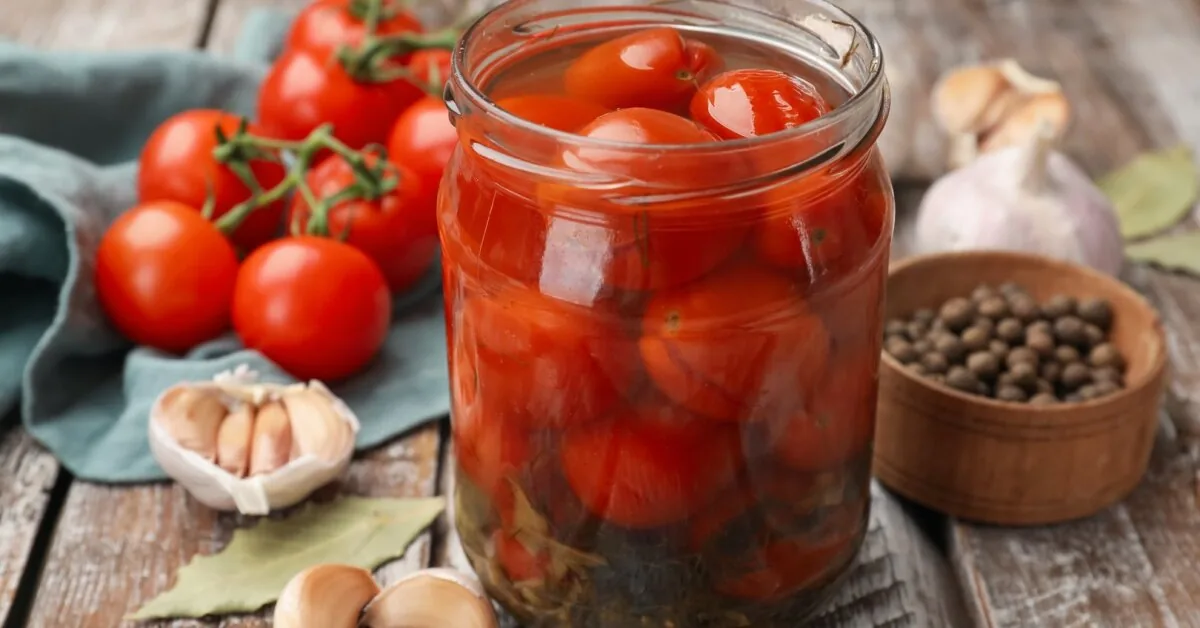
Formula 3–9–10 is a culinary code that anyone can remember: 30 g of salt, 90 g of sugar, and 100 ml of vinegar for each liter of water. However, the true secret of perfect pickled tomatoes lies in one more ingredient – vegetable oil. It is this that turns a good recipe into one you want to repeat every year, opening one jar after another and enjoying the familiar, warm, homemade taste.
Read more Denmark: a binding agreement with the US on Greenland strengthens security
Formula 3–9–10: why does it work?
The numbers 3–9–10 are easy to remember, and this is no coincidence. Behind them lie preservation principles supposedly tested by many marinades. 30 g of salt per liter of water creates the right salt balance: salt helps maintain the structure of the tomatoes and prevents them from overcooking. 90 g of sugar acts not only as a sweetener – it balances the acidity of the vinegar, softens the natural sharpness of the tomatoes, and gives the marinade a richer flavor. 100 ml of 9% vinegar ensures sufficient acidity for preservation.
“Amazing, but this proportion turned out to be so universal that it can be used for both meaty plum tomatoes and small cherry tomatoes – the taste always remains recognizable and balanced.”
Adding 100 ml of vegetable oil to this recipe makes it even richer. The oil forms a thin layer on the surface of the marinade, and most importantly – it envelops the tomatoes, making their skin more elastic and the flesh softer. As a result, the tomatoes are not only salty or sour but also have a rich, expressive flavor.
Suitable tomatoes – a guarantee of success
For pickling according to the 3–9–10 formula with oil, it is best to choose medium-sized tomatoes with firm and solid flesh and skin thick enough not to crack when poured with boiling water. Suitable are plum tomatoes, round tomatoes with few seed chambers.
The fruits should be roughly the same size to heat and marinate evenly.
Before placing the tomatoes in jars, they should be carefully washed under cold running water, remove the stems, and check for cracks, dents, or signs of rot. Even one spoiled tomato can ruin the entire jar.
Many experienced housewives recommend piercing each tomato with a wooden toothpick or sharp needle at the stem area. This helps the hot marinade penetrate inside more easily and reduces the chance that the skin will crack from sudden temperature changes.
Preparation of jars and spices
Cleanliness is one of the most important preservation principles. Jars should be thoroughly washed with baking soda or dish detergent, then sterilized by the chosen method – over steam, in the oven, or in the microwave. It is recommended to boil the lids for at least 5–7 minutes.
Classic spice set for tomatoes:
- dill umbrellas – provide a characteristic aromatic flavor;
- horseradish leaves – add piquancy and help maintain tomato firmness;
- garlic – adds a sharper taste;
- black and allspice peppercorns – add aroma and a bit of heat;
- bay leaves – enrich the marinade’s flavor.
Add spices to the jar according to taste, but do not overdo it. For a three-liter jar, 1–2 dill umbrellas, 1 large horseradish leaf, 4–5 garlic cloves, and 5–6 peppercorns are enough. Add no more than 1–2 bay leaves so they do not overpower the tomato flavor.

Step-by-step preparation
The entire pickling process according to the 3–9–10 formula with oil consists of several simple but important steps. The order should be followed.
First, place the prepared spices at the bottom of each jar. Then pack the tomatoes quite densely but without squeezing. It is best to place them slightly diagonally so that there is as little free space between the fruits as possible, but they are not compressed. Do not fill the jar to the very top – leave about 2–3 cm from the neck.
Then pour boiling water into the jars – this is the first pouring. Pour the water in a thin stream directly onto the tomatoes so the glass warms gradually and does not crack. Cover the jars with boiled lids and leave for 20–30 minutes.
During this time, the tomatoes will warm well, some air will escape from them, and they will become more suitable for further pickling.
“The 20–30 minutes during the first pouring is an important stage. If you pour off the water earlier, the tomatoes may not warm enough, and the marinade in the jar may later lose its clarity.”
Preparing the marinade and final pouring
After the specified time, carefully pour the water from the jars back into the pot. You can use a special lid with holes or simply hold the tomatoes so they do not fall out.
Measure the poured water. If you get not one liter but, for example, 1.1 or 1.2 liters, recalculate the amounts of salt, sugar, and vinegar accordingly. This is where the 3–9–10 formula comes in handy.
Add 30 g of salt and 90 g of sugar per liter of liquid to the pot with the poured water. Bring the marinade to a boil and simmer for 2–3 minutes until the sugar and salt completely dissolve.
Then pour in 100 ml of vegetable oil and 100 ml of 9% vinegar per liter of liquid. After adding vinegar, do not boil the marinade anymore – immediately pour the hot marinade into the jars.
Fill the jars to the very top so that the marinade slightly overflows the edge and there is as little air inside as possible. Immediately tightly screw the lids on the jars, turn them upside down, and cover with a warm blanket or thick cloth. Leave them to cool gradually for about a day.
Read more Pentagon has released more documents about UFOs, including documents about a secret military program
The role of vegetable oil in the recipe
100 ml of oil per liter of marinade is used in this recipe for a reason. Oil softens the taste of vinegar, making the marinade milder. It also helps better reveal the aroma of the spices and gives the tomatoes a richer flavor.
Refined sunflower oil without a strong smell is best suited for this recipe so as not to overpower the natural aroma of the tomatoes. However, some housewives choose first cold-pressed oil – it gives the appetizer a gentle nutty aftertaste, which pairs especially well with garlic and dill.

Maturation time and storage
Pickled tomatoes according to the 3–9–10 formula with oil are not recommended to be tasted earlier than after 3–4 weeks. During this time, the tomatoes absorb the marinade well, and the aroma of the spices becomes more pronounced.
The flavor becomes even richer, according to the recipe author, after 1.5–2 months.
Jars can be stored in a dark, dry place, such as a pantry or kitchen cabinet. The most important thing is to protect them from direct sunlight.
Variations of the classic recipe
The basic recipe offers many opportunities to experiment with spices and additional vegetables.
With bell pepper. Pieces of sweet bell pepper will give the marinade a brighter and sweeter flavor.
With onions and carrots. Small onions, onion rings, and carrot pieces will enrich the marinade.
With hot pepper. Half a chili pepper will add piquancy to the tomatoes.
With cherry and blackcurrant leaves. They will give the marinade a subtle aroma and summery flavor.
It is important to remember that additional vegetables should not completely replace the amount of tomatoes, as the marinade proportions may change.
Common mistakes and how to avoid them
Even a simple recipe can fail if a few important things are not considered.
One of the most common mistakes is using salt with additives. For preservation, it is recommended to choose plain rock salt without additional additives.
Another mistake is incorrectly recalculating the amount of vinegar if vinegar essence is used instead of 9% vinegar. Therefore, it is better to stick to the 9% vinegar amount specified in the recipe and not experiment.
Another mistake is insufficient warming of jars and tomatoes during the first pouring. The recipe recommends 20–30 minutes so that the tomatoes warm well.
“Never forget to sterilize jars and observe the proper pouring time. Preservation does not like rushing – it requires accuracy and patience.”
How to use pickled tomatoes?
Tomatoes prepared according to this recipe are not just a snack. They can be used in soups, vegetable stews, pizzas, or as a side dish for meat dishes.
The marinade does not have to be poured out – it can be used to make salad dressings, meat marinades, or sauce bases.
Sandwiches with pickled tomato, onion ring, and garlic clove are especially delicious. Such sandwiches are suitable for both festive tables and simple dinners.
Why is this recipe so popular?
The 3–9–10 formula with oil is a simple way to remember the main marinade proportions. You can change the spices, add various vegetables, adjust the amount of garlic, but the base remains the same.
Each jar holds a piece of summer – tomatoes, spices, and rich marinade that remind of warm sunny days. It is precisely the simplicity and easily memorable proportions that make this recipe one of those you want to return to every year.
Read more In Poland, fighters were urgently scrambled due to attacks in Ukraine
Source: ve.lt