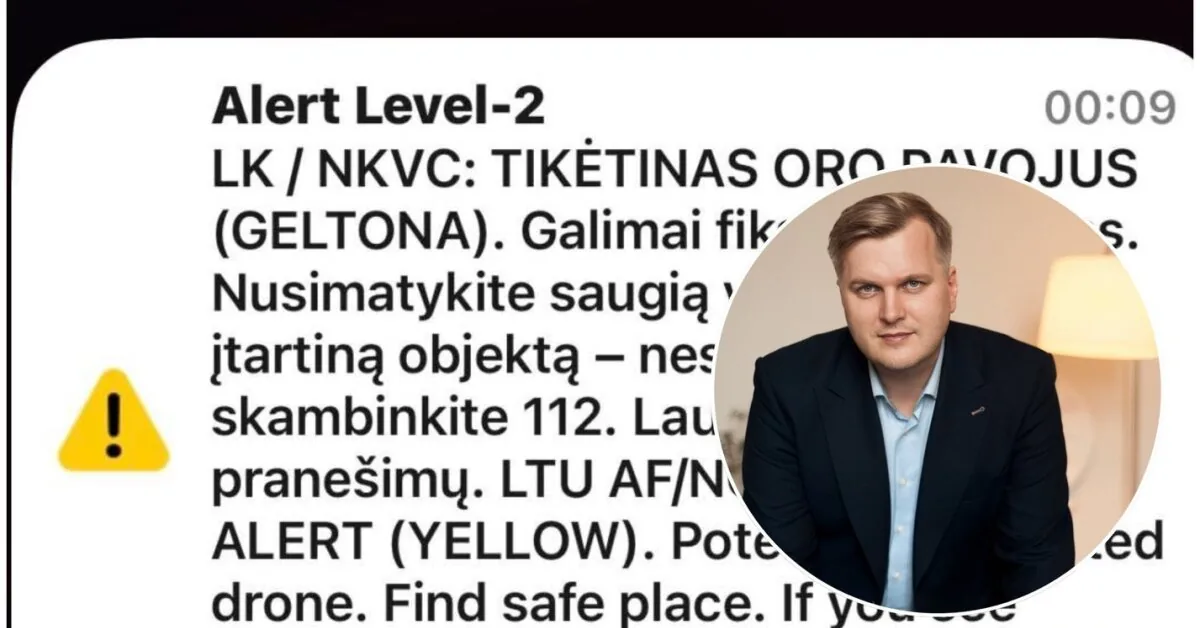










Negative news not only informs – it shapes our emotional background, expectations, and even our relationship with the environment. Therefore, today it is increasingly important to ask not only “what is happening in the world,” but also “what is happening inside me because of what is happening in the world,” according to a press release.
Read more Defense bonds issued for almost 45 million euros more
Why do negative news affect us more strongly than neutral ones?
“Our attention is not equally sensitive to everything happening around us. Information about possible danger is usually noticed faster, it is easier to remember, and it affects our emotional state longer. This is a natural feature of the human psyche – from a safety perspective, it has always been more important to notice a threat than a neutral event,” says Laura Soloveičik, a medical psychologist at the Personal Health Clinic.
She recalls a 2023 study by an international group of scientists from New York, Giessen, ETH Zurich, Munich universities, and the Karolinska Institute. The scientists analyzed more than 370 million cases where readers were presented with different news headlines. It was found that just one additional negative word in the headline increased the likelihood that a person would choose to open it.
The psychologist notes a kind of paradox: negative information tires us, but it is precisely that to which it is hardest to remain indifferent. When we receive many such news items per day, the nervous system repeatedly receives a signal to be alert, even if nothing dangerous is happening in our immediate environment at that time. Therefore, over time, the flow of negative news can not only cause anxiety temporarily but also maintain a general tension background, making it harder to relax and regain emotional balance.
According to L. Soloveičik, people react differently to threats. Some more easily understand that although the information is important, it does not necessarily mean a direct danger to their own life. Others’ attention remains focused on the possible threat longer, especially if the person is more sensitive to uncertainty, has more previous stressful experiences, or is currently living under greater tension.
The sense of control is also important. When a person feels that they can at least partly understand, predict, or somehow influence the situation, anxiety usually decreases. When the threat seems large, unclear, and completely independent of them, the mind tends to keep returning to it.
Factors that increase tension and maintain anxiety
Many people read not only the news itself but also reactions to it in the comments, and there, as the psychologist notes, we encounter not only the event itself but also many other people’s reactions – anger, fear, contempt, accusations.
“The more such reactions we see, the easier it is to get the impression that hostility is universal, and society is more divided than our direct daily experience shows,” says the specialist.
She points out that the comments section is not a reflection of public opinion. It is more often expressed by those who have a stronger emotional reaction and a greater need to express it. Moreover, the emotional tone of others also affects our own state – after prolonged reading, we may feel more tense, angry, or disappointed, even if the article or program itself would not have caused such a reaction. Experimental data also show that negative comments from other users can affect both the evaluation of the content itself and the perception of what other people’s opinions are.
“Our psyche reacts not only to real, currently experienced danger but also to possible future threats. The harder the threat is to predict and the less a person feels they can control it, the more room there is for anxiety, recurring ‘what if…’ scenarios, and constant vigilance. Therefore, a person may be physically safe, but their nervous system still remains tense, especially if the threat is constantly reminded by news and social networks,” explains L. Soloveičik.
In a 2024 international study led by scientists from the universities of Münster, Munich, and Osnabrück, 1,341 people from 17 European countries participated, and nearly 45,000 assessments of their well-being were collected. It was found that the beginning of Russia’s invasion of Ukraine was associated with poorer psychological well-being, and on days when there was more content related to the event on social networks, well-being was also worse.
“This clearly shows that geographical distance does not necessarily protect against the psychological impact of a threat. Especially when the phone, news portals, and social networks constantly remind us of the crisis,” notes the psychologist.
The cost of information noise
L. Soloveičik explains that a heavy burden is created not only by the amount of information but also by how quickly we have to change the direction of our attention. Within a few minutes, we can switch from a work task to news about geopolitical events, then to a personal message, a political argument, and then try to concentrate on work again.
She reminds that attention does not switch instantly. Especially emotionally significant or threatening information remains in the mind for some time, so when starting another activity, we cannot always immediately fully engage in it. Because of this, a person may feel that their ability to concentrate has worsened, although often the problem is simpler – attention is too frequently distracted, and there is a lack of uninterrupted time for one activity.
Read more EK leader calls to fight against ultranationalists
The psychologist emphasizes that newer experimental studies also show that repeated app notifications while performing another task can worsen its performance.
According to L. Soloveičik, over time it is important not only how the news makes us feel at the moment. They can gradually change what we expect from the surrounding world. If a large part of our attention is constantly devoted to wars, conflicts, disasters, and threats, the worst scenarios become easier to remember and may seem more likely.
“This can affect decisions – a person becomes more cautious, thinks more often about possible losses, tolerates risk less. And in relationships, the general tension background often manifests as reduced patience: we react more strongly to a minor issue not because it is so significant, but because our emotional resources have already been significantly depleted,” says the Personal Health Clinic specialist.
Also, a person experiences emotional fatigue, which often becomes apparent through changes in daily functioning: the person becomes more sensitive to stimuli, gets irritated faster, has difficulty maintaining attention, wants to communicate less, and the topics read remain in the mind for a long time. A contradictory feeling may also arise – the news is already tiring, but still, there is a desire to check them, as if it is hard to allow oneself not to know something.
How to reduce emotional fatigue?
L. Soloveičik emphasizes how important it is not to consider normal human reactions as signs of disorder. Anxiety about war, disasters, or other threats is itself an understandable reaction. However, if negative news becomes a constant background of everyday life, the overall tension level may increase, sleep may be disturbed, and feelings of helplessness and emotional exhaustion may arise. Therefore, one of the most important questions is not how many news items I read, but whether I can still step back from them when I already know what I really need to know.
According to her, it is useful to decide in advance when to check the news, how many sources to follow, and at what time of day to consciously stop seeking information. For example, reviewing the news once or twice a day, turning off unnecessary notifications, and unsubscribing from social media accounts that constantly cause tension but do not provide valuable information.
“It is also important when we stop. If we have already understood what happened, and further reading only repeats the same threats, additional information usually no longer increases clarity. At such times, it is worth consciously moving on to another activity, especially one that brings attention back to the immediate environment – work, movement, conversation, or rest,” advises the psychologist. – In other words, it is important not only to choose what we read but also to have a clear moment when we tell ourselves: ‘For today, this information is enough for me.’
Three questions to help avoid constant vigilance
L. Soloveičik suggests changing the relationship with information and asking yourself three questions:
- What is happening in the world?
- What is happening inside me because of what is happening in the world?
- What can I realistically do?
The first question helps to be informed; the second – to understand oneself; the third – to regain the feeling that I have a choice and can decide how I will behave and take care of myself in a particular situation.
“If I can do something – prepare, take care of loved ones, help another, get involved in the community – it is worth acting. If I cannot change anything, I have to learn to be with uncertainty. We can care about what is happening in the world and at the same time decide not to let world events occupy all our inner life space. I think that in today’s world, this becomes one of the most important tasks of psychological resilience: to remain sensitive but not burn out; to be informed but not be in a constant state of alert,” says the psychologist.
When the impact of information becomes too strong
According to L. Soloveičik, if a person notices that anxiety about the news does not end after turning off the phone or TV, it is worth taking it more seriously, especially if:
- anxiety disrupts sleep quality;
- it is difficult to concentrate at work;
- constant body tension is felt;
- panic episodes occur;
- the person becomes very irritable or socially withdrawn;
- checking the news becomes difficult to control;
- pleasure in usual activities disappears;
- relationships begin to suffer;
- feelings of hopelessness or severe emotional exhaustion arise.
“In such a case, one should not wait for it to ‘pass on its own.’ A psychologist can help understand what maintains the anxiety cycle, recognize automatic thoughts, better regulate emotions, change habits, seek meanings, and create a healthier relationship with information,” advises the Personal Health Clinic specialist.