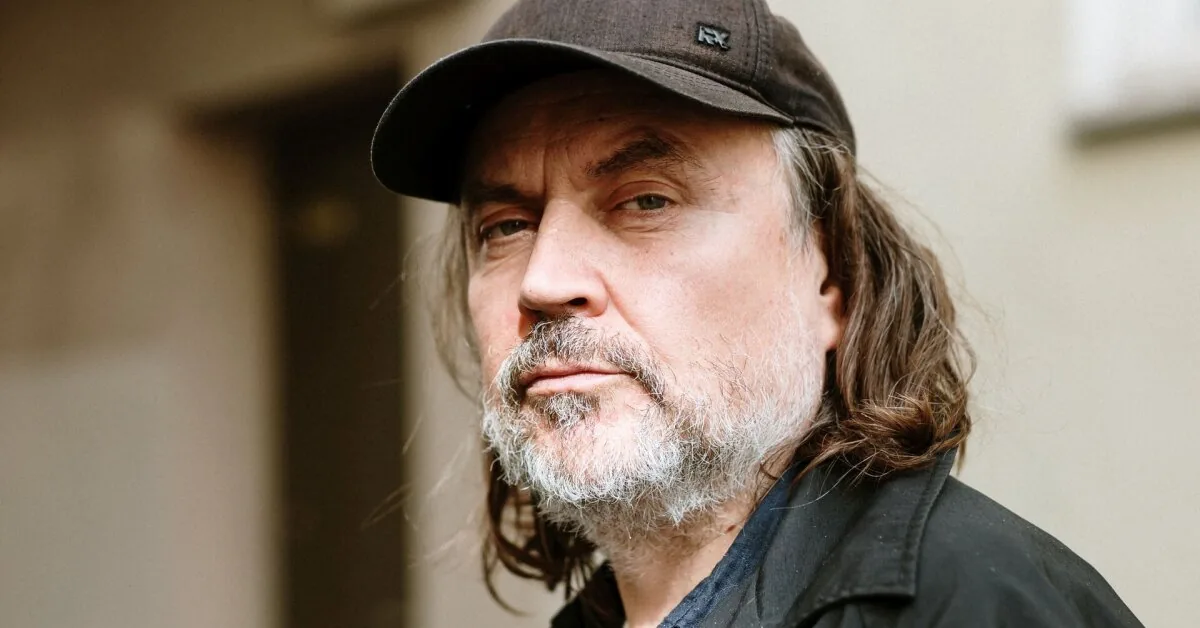
The evening was long. There was a lot of talk. But what I pulled from the dictaphone after a while incredibly surprised me. Oscar and I had no way of knowing what would happen in the late autumn in the Lithuanian cultural field. And how strongly the word “freedom” would be repeated again.
Read more Vaiva lived in Shanghai, created a business, and now dared to do what many fear
This conversation was published in “Kelionė” magazine. Oskaras Koršunovas was interviewed by Laisvė Radzevičienė.
The original article is published at this link Oskaras Koršunovas: “A free person is open to good.”
– Oskaras, you started creating your performances when the first seeds of freedom were sprouting in Lithuania. You know very well what censorship and criticism for a viewpoint unacceptable to others mean. Do you often feel uncomfortable?
– At the beginning of my career, there was a lot of resistance. A lot. From attempts to remove performances to constant criticism. There is probably no other director in Lithuania who has been criticized so much.
– And why?
– Many reasons. Now everything is – young, for the young. Back then, I was an upstart, a kid who came and started creating a different kind of theater. Such upstarts are unacceptable. And the competition was strong – Eimuntas Nekrošius, Rimantas Tuminas. With the late Tuminas, we started almost together, debuted together on the same stage of the Vilnius Small Theater, even shared a dressing room.
Later, when our troupe started touring abroad, there was a lot of envy. But that’s normal. Back then, there was no internet; you could only tell about yourself as much as the press reported. We received so many awards that they couldn’t keep up with printing, and often the information remained – only in the foreign press. Now, on internet portals and social networks, you can write as much as you want!
In my performances, one can discern prophecies of the future, and some performances were simply not properly appreciated because they came out too early.
– When you look at your career from the perspective of time, doesn’t it seem to you that you were born too early? Do you feel good in your time?
– I entered a very interesting time. And you’re right, there are signs that I was a little ahead of my time – in my performances, one can discern prophecies of the future, and some performances were simply not properly appreciated because they came out too early. Take “The Face of Fire,” for example.
What young people are staging in theater today, I staged 20 years ago, the same plays, the same authors. But for an artist, it is always better to be ahead of their time, even if at that moment they might feel discomfort and be criticized. You cannot lag behind; if you want to speak, you must be at the forefront.
I remember Brezhnev’s times. I would sit in school and it seemed to me that time had stopped, that nothing interesting would ever happen again, and my life would never change. A kind of capsule of eternity. During history lessons, I would wonder – so much had happened in the world, and here we were, frozen, suspended. And if someone had told me then that I would have to live through a time of intense change, see an empire crumble, witness strong geopolitical and cultural shifts, I would never have believed it.
Nevertheless, I had the good fortune to live for theater during its most grateful time. In the agony of the Soviet era, theater was interesting and important. I saw the most interesting creative period of Jonas Vaitkus, Eimuntas Nekrošius, and even joined them. I started rehearsing my first performance, “To Be Here,” based on Daniil Kharms’ play, back in the Soviet Union. It was 1988–1989; I was creating the forbidden Kharms, having typed the play on a typewriter. To be honest, it wasn’t very clear if I would even be allowed to stage it. The premiere of “To Be Here” took place on March 22 in already independent Lithuania. And it was probably the first performance of a completely different Lithuania.
We founded our theater in 1999, at a time when Lithuania was already beginning to recover, when we were preparing to join the European Union. The falling Berlin Wall opened the world to us; with our history, we were interesting to it. Not to mention us – it was a golden age, a time of opportunities. We rode such a huge wave and made a stunning career.
Today, young people do not have such opportunities.
– Because there are many choices, many theaters, many actors? Do you have to be incredibly interesting, unexpected, new, talented to reach the top?
– We were from Eastern Europe, from a closed territory, something new, unknown. Now there are no such conditions, no such festivals, no such interest.
It was a time for theater. My generation is like the last generation of great theater directing. It’s hard to explain today how everything seemed to us back then, but I’ll try: in 1984 or 1986, a “The Queen” record came into my hands, with the most serious vows not to scratch it. With trembling hands, I placed it on the turntable; the feeling was as if I were holding alien photographs now. And if someone had told me then that in 10 years everything would change, that the guitarist of that same band would shake my hand while presenting me with an award, that I would talk to him, raise a glass of champagne – would I have believed it? No! But the other guy who received that award, drinking champagne, was no longer surprised; it seemed to him that it was meant to be.
This difference was only possible in the time when I started and created. That’s why I understand the youth who are so interested in this time.
However, this golden, unique time also had certain consequences. Not everyone accepted it, not everyone understood it, and not everyone survived…
And I’m not saying it was easy, rather – important for history. A complex, difficult, dangerous time of constant struggle. Both the Soviet army, and Afghanistan, and psychiatric hospitals – I didn’t participate everywhere, I slipped through some, but I certainly know what it meant.
I avoided Afghanistan by checking into a psychiatric hospital. The militia took my friend and me down from the roof of the Vilnius Sports Palace, where we wanted to hang the tricolor.
Read more Iran condemns discriminatory US behavior over unissued World Cup visas
I avoided Afghanistan by checking into a psychiatric hospital. The militia took my friend and me down from the roof of the Vilnius Sports Palace, where we wanted to hang the tricolor. When I was kicked out of the entrance exams, I urinated on Lenin’s monument in Lukiškės Square, shouting: “I’ll show you all.”
It’s very interesting to look back from the perspective of time at certain things that seemed absurd then, but turned out to be quite good. I didn’t get into acting, because, as it turns out, I was meant to become a director. Failure can sometimes be success.
I said romantically that when reading a history textbook in school, I thought nothing would ever change, but in that world behind the Iron Curtain, I probably wouldn’t have survived, because conflict is in my blood. I still conflict with the system now, but that system was completely different. Sometimes I think that we yearned for freedom so much because we knew what it meant to live in unfreedom. Unconsciously. Without realizing its importance. That’s why the new socialism, which young people admire so much, is unacceptable to me. I understand what they admire – beautiful, humane ideas – but they also have another, darker side. We experienced that, which is why freedom becomes more important than anything else to us.
– We perceive freedom differently. At least to me, it seems that freedom should also speak of responsibility and limits…
– I am a citizen and I perfectly understand that there is only one path – a certain harmony, a certain balance. One of the most important principles is the ability to maintain balance – not only physical, but also moral. I strive to maintain that balance, adequacy, but in my ideas, I am always on the side of the free individual.
– In your eyes, what is a free individual?
– Able to create and be happy. When similar topics, like the ones you’re formulating now, arose for me in childhood, I would ask my mother: what do you believe in? She would answer that she believed in good. Her statement seemed neither here nor there, because what does it mean – I believe in good? Now I understand that much deeper; my mother, apparently, instilled it.
To be honest, I have no ill intentions. When I speak of freedom, I mean those intentions that I can freely realize and in which there is no evil. However, the world is not like that; evil exists in it, and that’s where confrontation begins. So, when considering the concept of a free individual, I first think that they are open to good and free within it.
– Do you think theater today has the opportunity to experience its good times by talking about things that are extremely important?
Cultural processes will no longer catch us off guard, because technology has changed a lot. One thing is clear: everything is happening unpredictably and at an incredible speed.
– The kind of theater that was, the kind that you and I love, will no longer exist. It won’t come back, and it doesn’t need to. Complex, metaphorical theater formed as a certain resistance, an opposition to the system. Then there were processes that, I believe, will not be repeated. Cultural processes will no longer catch us off guard, because technology has changed a lot. One thing is clear: everything is happening unpredictably and at an incredible speed.
At the end of my first performance, “To Be Here,” the main character asked: what can change the course of events not only on Earth, but also on other planets? A female voice from the sky would answer him – a little mouse. But then the 1990s came, and a huge tectonic shift occurred, changing both the world and us. Now, before our eyes, the world is absolutely changing again.
We live in a time of propaganda. Our pure soul, which lived peacefully until the 2000s, is today influenced by technologies, the internet, social networks. They contain many wonderful things, but also – incredibly dangerous tools for total manipulation of society.
– In our conversation, I’ve already heard so many themes that could become performances. Why don’t they?
– I don’t know. Theaters live in the past, not the very distant past, or the past that truly needs to be reflected upon, for example, Siberia, genocide – these are eternal themes. I’m talking about some old trends that are changing at an incredible speed. You’ve noticed, theater talks a lot about sustainability, which is important, but today – it’s certainly not the most important topic.
– It can be observed that in the explosion of technology, a thinking person chooses withdrawal. Is withdrawing always bad?
– I believe we have the freedom to act as we wish. Even to withdraw. It’s a bit strange when young people withdraw, if they flee to homesteads, forests. A young person must participate in changes, create; that’s why they are young.
I constantly face dilemmas. On the one hand, I am drawn to jump into the whirlwind of events; in the strangest ways, I found myself in revolutions, in wars, many such events occurred, sometimes even against my will. And now, against my will, I am talking to you about events I might not want to talk about. But another part of me always wanted to go to a homestead, to the forest, by the river – my mother wanted me to become a forester; that profession seemed promising to her. I would like to be everywhere, at the forefront, and at the same time be nowhere. I don’t know what is better.
There is a desire to withdraw into oneself, to live in one’s inner world, to flee from all events – I dream of monasticism. I constantly fall asleep imagining myself as a hermit in some homestead.
Another deeply hidden desire of mine to become a writer only revealed itself now, with the advent of Facebook; previously, I only wrote in theater and about theater, I didn’t have the opportunity to review everyday life. But Facebook has also changed, the golden age is over, no one writes diaries here anymore…
There is a desire to withdraw into oneself, to live in one’s inner world, to flee from all events – I dream of monasticism. I constantly fall asleep imagining myself as a hermit in some homestead, in my castle, and in the morning I wake up and rush into the action. On the other hand, I consciously created a system to find myself in those events. Theater is like a bird trap; it must constantly react to what is happening in society.