
Manipulating perception?
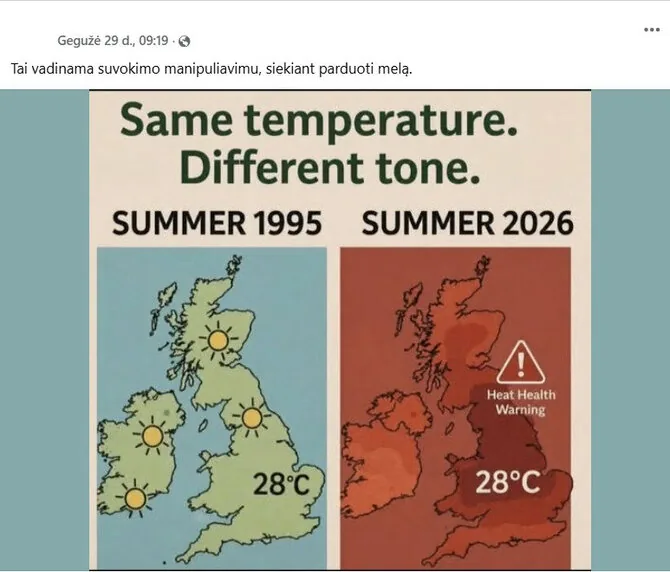
A netizen shared two UK maps on her Facebook account. They allegedly show the same temperature of 28 degrees Celsius recorded in the summer of 1995 and 2026.
The only difference is that the 1995 map is green, while the 2026 map is red and includes a warning about high heat.
The illustration reads: “Same temperature. Different tone.” The netizen herself commented: “This is called manipulating perception to sell a lie.”
The woman herself did not specify that the lie she referred to was climate change, but from the context, it is clear what she meant.
Commentators under this post also complained: “One day it’s warmer and already the sick are screaming about warming, even though nothing has really changed in 50-100 years!”
One man claimed to be in England and said, “most people repeat that it was always similar, and that greenhouse effect is only for corrupt politicians… Everywhere they lie similarly for money.”
Conclusion drawn without evidence
First of all, it is worth noting that the netizen shared the post at the end of May, although the picture indicates that the temperature was recorded in summer. This had not even begun yet.
Furthermore, the maps are presented without any context. If it is being suggested that a temperature of 28 degrees Celsius was and will be recorded in the UK in both 1995 and 2026, this is entirely possible. But this does not prove that climate change does not exist and does not affect global temperatures.

Even imagining that the netizen miraculously predicted the upcoming summer temperature in the UK, it is difficult to understand what the mentioned 28 degrees Celsius means. Should it be just one day’s highest temperature, or simply heat recorded at one time of day, or something else?
In any case, one hot day neither proves nor disproves climate change. In this case, scientific evidence and trends must be considered.
15min last year examined an identical manipulation, only then an Italian map was shared.
Also read: Two maps from 1995 and 2025 prove that the climate is not changing? Here’s why that’s not true | 15min.lt
Also read: A lie about a “lie” regarding climate change: why has Sweden cooled down in 36 years?
Also read: Works like bulls: red maps give rise to lies that the climate is not changing
Record spring in the UK
First, let’s examine what the weather has actually been like in the UK recently.
On May 25, the country recorded the hottest May day on record. Near London, thermometers reached 33.5 degrees Celsius. Thus, 28 degrees could have been measured at some point during the day or days, but it was still May then.
Before that, the record for the hottest May day was 32.8 degrees, recorded in 1922 and repeated in 1944.
“Records are usually broken by only tenths of a degree, so this heatwave is unprecedented for this time of year,” said the UK Meteorological Office (“Met Office”) in a statement.
“Even in summer, we rarely see temperatures above 35 degrees, so to see temperatures approaching 35 degrees in May is quite historic,” said Met Office meteorologist Tom Morgan.
Climate advisors warned the UK government that the country is “built for a climate that no longer exists” and urged it to adapt infrastructure, such as schools and hospitals, to a warming planet.
Heat dome
On May 26, European forecasters warned of exceptional heat not only in the UK but also in other European countries. Temperatures across the continent significantly exceeded seasonal norms.

On May 25, France, like the UK, recorded its hottest May day in history. In France, heat-related deaths had already claimed 7 lives at that time.
These high temperatures, which usually do not occur until mid-summer, were caused by a so-called heat dome – warm air from North Africa trapped under a high-pressure system over Western Europe.
Outdoor work restrictions were introduced in some parts of Italy, beaches in Southwestern France filled up earlier than usual, and farmers reported earlier harvests as temperatures across the region exceeded 30 degrees Celsius.
According to the Irish meteorological service “Met Eireann”, a record May temperature of 28.8 degrees Celsius was recorded at two Irish meteorological stations.
What awaits Lithuania?
According to the Lithuanian Hydrometeorological Service (Meteo LT), long-term forecasts currently indicate that summer in our region should be at least slightly warmer and drier than the average for the period 1991-2020. However, such calculations show similar results almost every year, as they are partly based on long-term trends.
Out of the past ten summers (2016-2025) in Lithuania, as many as 7 were warmer, only 2 were colder than average, and 1 was close to the norm. Thus, even statistically, there is a higher probability that this summer may be at least slightly warmer than average. On the other hand, the same could have been said a year ago. True, last year it turned out to be slightly cooler than the 1991-2020 average.
Read more Why echinacea became one of the most fashionable garden plants
However, the service notes that forecasts for the upcoming summer can usually only be speculated.
Heatwave proves climate warming
Scientists state that due to human-induced climate change, extreme weather phenomena such as heatwaves, droughts, and floods are becoming more intense, leading to more frequent temperature records.

“The increase in extreme temperatures is a good indicator of ongoing climate change and is likely to become the new normal,” Met Office meteorologist Greg Dewhurst told AFP news agency.
2025 was the hottest year on record in the UK, and in 2022, temperatures in the UK rose above 40 degrees for the first time since records began.
The European Union (EU) climate monitoring service announced that last June was the hottest in Western Europe since such data began to be recorded.
The trend of climate warming is visible every year, and records are broken almost annually.
According to the National Oceanic and Atmospheric Administration (NOAA) data, 2024 was the warmest year since 1850, when global data began to be recorded. The global average surface temperature was 1.29 degrees higher than the 20th-century average and 1.46 degrees higher than the pre-industrial average (1850-1900 period).
It is also observed that temperatures in Europe have risen by approximately 1 degree more than in the rest of the world.
NOAA notes that all ten warmest years in 175 years have been recorded in the last decade. At the beginning of the 21st century, the first year that “broke” the record was 2005. Currently, 2005 is only the 13th warmest year in history.
In the “European State of the Climate 2025 report” by the Copernicus Climate Change Service and the World Meteorological Organization, Europe is identified as the fastest-warming continent in the world. Only the Arctic region is warming faster.
Over the past three decades, the average annual air temperature in Europe has been rising more than twice as fast (0.56 °C every 10 years) as the global average (0.27 °C every 10 years).
In 2025, almost all of Europe was warmer than usual, and in some countries (Iceland, Norway, UK), they became the warmest in recorded history.
The ocean region near the European continent also experienced unusually high annual average sea surface temperatures. In 2025, a record-high annual average sea surface temperature for the European ocean region was recorded.
In 2025, a large part of Europe experienced soil moisture deficit, reduced river runoff, but also fewer floods than in previous years.
In Europe, a record area of land was burned due to drought and heat, especially in the Iberian Peninsula, and a record amount of greenhouse gases was released into the atmosphere during fires.
At the same time, all European glaciers continued to melt, most rapidly in Iceland. However, most of the glacier’s net mass was lost in Greenland.
Recurring disinformation
The European Digital Media Observatory (EDMO), in cooperation with fact-checkers, reviewed the hoaxes and narratives that appeared online in 2022, prompted by the heatwave.
Most often, the aim was to deny the existence of climate change altogether or its links to human activity.
“This narrative conveys the message that we, as humans, can continue to live as always, because concerns about climate change are unfounded or, if this phenomenon exists, it is unrelated to humanity’s decisions and actions,” notes EDMO.
The observatory also reviewed several maps whose images were attempted to be manipulated in the online space.
“A characteristic of the narrative conveyed by all these examples of fake news is a concerted effort to discredit traditional media, whose reports on climate change, according to disinformation narratives, cannot be trusted because they only spread unfounded panic. At the same time, the aforementioned false stories also convey another narrative, according to which climate change is not real and the current situation would not be so different from what we have experienced in the past.
Sometimes the combination of these two narratives creates real conspiracy theories: traditional media spreads panic about climate change (which does not exist anyway) so that some “greater forces” can control and enslave people,” writes EDMO.
15min verdict: lacks context. A Facebook user shared maps without any context. One shows, as can be understood, the temperature recorded in the UK this summer, although summer had not even begun. A new heat record was recorded in this country at the end of May, which exceeded the 28 degrees Celsius she mentioned. In any case, a few hot days with a 31-year difference prove nothing. Scientists agree that global warming exists, and record heat is a consequence of it.
This publication was prepared by 15min in cooperation with “Meta”, aiming to curb the spread of misleading news on the social network. More about the program and its rules – here.
Read more President Brazauskas’s vacation: cross-country run, yacht with canned goods and annoying calls