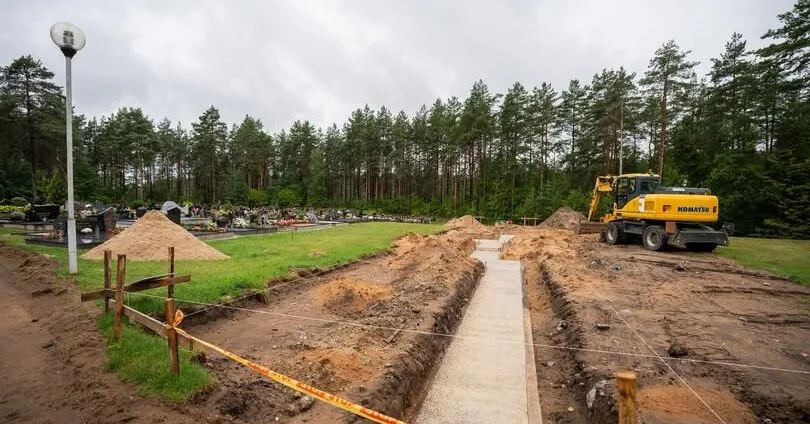
In Leipalingis, preparations are underway for the reburial of partisan remains. The remains of 46 participants in the post-war armed resistance will be reburied in a columbarium being set up in the city cemetery.
Read more After Mačiulis’s sharp remarks – association’s retort: «Disparaging and unfounded statements»
The remains of four more freedom fighters, according to the wishes of their relatives, will be laid to rest in family graves in the Leipalingis and Liškiava cemeteries.
The transfer of remains from the Tuskulėnai Peace Park memorial complex and the solemn reburial ceremony are planned for November.
Currently, details are being coordinated with the responsible institutions and the partisans’ relatives – a detailed program and exact time will be announced closer to the reburial.
The government allocated 214 thousand euros for the construction of the columbarium.
With 60 burial places arranged, the new memorial site will house the remains of more than 40 partisans found, identified, and preserved by the Lithuanian Genocide and Resistance Research Center (LGGRTC) in the area.
It is also planned that when constructing the columbarium, the possibility to expand it to 100 burial places in the future will be created. This may be necessary as the search and identification process of partisans continues.
According to the Lithuanian Genocide and Resistance Research Center (LGGRTC)
searches for partisan remains in Leipalingis have been conducted since 2020; currently, more than 40 partisan remains have been found, including those of one of the most significant partisan resistance leaders, Juozas Vitkus-Kazimieraitis. He was solemnly buried in October 2023 in Vilnius, Antakalnis Cemetery.
BNS wrote that most of the found remains have been stored for several years in temporary coffins at the LGGRTC Search and Identification Department premises in Vilnius, as funds for the construction of the columbarium had not yet been allocated.
The partisan war against the Soviet Union occupation in Lithuania took place from 1944 to 1953. At least 50,000 people participated, and about 100,000 Lithuanian residents took part in the resistance movement as members or supporters of underground organizations. Over 20,000 partisans and their supporters died in this war.
Read more With increasing security threats, Germany opens a new drone defense research center