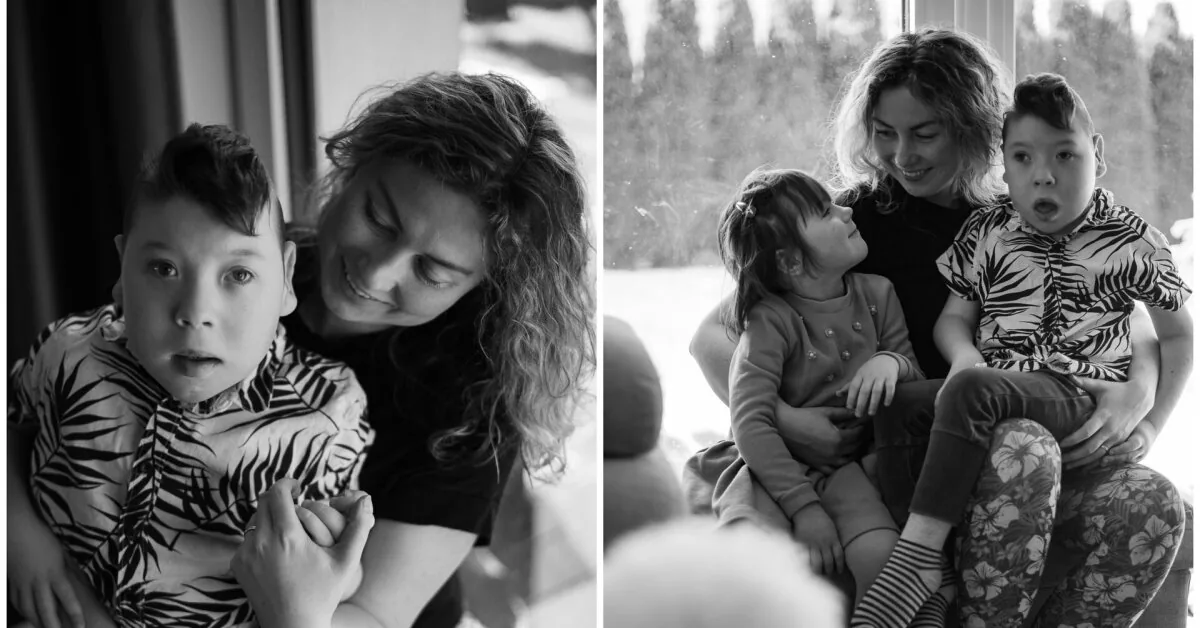
“For me, raising a child with a disability in a healthy way means not only taking care of their medical needs but also not losing sight of the entire family – preserving space for parents, brothers or sisters, rest, help, and life beyond the illness,” says Eglė Lasienė.
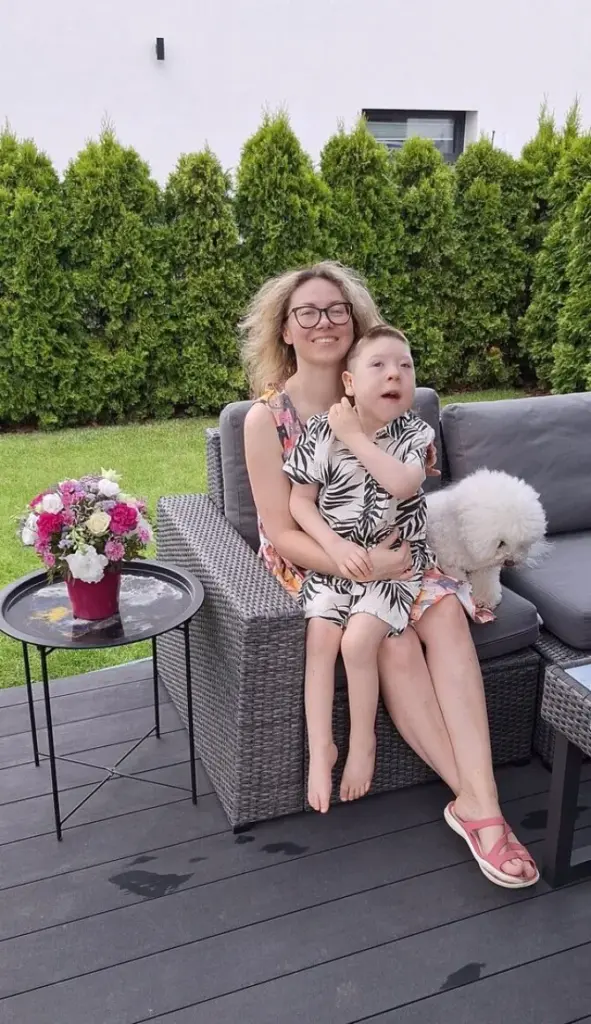
Her family consists of four people: mother, father, and two children, one of whom – Tauras – has a severe disability.
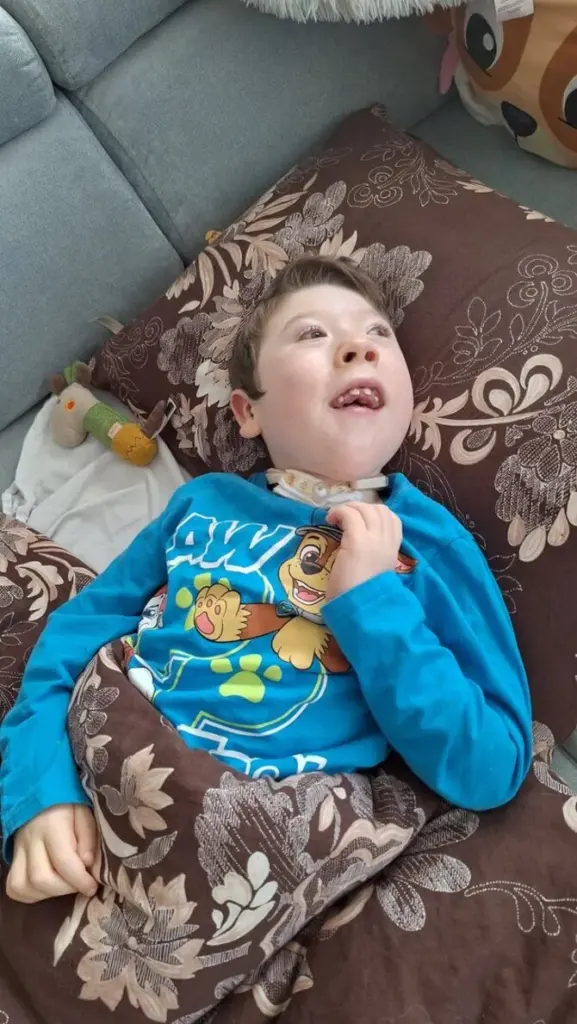
“Tauras’s disability is complex: he doesn’t walk, doesn’t speak, doesn’t eat on his own, and currently even breathes through a tracheostomy. When he was born, he scored 10 on the Apgar scale, which seemed to promise that *everything would be fine* – a *healthy* child was born. However, later problems started to emerge like a needle from a sack, and today we are raising a child with palliative care needs, who is very ill, and has a severe disability. We live in Kaunas, and we also have another child in the family, a few years younger, lively, cheerful, with typical development – Tauras’s sister,” Eglė recounted.
The woman openly shares her personal and family experiences on the blog “Kitokia motinystė” (Different Motherhood) and also speaks publicly in the media. This time, we talked with Eglė about how to raise a child with a disability in a healthy way, without losing sight of her own and other family members’ needs.
– If you had to single out the biggest challenge, the difficulty you experienced as a mother of a child with a disability, what would it be? Why that specifically?
– I couldn’t single out the biggest difficulty, as they constantly change with the child’s age. Initially, the biggest difficulty was that he didn’t breastfeed himself, and my husband and I fed him either with a cup or a syringe, never losing hope that he would eventually breastfeed himself; after a month, we succeeded.
Also, from birth, Tauras was extremely allergic, so you can only imagine how difficult it was for a new mother to be unable to eat practically any of her favorite foods, as everything either caused a rash or terribly bloated the child’s stomach. And this continued for 8 months until, finally, after discovering the allergens and removing them from his diet, we managed the situation.
At that time, Tauras finally stopped crying constantly, and life temporarily became easier. Also, for the first year, he slept very poorly and cried a lot, so we only traveled a longer distance from home when he was about a year old.
Later, difficulties changed with the child’s age – epilepsy, abdominal pain, swallowing disorder, breathing difficulties, and frequent pneumonia appeared.
In this journey of raising him, we had to reach a new, previously unexperienced point in his care – from trying to feed him and hoping he would eventually eat on his own, to moving to a gastrostomy; hoping he might walk someday, to encountering a drug-resistant form of epilepsy that stopped all development and the child ceased to progress; due to respiratory insufficiency and frequent illness, to inserting a tracheostomy, which means constantly needing to suction mucus and having a mucus suction device nearby.
This journey is not only a physical difficulty that constantly changes and brings new challenges every year. It is also a huge emotional and psychological burden, feeling constant anxiety about how everything will be, living in uncertainty when sometimes you can’t see even two meters ahead, and constantly experiencing manifestations of grief that something you hoped for will never be.
Also, seeing a *healthy* child turn into a palliative patient and trying not to lose oneself as a person amidst all this difficulty: to work, to live, to raise another child, and to see the family as a whole unit, not just the child with a disability.
This journey is not only a physical difficulty that constantly changes and brings new challenges every year.
– What does the phrase “raising a child with a disability in a healthy way” mean to you and your family? What does it entail?
– For me, it probably means seeing the whole family and all its members, not just the one who is most ill and has a disability. Because in a family, the needs of all members are important – both spouses and all children – and by focusing only on the one with greater care needs, one can overlook the important inner lives of other members.
Read more Still has it: Andrius Gudžius surprised with an amazing result
And that is also incredibly difficult! Because a child with a disability automatically means different – more complex – care and a greater physical and emotional burden. So, for there to be room for the needs of other family members, external help is needed, that so-called “village to raise a child.”
Initially, I thought this *village* was just close relatives. However, the more time passes, the more I understand that relatives alone cannot replace an entire village – because they too are limited, and sometimes those relatives are no longer there, as in our case – almost all grandparents have already passed away.
So, we had to seek out and allow various forms of other village manifestations: currently, these include a nurse coming to our home, a special kindergarten, a hospice for temporary respite, volunteers in hospitals, and colleagues or other, less close, people who can be with Tauras.
Allowing such help was not easy – it was like another difficult step in the journey of different motherhood, as I had to admit to myself that I am limited, that I need help, not to feel like the worst mother in the world who leaves her child with someone else. However, it was precisely this that helped me remain as healthy as possible in body and mind, sharing the burden with someone else, rather than just carrying it on my husband’s and my shoulders. Nevertheless, it was indeed a complex journey of acknowledging my limitations, separating from the child, and letting go of control.
– Who helps you? What kind of help do you receive? Is the help in Lithuania sufficient?
– As I mentioned, I see all possible help as a “village to raise a disabled child.” And that help is very diverse, but from all the various puzzle pieces, some tangible picture emerges.
What is most needed is real respite – for someone to be with your disabled child while you can take a break. So, this can be either a person coming to your home and allowing you to go out, leave, and rest somewhere, or inpatient facilities that take over the care of such a child for a period.
We currently use temporary respite services at home and in specialized institutions, and we receive a daily social care service, where a person comes daily to help care for Tauras. In fact, the situation has changed significantly compared to what it was before.
However, there is still a problem of human resource shortages – when employees sometimes cannot be found, or an occupancy problem for institutions when they no longer have places. So, greater opportunities for real respite would certainly add well-being to the lives of such families.
I am also incredibly grateful to organizations like “Niekieno vaikai” (No One’s Children), which care for not only parentless children in hospitals but also help parents care for children with disabilities when parents are away or unable to do so themselves at the time. Such institutions are also part of the “village to raise a disabled child,” which is very important to mention.
– What are the most essential things for a child and a family raising a child with a disability?
– Help (smiles – author’s note). And that it would be possible to easily and smoothly get information somewhere about what you are entitled to, where to turn, what institutions provide certain services.
Because as I remember myself at the beginning, it felt like wandering through a dark forest where you couldn’t see a step ahead – you call, ask for information, and no one knows. Then you find out from other parents raising similar children. Then you apply again, search, knock on doors until you get through or not.
There is a great lack of a central contact person to help families raising a child with a disability, for someone to truly care about them and not leave them to wander alone in those forests.
And a greater variety of services and real help: for someone to truly be there, not just to help, to allow for a break, rest, and not just to exist, but to live: to work, to have holidays, to sleep.
Read more Due to the Ebola outbreak, US authorities urge strict measures