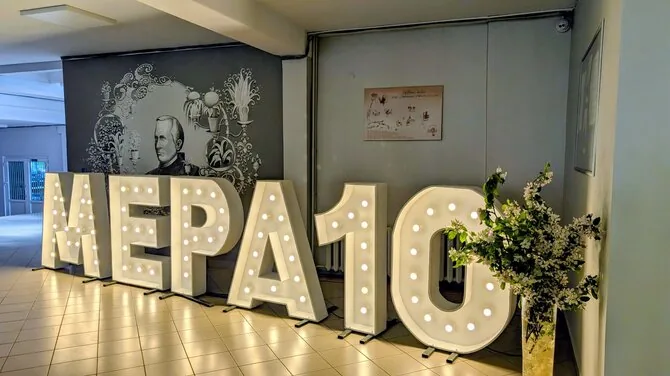
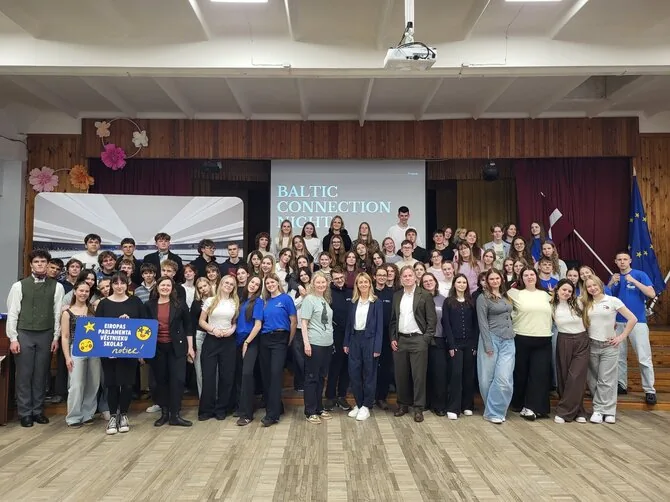
The festive event at Kretinga’s Jurgis Pabrėža University Gymnasium was not accidental. History teacher Dalia Zibalienė, whose gymnasium has participated in the MEPA program from the very beginning, herself reminded the European Parliament (EP) office in Lithuania about the upcoming decade and invited to celebrate the anniversary in Kretinga.
Read more In summer, the threat of these diseases to farms is even greater: what breeders need to know
According to the teacher, MEPA at their school has become not only a project but also a community. “Over ten years, we have raised many MEPA participants. Children come to the ninth grade still cautious, but quickly see that many activities and meetings take place here, a sense of community emerges, and they get involved,” said D. Zibalienė.
She emphasized that the program provides students with much more than theoretical knowledge about the European Union.
“It is a project that nurtures a young European – a person who is not afraid to speak, discuss, express their opinion, and understands that in the future it is precisely they who will shape Lithuania,” said the history teacher.
Students participate in meetings with Members of the European Parliament and Lithuanian politicians, cooperate with the municipality, youth organizations, contribute to initiatives supporting Ukraine, and help the local community understand how EU funds are used in their city. “We create leaflets, distribute information about EU investments in our region because people’s attitudes towards Europe are very diverse,” explained D. Zibalienė.
It is a project that nurtures a young European – a person who is not afraid to speak, discuss, express their opinion, and understands that in the future it is precisely they who will shape Lithuania.
Jurgis Pabrėža University Gymnasium student Darija Dzikevičiūtė admitted that at first MEPA activities seem unclear to many, but over time help to understand Europe and their role in it more deeply.
“At first, we didn’t really understand what was happening here and what we were doing. But in the second year, we began to understand better what Europe is, why all this is important, and we got much more involved in the activities,” she said.
What is MEPA?
The “Schools – Ambassadors of the European Parliament” program has been implemented in Lithuania since 2016. Its goal is to educate young Europeans, present the impact and benefits of the European Union in various areas of life, and encourage young people to be active citizens of their country and the European Union.
The program is open to gymnasiums and vocational schools where 16–18-year-olds study. Teachers from participating schools use special MEPA educational materials, organize Europe Day celebrations, discussions, and other events. Students and teachers from the best-performing schools in the program are invited to “Euroscola” events in Strasbourg or training seminars in Brussels. The program in Lithuania is coordinated by the European Parliament office in Lithuania.
Why is voting important?
Steve Clark, a representative of the European Parliament and director of offices in various countries’ capitals, who came to Kretinga, spoke to the youth about democracy, European Parliament elections, and why voting is not a formality. He reminded the EP election campaign message: “Vote. Or others will decide for you.”
According to S. Clark, in elections people choose who will make decisions about money, security, infrastructure, the economy, and Europe’s direction. “You are not just sending people to talk. You are sending them to make decisions. These are political decisions that have consequences,” he said.
As an example, he cited the United Kingdom’s withdrawal from the European Union. He said that most young people then wanted to remain in the EU, but participated too passively in the elections. “They didn’t go to vote and let others decide for them. If they had voted as actively as others, today I wouldn’t have to apologize for being a Brit working in the European Parliament,” he said.
They didn’t go to vote and let others decide for them. If they had voted as actively as others, today I wouldn’t have to apologize for being a Brit working in the European Parliament.
S. Clark also spoke about the war in Ukraine, disinformation, artificial intelligence, climate change, rising living costs, and security challenges. According to him, democracy is threatened not only by wars but also by the information environment. “If we can no longer agree on what is true, and if algorithms encourage us to be angry, democracy also becomes vulnerable. We lose the foundation on which a civilized state is built,” said the EP representative.
How to distribute European money?
In one part of the event, young people had the opportunity to practically try to allocate part of the European Union budget. Students discussed what share they would allocate to defense, security, climate change, space.
“We wanted students to better understand how the European budget is distributed and how difficult it is to allocate it when different views and interests collide,” said science communicator Goda Raibytė-Aleksa, who led the education.
The space theme was given broader attention at the event. The communicator presented the European space sector to the students and later invited them to perform other creative tasks: to create an idea for a joint Lithuanian and Latvian satellite mission and suggest what kind of person could be symbolically delegated to an astronaut mission.
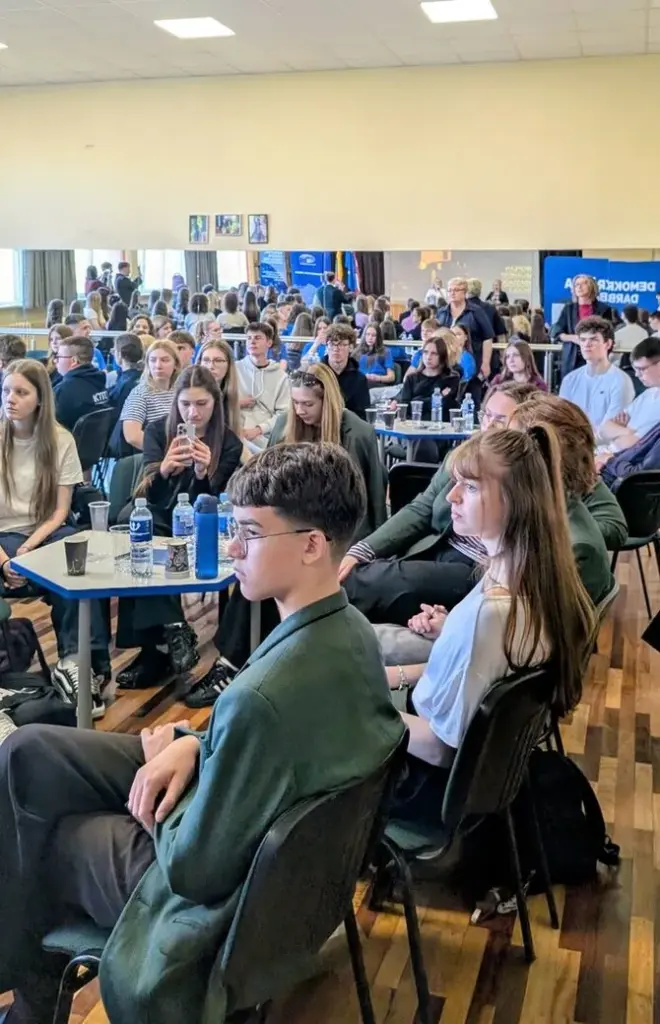
Students worked in mixed Lithuanian and Latvian groups, so they had not only to decide on priorities but also to agree with peers they had just met.
Read more Million-dollar claims from Germany’s Siemens Energy chase Lithuania’s strategic energy project
“We deliberately mixed the groups so that students would discuss, get to know each other, learn to argue and find common solutions,” said G. Raibytė-Aleksa.
What is the long-term budget?
S. Clark explained to students that the long-term EU budget is a seven-year plan that outlines how much funding will be allocated to common European goals.
“The European Union budget complements what national governments spend. It is added value – something extra that allows addressing tasks from a European perspective and doing what individual member states could not do alone,” said the EP representative.
He also debunked the common myth that most of the EU budget is spent on administration. “That is not true. Only seven percent of the budget goes to administration, and the remaining 93 percent is allocated to real programs that directly benefit people in Europe,” explained S. Clark.
Latvian experience
Representatives of Latvian schools also came to Kretinga. The community of Liepaja Oskars Kalpaks Secondary School has been participating in the MEPA program for almost a decade. Teacher Linda Sausina said that the values important to the school are closely linked to European values, so the program became a natural part of education.
“Our school pays a lot of attention to values, citizenship, and active involvement of young people. We want to educate future leaders and active citizens, and this program is one of the best ways to teach democracy and show why it is important,” said L. Sausina.
She recalled one student who initially did not dare to speak publicly and doubted whether his opinion could be heard. After a trip to Strasbourg, he returned changed.
“I remember one of our students – at first he was very afraid, lacked confidence, did not dare to express his opinion, and did not think his voice could be heard. But after the trip to Strasbourg, he came back completely changed. It seemed he gained so much confidence that he could even run into a burning building – this experience gave him so much courage,” said the teacher.
Student Daniels Derkevics from Liepaja said that MEPA activities help develop critical thinking and understand that a young person can make a change. “Such events provide an opportunity to travel, meet other young people, and realize that you yourself can make a change. When you sit among hundreds of young Europeans in Strasbourg, you start to feel that your opinion really matters,” he said.
When you sit among hundreds of young Europeans in Strasbourg, you start to feel that your opinion really matters.
Students Enija Alseika and Kate Eva Embrekte from Liepaja Zenta Maurina Grobina Secondary School said that their school organizes quizzes about Latvia and Europe, open lessons with politicians, trips to Strasbourg. Students have also implemented a local civic initiative – they analyzed a problematic road section, prepared proposals, and submitted them to the municipality. The municipality intends to resolve it.
“It was very interesting – it was my first time participating in such an event. I liked most meeting other people and learning more about Lithuania,” E. Alseika added about the event in Kretinga.
Europe is also in Kretinga
S. Clark noted that young people in different European countries have cultural differences: in some places, students speak loudly and boldly right away, while in others, like the Baltic countries, they are more reserved at first. However, their concerns are often very similar.
“Young people everywhere have a lot of energy, ask great questions, sometimes very unexpected ones. It just takes more time to break the ice in some places,” he smiled.
According to him, the security issue is especially strongly felt in the Baltic region because the war in Ukraine, drone incidents, and the proximity of Russia and Belarus are not abstract topics here. But despite different geographical experiences, young people across Europe think about similar things – studies, the future, housing, work, climate change, and their place in the world.
S. Clark believes that such regional meetings help show that Europe is not just Brussels or Strasbourg. It is also in Kretinga, Liepaja, Grobina, Vilnius, or Riga.
“This place is just as much Europe as Brussels or Strasbourg. Don’t let anyone tell you otherwise – you are just as European as everyone else,” he emphasized. “We have to step out of our comfort zone and be where people live – show that we care about what happens here as much as anywhere else in Europe.”
The project is partially funded by the European Parliament. However, the author(s) alone are responsible for the opinions or views expressed in the content; the European Parliament cannot be held responsible for them.
Read more KUL performed a rare operation that gave the patient hope to walk again