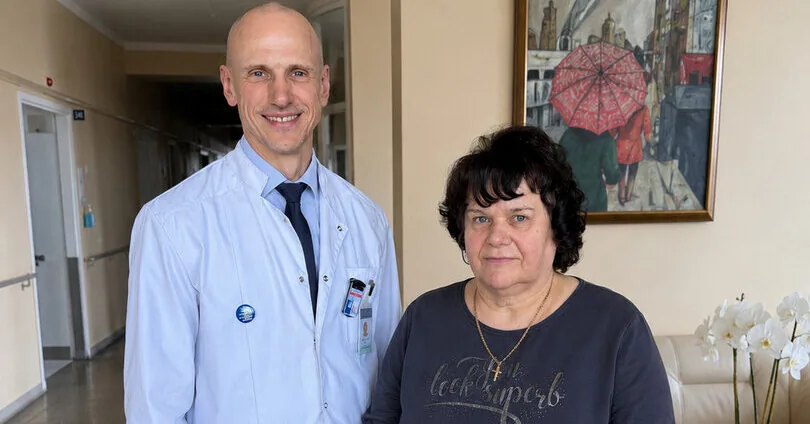
A 68-year-old woman from Klaipėda, Joana, was diagnosed with a very rare spinal cord hernia, which required a precise operation, high specialist competence, and a long rehabilitation process for treatment. Today, the patient is already taking her first independent steps again, and doctors call her story an exceptional example of perseverance and the possibilities of modern medicine.
Read more „Bepročio teorija“: Trump threatens every eleventh person in the world
The disease progressed quietly and slowly
After evaluating the magnetic resonance imaging, KUL neurosurgeon Šarūnas Varnas diagnosed the patient with significant changes in the lumbar spine. Two operations were performed because of these, but Joana’s neurological condition did not improve.
“There was a period when my legs were completely ‘taken away.’ I could not get out of bed; it seemed like my body refused to listen to me,” recalls the woman from Klaipėda.
To find the cause of her poor condition, doctors performed an additional magnetic resonance imaging of the thoracic spine. It revealed a very rare pathology – a spinal cord hernia.
According to Š. Varnas, this disease develops very slowly and can be hidden behind other spinal problems for a long time.
“Patients often feel weakness, gait disturbances, heaviness in the legs, but such symptoms are also typical of other spinal diseases. Therefore, diagnosing it is particularly difficult,” explains the doctor.
The operation required exceptional precision
After establishing the exact diagnosis, the neurosurgeon decided to perform a third operation on the patient, which was one of the most complex. According to Š. Varnas, the situation was complicated by the fact that the spinal cord had been stuck in the narrow spinal canal for a long time and had fused with its edges.
“The spinal cord had to be very carefully freed, returned to its anatomical position, and the defect closed without damaging it. Even the slightest mistake could cause irreversible neurological damage or complete paralysis of the legs,” says the specialist.
The operation was performed by approaching the lesion from the front side at the fifth thoracic vertebra. According to the doctor, this is a technically very complex procedure, and such cases are rare even in large neurosurgery centers.
Š. Varnas is pleased that a follow-up magnetic resonance image after the operation showed no irreversible spinal cord damage.
Read more Newspaper: The EU will strengthen trade protection measures against China
“This is very good news. It means that the spinal cord has the potential to recover. It takes time, work, and patience. In such cases, surgery alone is not enough. A very motivated patient and rehabilitation are needed. Joana is a very motivated, determined, and optimistic patient. This clearly yields results. It is nice to see how quickly, compared to the initial condition, she is progressing,” says the neurosurgeon.
A special role – rehabilitation
After the complex operation, the patient faced a long and difficult rehabilitation phase. In the first days after treatment, Joana could neither stand nor move her legs, so the recovery process required not only the professionalism of specialists but also the patient’s enormous willpower. The first attempts to stand were very difficult.
“I started with a few seconds. Through tears, through hard work, through prayer. I stood for a few seconds, then minutes. Very hard, but I stood. I realized that if I gave up, I would never stand up. But with strong support from family, friends, and medical staff, I never lost hope to get stronger and walk again,” Joana recalls.
Today, the woman already moves with a walker, can stand on her own, walk to the toilet, and perform some daily activities.
“When someone puts your legs into bed – that is one state. But when you can stand up and take a few steps yourself – it is a completely different life. When I heard the diagnosis, it seemed like a miracle just to think that I could walk to the toilet. And today I understand that the miracle is already happening. I am grateful to doctor Šarūnas, the entire medical team – from support staff to doctors. They were my miracle workers, my supporters, and those whose professional work I will remember all my life,” she says.
The patient especially thanks KUL physical medicine and rehabilitation doctor Kristina Lysienė and the entire team of specialists for the progress achieved.
“Rehabilitation required consistent daily work and comprehensive involvement of specialists. The entire rehabilitation team worked – from physiotherapists and occupational therapists to nurses and wound care specialists. Each was responsible for a different stage of rehabilitation. In such cases, teamwork and the patient’s attitude are very important. Joana was very optimistic, responsibly followed recommendations, so we saw continuous progress,” says K. Lysienė.
After treatment, the KUL patient returned home, but the rehabilitation process continues. Daily exercise, workouts, and electrostimulation have become an integral part of her routine, and home, as Joana herself says, has turned into a small rehabilitation center. The woman does not hide that the greatest strength at this stage is the support of loved ones and a clear goal – to come to the planned consultation in September relying on only one cane.
Read more Suspected homemade vodka production and possession in Birštonas municipality and Šilutė