Belarusians dislike the increase in defense spending
Claim: Lithuania invests too much in defense and armaments, while social and economic problems are neglected.
Read more Latvian diplomat who stood up to Russia’s claws – about the Kremlin’s influence tentacles
Facts: Defense spending in Lithuania is indeed very high and growing rapidly. In 2026, 4.79 billion euros are allocated for defense, i.e. 5.38% of GDP – an increase from 2025, when the defense budget was about 2.5 billion euros (3.03% of GDP).
However, the claim that social spending is neglected does not correspond to budget data. In 2025, Lithuania allocated 20.19 billion euros for social needs – social protection, healthcare, and education.
This exceeded defense funding, which was 2.57 billion euros, by more than seven times. In 2026, this ratio decreased slightly, but social sectors still received 22.14 billion euros, while defense was allocated 4.91 billion euros – almost four and a half times less.
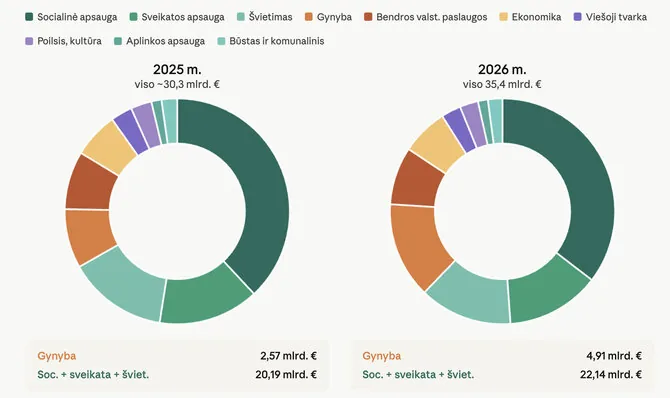
The 2026 state budget foresees about 27.5 billion euros in expenditures, and revenues of about 21.1 billion euros (including EU funds). The budget is structured by functions: health, education, social protection, defense, internal affairs, etc. Each line has its own purpose and limits.
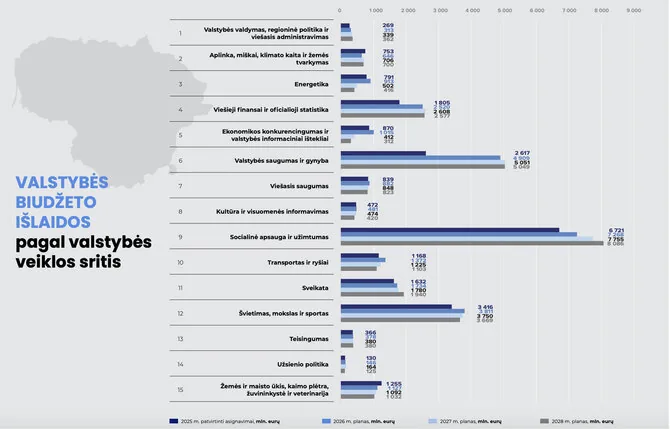
The claim that social and economic problems are neglected is manipulative, as it pits defense against the economy as if the state could only choose one. Lithuania is increasing military spending due to the real security situation in the region – Russia’s war against Ukraine and constant threats to NATO countries.
Lithuania’s economy is not just one factory
Claim: Lithuania’s economy is described as weak: emphasis is placed on the declining number of investment projects and industrial decline. The closure of the “Šatrija” sewing factory is given as an example.
Fact: Lithuania remains a growing economy in the European Union, developing sectors such as technology, financial services, lasers, biotechnology, and logistics.
Lithuania’s economy grew the fastest in the EU in the fourth quarter of 2025, according to the latest Eurostat data. Compared to the previous quarter, the country’s gross domestic product (GDP) increased by 1.7%.
This was the largest quarterly growth among all EU countries. Other countries with positive growth included Spain and Portugal, whose economies grew by 0.8%, and Finland by 0.6%.
The closure of individual factories or fluctuations in investments are not proof that the entire economy is collapsing. The propaganda text deliberately omits the broader economic situation and presents only negative examples to create an impression of disaster.
Log in the eye – demography
Claim: Lithuania is supposedly “dying out” because people no longer have children, and the state is collapsing demographically.
Facts: Claims about birth and death rates in Lithuania basically correspond to official statistics. According to official statistics, in 2025 only 17.5 thousand babies were born in Lithuania – the lowest number since independence was restored, and 36,869 people died.
However, drawing the conclusion that Lithuania will “die out” itself from these data would be wrong.
According to the Official Statistics Portal data, at the beginning of 2020, Lithuania had almost 2 million 810 thousand permanent residents, and in 2025 – more than 2 million 890 thousand. This means that the population has not decreased in recent years but has even grown. Lithuania gained about 80 thousand permanent residents.
A nationwide population and housing census is conducted every ten years in Lithuania. The last one took place in 2021. It was then calculated that over the decade the number of permanent residents decreased by 232.6 thousand or 7.6%.
In recent years, migration has significantly affected the country’s population: since 2023, the number of permanent residents has started to grow again due to positive net international migration.
In 2025, more than 18 thousand people returned to live in Lithuania, and the overall migration balance remained positive — more people arrived than left. According to the State Data Agency, the migration balance last year was 23.1 thousand.
The analytical review prepared in 2025 by the Research Department of the Information and Communication Department of the Seimas Chancellery summarizes Lithuania’s demographic situation from 1990 to 2025. It helps to understand the reasons for the changes.
The review indicates that during this period, the birth rate in Lithuania dropped sharply. Since 2000, birth rates gradually stabilized and rose between 2010 and 2016. However, later the birth rate began to decline again and reached a historically very low level in 2023.
According to the report, such low birth rate trends were caused by the consequences of intense youth emigration until 2018, changed value attitudes, later family formation, economic, social, and lifestyle changes typical not only for Lithuania but also for other high-income Western societies.
Since 1990, significant fluctuations in the country’s mortality have been recorded. Mortality increased from 1990 to 2000. Since 2000, a gradual decrease in mortality has been observed, possibly related to improving healthcare and disease prevention measures and overall economic stabilization. However, since 2020, Lithuania’s mortality has increased – notably due to the impact of the COVID-19 pandemic.
The review also notes that from 1990 to 2018, Lithuania’s migration balance was negative (emigration exceeded immigration). Since 2018, emigration rates have stabilized, and the flows of people arriving to live in Lithuania – both Lithuanian citizens and foreigners – have significantly exceeded those leaving.
Since 2011-2012, a gradual increase in immigration has been observed, which surged in 2022.
However, the deadlock situation, as the show host called it, is essentially no different from Belarus. The scale of numbers in Belarus is different, but the birth-to-death ratio is the same as in Lithuania: in 2025, 54,257 children were born, and deaths were twice as many — 116,530. The natural population decline in both countries is practically the same — almost seven people per thousand inhabitants. This means that the populations of Belarus and Lithuania are currently decreasing at a similar rate.
If last year’s rates remained the same, the last resident in both countries would die in about 145 years. The only difference is that in Lithuania this would happen about 10 months earlier.
Repeated lies about transgender children
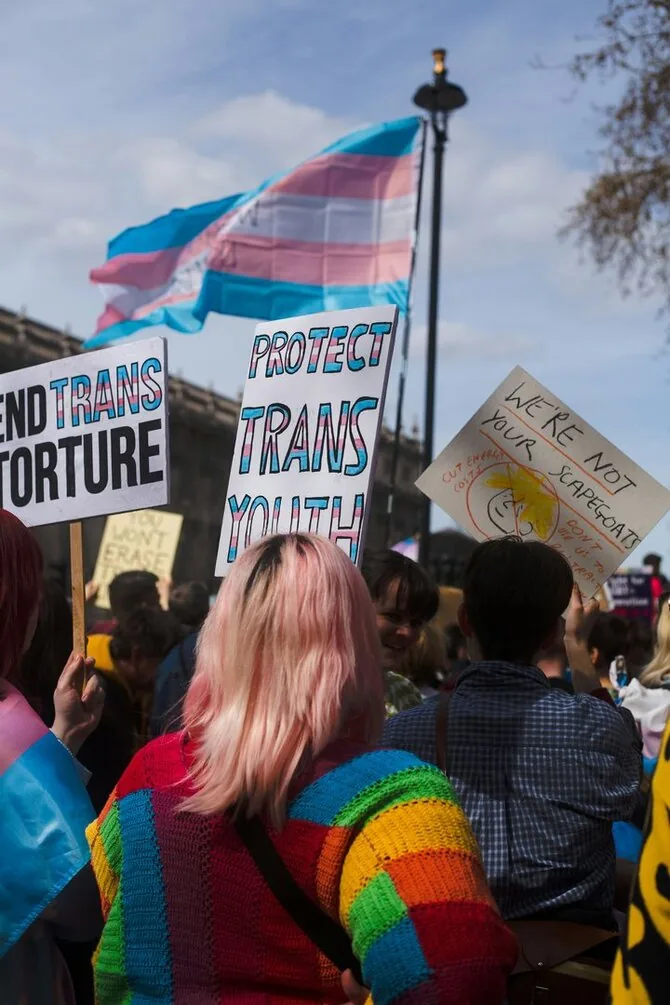
Claim: The Baltic states are supposedly morally degrading because children are being “imposed” with gender change ideology.
Facts: This is one of the most common Kremlin propaganda narratives about the allegedly “decayed West.” The show relies on emotional stories about boys in skirts or supposedly easily accessible hormone therapy for children but provides no reliable sources, statistics, or official data.
Such claims are more intended to scare the public, provoke outrage, and intensify culture wars than to inform.
None of the Baltic states has a program or law that encourages or obliges schools to change children’s gender. It is very difficult even for adults.
Although the Civil Code since July 1, 2003, provides the right for unmarried adults to medically change their gender, in practice this provision has not yet been fully implemented.
Back in 2003, the Ministry of Health had prepared and registered a draft Gender Change Law, but it was never adopted – the document was removed from the Seimas agenda.
As a result, Lithuania still has no valid law clearly regulating the conditions and procedures for gender change, and individuals usually can only exercise this right by applying to court.
There is also no legal regulation providing for puberty blockers for minors as an officially recognized treatment practice.
Lithuania’s Law on the Protection of Minors from the Negative Impact of Public Information contains a provision that information negatively affects children if it “denigrates family values, promotes a concept of marriage and family formation different from that enshrined in the Constitution of the Republic of Lithuania and the Civil Code of the Republic of Lithuania.”
15min verdict: lacks context. In Belarusian state media, Lithuania is portrayed as a failing state – emphasizing rising defense spending, low birth rates, isolated economic difficulties, and alleged “moral degradation.”
Some of the figures presented are true, but they are taken out of broader context or interpreted misleadingly.
It is omitted that Lithuania allocates several times more funds for social needs than for defense, the country’s economy remains one of the fastest-growing in the European Union, and the population has increased in recent years due to positive migration.
Unfounded Kremlin propaganda narratives about alleged children’s “gender change propaganda” in the Baltic states are also repeated, although there is no factual evidence for this.
The publication was prepared by 15min in cooperation with Meta, aiming to stop the spread of misleading news on social networks. More about the program and its rules – here.
Read more State Forest Service sounds the alarm: Lithuanian spruces are dying