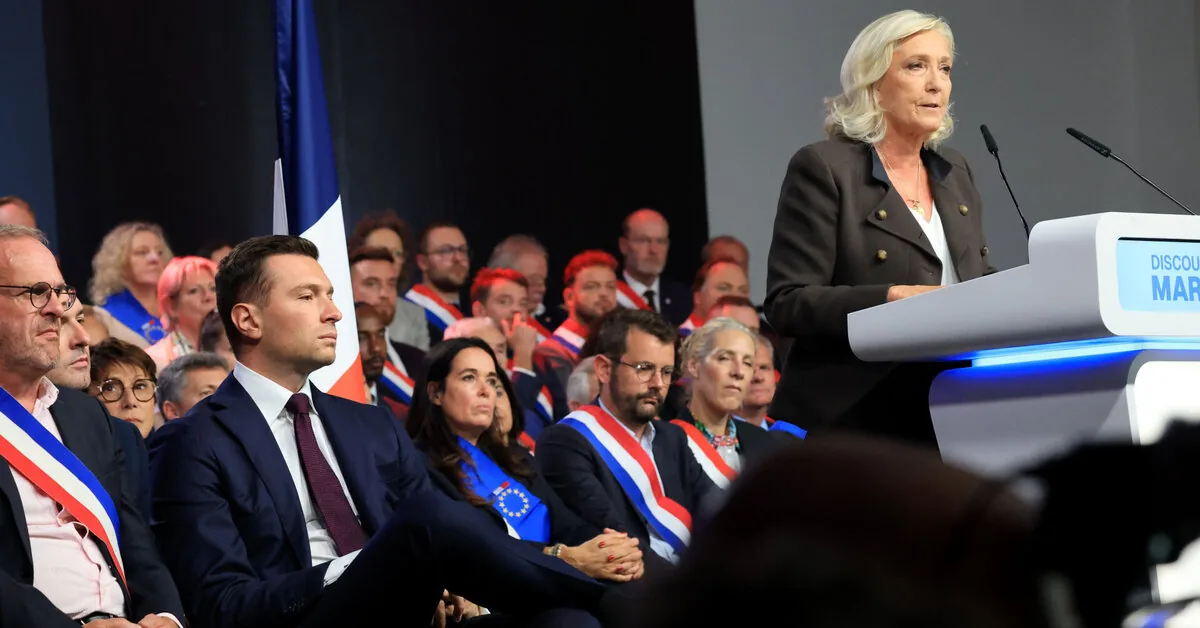
One of the AfD national leaders, Alice Weidel, who is celebrating the party’s victory with nearly 44% of the votes in the state of Saxony-Anhalt, stated that “no chancellor has ever been as unpopular as Friedrich Merz, who has become a great burden to Germany’s successful development.”
Read more Emmanuel Macron: France and South Korea will invest 1 billion euros in the audiovisual sector
The Christian Democrats, including F. Merz and the losing Saxony-Anhalt state premier Sven Schulze, gathered to consult after Sunday’s elections. The Christian Democratic Union (CDU) received 17% of the votes in this eastern federal state – this result is primarily explained by voters’ anger over the ruling coalition’s economic stagnation.
The German Chancellor said on Monday that he was deeply shocked that his center-right party suffered a crushing defeat against the far-right party in the regional elections but promised to continue reforms.
The main AfD candidate in Saxony-Anhalt, 35-year-old Ulrich Siegmund, told the public broadcaster ARD that voters sent a signal to Berlin that “things cannot continue like this.” Mocking the 70-year-old chancellor, he added that “a very good supporter of our election campaign was Friedrich Merz.”
U. Siegmund also said that although his party fell slightly short of an absolute majority, it is now reaching out to other parties and individual parliamentarians to form a stable ruling coalition.
“This is a very clear government mandate,” said U. Siegmund. “It could hardly be clearer.”
AfD’s success was welcomed by its supporters abroad, including US tech magnate Elon Musk, who sent a German message “Gut gemacht!” (“Well done!”) on the platform X.
Although Sunday’s result brought joy among AfD supporters, the prospect of a far-right government taking control of a German federal state for the first time since World War II deeply worries other parties, many migrants, and minority groups.
Germany’s domestic intelligence agency calls the Saxony-Anhalt AfD a right-wing extremist group, and some of U. Siegmund’s staff are former members of a now-banned neo-Nazi organization.
“I am scared,” said a 28-year-old man who arrived from Afghanistan in 2015 and asked not to be named.
“I have two children here,” he told the news agency AFP in Magdeburg, the capital of Saxony-Anhalt. “What will happen if I have to leave?”
“No need to be afraid”
Another AfD national leader, Tino Chrupalla, tried to dispel these fears, saying that “no one needs to be afraid of us.”
He told Deutschlandfunk radio that his party is not hostile to people of migrant origin “if they are integrated, speak German (…) and contribute to our economy.”
Read more In this Vilnius beach, increased pollution has been detected: swimming is not recommended
A. Weidel spoke more aggressively at a press conference in Berlin, harshly attacking F. Merz’s government and predicting that her party will take power in the 2029 national elections.
“People in this country do not want things to continue as they are,” she said, demanding an end to “illegal migration, open borders, sharply rising foreign citizen crime, and refusal to carry out deportations.”
A. Weidel also criticized Germany’s “disastrous energy policy” and “rapidly spreading deindustrialization that is breaking Germany’s backbone.”
Pressure on F. Merz is growing not only from the far right but also within his coalition. The government is struggling to revive the country’s economy, and there are disputes over social policy, especially pensions.
Visibly upset, Saxony-Anhalt state premier and CDU member S. Schulze said on Sunday that national government policy did not always help his campaign. In his words, “we often faced headwinds, and it was not always easy.”
“A shocking moment”
Daniel Günther, the CDU-affiliated premier of Schleswig-Holstein, called the AfD victory “a shocking moment for our country.”
“For the first time since the end of World War II, AfD – a party whose Saxony-Anhalt state chapter is classified as right-wing extremists – is close to securing an absolute majority,” he said.
AfD was founded in 2013 as a Eurosceptic protest party and soon turned into a party against Islam and immigration, criticizing former CDU Chancellor Angela Merkel’s open-door policy.
F. Merz promised to bring the CDU back to its conservative roots and took tough measures against illegal immigration while trying to revive the economy.
Oliver Lembcke, a political scientist at Ruhr University Bochum, said that “we are witnessing a tectonic shift in the party system.”
F. Merz began his term promising to distance the CDU from AfD, but the party has strengthened despite the CDU moving in a more conservative direction.
“This raises a new important question for Merz: what strategy can the CDU use to change this trend?” said O. Lembcke.
Read more Entertainment on Polish roads – 5 people injured in a crash involving a 17-year-old