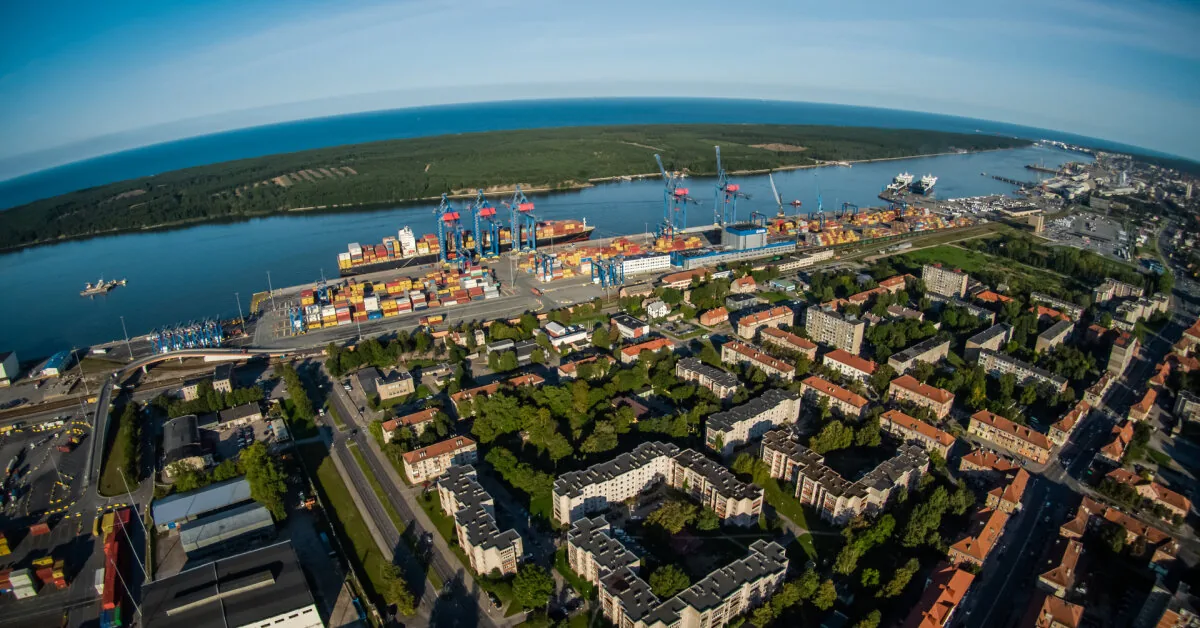
More than three decades ago, the restored independence marked the beginning of fundamental changes and transformation for the Klaipėda port. On June 3, 1991, the Klaipėda Port Authority was established and began leading the port on a path of intensive modernization.
Read more Not all «autonomous» cars are autonomous: when to expect a breakthrough in Lithuania?
For 35 years, the Port Authority has been developing and creating a modern, sustainable, and state-strengthening Klaipėda port. The Authority takes care of the development and maintenance of port infrastructure: initiating the construction or reconstruction of quays, dredging works to allow larger ships to sail to Klaipėda, and ensuring that all this is done on time and with quality. It is also responsible for safe navigation.
A particularly important function is the management of the port area. The Authority leases land and infrastructure to companies operating in the port, coordinates their activities, and creates conditions for development. In recent years, increasing attention has been paid to environmental protection – consistently implementing solutions that reduce pollution and promote more sustainable port development.
Over more than three decades, the identity of the only maritime port in the country has fundamentally changed, and the boundaries of possibilities have been redrawn. Today, ships that once seemed too large for Lithuania dock at the Klaipėda port, and operations previously impossible are now carried out.
Historical transformation
According to Romualdas Adomavičius, historian at the Lithuanian Sea Museum, the significance of the Klaipėda port for Lithuania today far exceeds the traditional understanding of a place where cargo is loaded and unloaded. He says the port has gradually become one of the most important economic, logistical, and energy support points of the state, whose importance only grows as the geopolitical situation changes.

One of the most important economic benefits of the Klaipėda port to Lithuania today is its role as the largest transport hub in the country, the historian says. Huge volumes of cargo move through the port, and a significant part of the economy is directly and indirectly related to its activities – from logistics and transport to industry and energy sectors.
“Klaipėda port is the largest transport center in Lithuania. Huge amounts of cargo move here, so a large part of the economy is in one way or another connected to the port’s activities. It is not just an infrastructure object – it is an economic hub that generates movement for many businesses and sectors,” emphasizes R. Adomavičius.
It is not just an infrastructure object – it is an economic hub that generates movement for many businesses and sectors.
Vygantas Vareikis, historian at Klaipėda University, calls the transformation of the Klaipėda port one of the largest structural changes in Lithuania. According to him, the port’s change affected not only cargo handling or industry but also the social life of the city and changed the face of Klaipėda.
“The transformation of the Klaipėda port can be viewed from several perspectives – economic, infrastructural, social, and city landscape. What happened in Klaipėda is an exceptional case because the changes affected not only the port’s activities but the entire city structure,” says V. Vareikis.
Until the 1990s, Klaipėda was one of the most important Soviet fishing ports in the Baltic. It had a large fishing fleet, floating bases, various types of trawlers, ship repair and net-making workshops, fish processing and canning infrastructure. However, as this system changed, the port had to reorient itself.
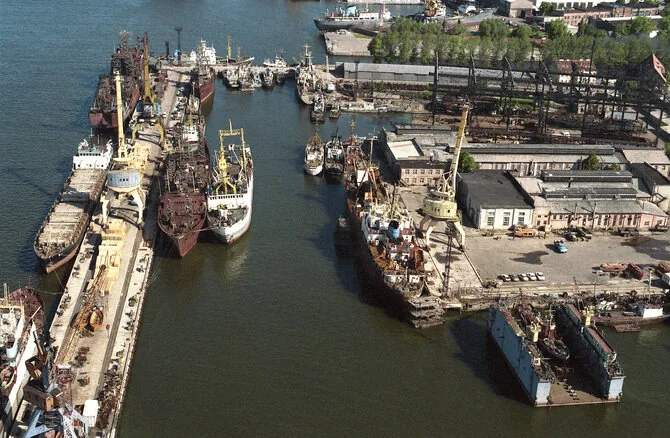
According to V. Vareikis, during the transitional period, the port was saved by new cargo flows – equipment for the withdrawal of the Soviet, later Russian, army from East Germany via the Klaipėda-Mukran ferry, Russian metal cargo, and later bulk fertilizers, containers, and ro-ro cargo or cargo vehicles transported by ferries.
“At that time, huge Russian metal cargoes passed through Klaipėda. Huge castings were transported from Cherepovets, which sometimes even the port itself could no longer accommodate – they were placed even next to the street. This was the first vivid stage of the port’s reorientation,” V. Vareikis recounts.
What happened in Klaipėda is an exceptional case because the changes affected not only the port’s activities but the entire city structure.
Container handling emerged
R. Adomavičius emphasizes that one of the most important directions of the new era was containerization. Former fishing quays were adapted for container, bulk, and chemical cargo terminals, and Klaipėda established itself as an important transport hub on the eastern Baltic coast.
“At the end of the twentieth century and already in the twenty-first century, container terminals appeared massively in world ports. The container became a universal means of transport – it can be transferred from a ship to a railway or truck, so such terminals became the basis of modern ports. Klaipėda port became one of the most important container redistribution centers in this region,” says R. Adomavičius.
V. Vareikis also highlights that the structure of port cargo handling has fundamentally changed. In 1992, the first private cargo company “Bega” appeared, later container terminals grew, transport cargo increased, and the importance of bulk cargo changed.
“The specifics of cargo handling have fundamentally changed. Previously, metal and oil products dominated, later bulk fertilizers, and today containers and ro-ro cargo have increasing importance. Klaipėda port adapted to the new logistics reality,” says the KU historian.
Part of security infrastructure
However, the importance of the Klaipėda port today is no longer only economic. Historians emphasize that the port has also become part of the state security infrastructure. The liquefied natural gas terminal changed Lithuania’s energy situation, and the port infrastructure is important for military mobility as well.
According to R. Adomavičius, the liquefied natural gas terminal is one of the clearest examples of how the port can ensure not only economic but also strategic state benefits.
“The liquefied natural gas terminal at Klaipėda port guarantees that Lithuania can be supplied with gas from the West. Today, it is used not only by Lithuania but also by Latvia and Estonia. This is not only an economic but also an energy security issue – having a port and the ability to receive such cargoes makes us much less dependent,” says the historian.
According to V. Vareikis, the port is one of the most important connections to the world, especially in case of crisis.
“The majority of cargo is transported by sea – not by rail or planes. If we talk about a geopolitical crisis, the connection would be through Klaipėda port, not through the Suwałki corridor. Without Klaipėda port, Lithuania would be in a completely different position,” summarizes V. Vareikis.
If we talk about a geopolitical crisis, the connection would be through Klaipėda port, not through the Suwałki corridor. Without Klaipėda port, Lithuania would be in a completely different position.
Spaces opened to the city
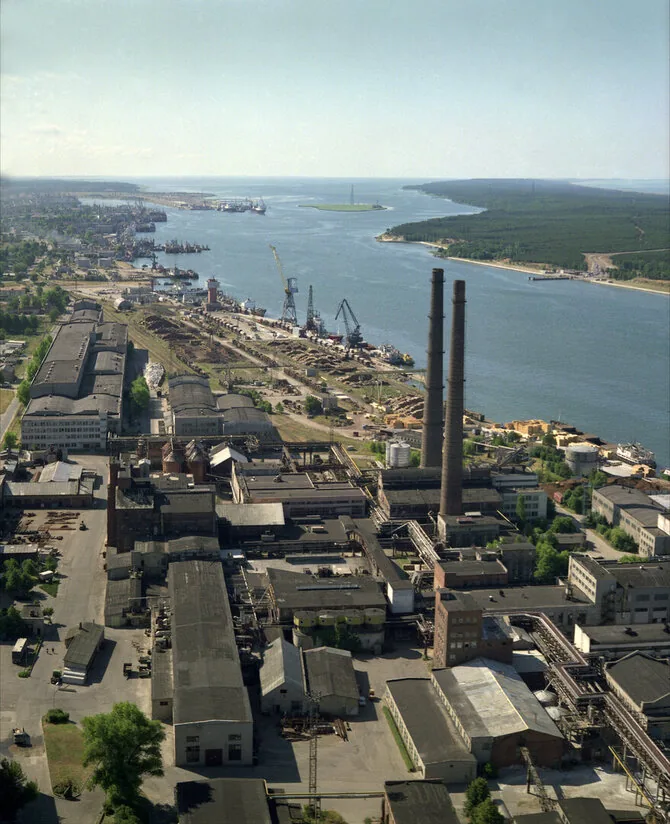
Over 35 years, the port’s relationship with the city has also changed. Some of the old industrial areas in the city center have opened up to the residents – the castle site, the cruise ship terminal area, former ship repair spaces have turned into new city attractions.
“Previously, residents practically had almost no access to the sea. Now the castle site has opened, the Cruise Ship Terminal, new spaces are developing in former industrial areas near the Dangė River and the sea. This is one of the biggest changes in the city landscape since World War II,” says V. Vareikis.
Importance will only grow
The transformation and progress of the Klaipėda port over 35 years have strengthened its importance to Lithuania, and historians are confident that the port’s role will grow even more in the future.
According to R. Adomavičius, alongside traditional cargo handling, energy, defense, tourism, and cruise shipping functions will become increasingly important.
According to the speaker, for a small country like Lithuania, having a strong maritime port means better connectivity with the world, greater trade opportunities, and stronger economic resilience.
“More and more, we see the advantages of having Klaipėda port. It is not just a transport route or logistics center – the port creates additional benefits for Lithuanian residents, businesses, and the entire region,” concludes Romualdas Adomavičius, historian at the Lithuanian Sea Museum.
Historians emphasize that over 35 years, Klaipėda port has transformed from a former fishing and trading port into a strategic support for independent Lithuania. It connects the economy, energy, defense, industry, city, and state with the world. In the eyes of historians, this is one of the most striking infrastructure changes in independent Lithuania – not only in Klaipėda but in the entire country’s history.