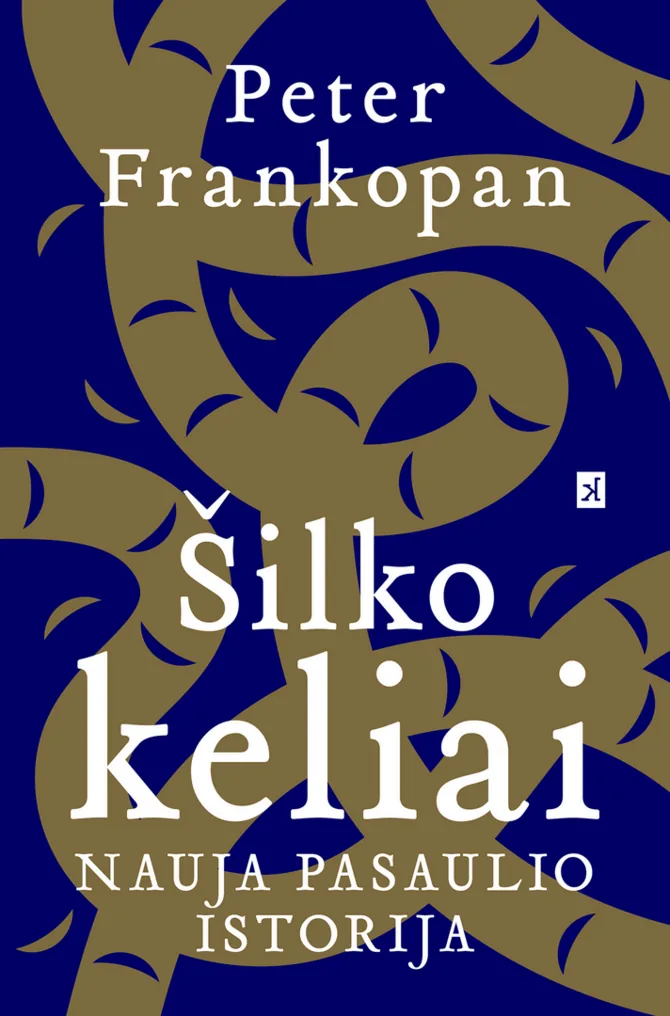
The historian also told us that he plans to visit Lithuania again this October – he will attend the literature festival “Open Books” in Vilnius. In an exclusive interview with the portal 15min, we talked with P. Frankopan about his book “The Silk Roads,” which was published in Lithuanian this year (published by “Kitos knygos,” translated by Tomas Marcinkevičius-Baronas), and about why the themes explored in it resonate more than ever today.
P. Frankopan is a professor of world history at the University of Oxford, heading the Oxford Centre for Byzantine Research. He is also the UNESCO Chair in Silk Roads Studies and a Bye-Fellow at King’s College, Cambridge. In his research, the renowned historian examines the history and politics of the Mediterranean region, Russia, the Middle East, Persia and Iran, Central Asia, China, and other regions.
– In your book, you systematically explore the origins of the Silk Roads, their development through different historical periods, and their long-term impact on world history. For example, in the concluding chapters – “The Road to Disaster” and “The Road to Tragedy” – you focus on the geopolitical realities of the late 20th and early 21st centuries. In your view, how does the historical legacy of the Silk Roads help us better understand today’s global tensions and power shifts?
– I think this question can be approached from three aspects. First, if we look at the world from London, Lithuania, or any other place, it is clear that the most important processes today are happening between Istanbul and the coast of China’s Pacific Ocean. This is where the greatest opportunities and the most serious challenges are concentrated. Of course, we should start with Russia’s war in Ukraine and its possible consequences – this directly affects Lithuania and other Baltic states. Also important are the processes in the Persian Gulf region, China’s rapid growth, the simmering tension between India and Pakistan, which could escalate at any time. Climate change, resource consumption, and fossil fuel extraction also contribute. So, although internal political changes in Europe are not insignificant, on a global scale they often pale compared to what is happening in Asia.
Second, looking at the United States as a global superpower, there is a long-term effort to manage or at least slow down the influence of rising Asian powers – primarily Russia and China. In recent years, the US has paid more attention to its immediate region: strengthening its position in the Western Hemisphere, pressuring Venezuela and Cuba, and signaling more clearly to Europe that it must take care of its own defense. Still, the main strategic question remains the same – how well the US will compete with China.
At the same time, we see growing ambitions of other regional states – Israel, Turkey, Iran, Saudi Arabia, Qatar, India, Pakistan. They actively seek greater influence, expand their roles, and often act disregarding established rules. Some even redefine their geopolitical identity. This shows an intense redistribution of power, and US efforts to manage these processes face increasing challenges.
Third, the very concept of the Silk Roads essentially speaks about connections. It is not a single place or civilization, but a network linking different regions, peoples, and economies. Trade, the spread of ideas, movement – all these shape the world. Today, we see this through control of strategic “choke points,” land and sea trade routes, energy and raw material chains. From an economic historian’s perspective, these patterns remain surprisingly consistent.
Perhaps in Europe over the past three decades, we have tended to think that the direction of history is already clear and that the most important thing is the spread of our values. But looking at the past, it is clear that states primarily focused on connections, resources, and trade routes. This also applies to Lithuanian history – expansion happened where economic and strategic opportunities opened up.
What does this say about the present? Although history is not an exact predictor of the future, it reminds us of essential things: energy, food and water resources, raw materials, power, and connections. Today we live in a highly competitive environment where states consistently pursue their interests, even if this conflicts with others’ expectations. Meanwhile, the West often expects others to follow the rules it sets. This tension shapes the complex picture of the modern world.
– Indeed. While reading your book, I kept thinking that to understand the current situation, it is necessary to look back at history. You analyze many past events, and they unexpectedly explain very clearly what is happening today.
– You know, I won’t argue – after all, I am a historian. But I also understand that history sometimes offers deceptive comfort: that all this has happened before, so now everything will somehow resolve itself.
I think Europe is not very good at looking at itself from the outside.
I think Europe is not very good at looking at itself from the outside. Structures like the European Union or NATO are undoubtedly important and useful – although, of course, there is always room for improvement. Still, they also act as mechanisms maintaining stability: like clubs aiming to preserve the existing order and change it as little as possible. The problem is that over the past three decades, the world has fundamentally changed. China’s economy has grown eighteenfold, and Russia after the collapse of the Soviet Union in some ways again resembles the previous system – for the older generation in Lithuania, this may seem uncomfortably familiar.
Putin’s Russia is a top-down governed, militarized state where decisions are made by a narrow, fairly homogeneous elite. Society is told that these decisions determine the country’s fate and survival. Therefore, the war in Ukraine is presented as a necessary, even defensive struggle on which Russia’s future depends – even if it means huge sacrifices. From Vilnius, Kyiv, or Paris, this may seem absurd, but from Russia’s perspective, it is completely logical. Here lies the true role of history – it helps understand the thinking of other states and societies. If we do not understand how and why others make decisions, it will be very difficult to respond appropriately.
Of course, history can also comfort – reminding us that there have been even harder times in the past. Even if today’s situation seems tense, the 20th century was much more dramatic for Lithuania: wars, occupations, repressions. Previous generations lived under incomparably more difficult conditions. This does not mean current challenges are insignificant, but we have the opportunity to learn from them. Therefore, history is valuable because it helps keep a clear mind – it does not allow panic just because some world leader wrote something on social media on a Monday morning.
History is valuable because it helps keep a clear mind – it does not allow panic just because some world leader wrote something on social media on a Monday morning.
– In your book, you use etymological analysis (for example, examining words like “slavic” or “ciao”) as a tool for interpretation. What cognitive value do language and etymology have in reconstructing historical connections and cultural contacts? Can language be considered a kind of “archive” where traces of global interactions remain?
– I have sort of two “roles.” As a professor, I could talk for hours about epistemology and linguistics – I find it truly interesting and important. But at the same time, I understand that this often becomes a kind of closed circle where very smart people analyze the roots of Indo-European or Sanskrit words, sometimes losing connection with what really matters.
Language is primarily a means of communication. And the most important thing is not just what a person said, but what they meant. The ability to accurately understand statements in different languages (I myself read sources in various languages) is not the biggest challenge. Much more important is understanding the intention, the direction of meaning.
Therefore, I am always interested in the origin of words – what, for example, “Lithuania” or “Russia” mean, where the roots of these names come from, or even a word like “ciao.” People rarely think about this, but its origins are linked to the Venetian phrase sciavo vostro – “I am your servant.” This clearly shows how language is rooted in historical social relations. Similarly, the word “slav” is historically associated with a linguistic group covering a large part of Eastern Europe – from Poles, Lithuanians, and Russians to Bulgarians. Such things allow a different perspective on European history and its interconnections.
Interestingly, everyone knows Napoleon, Johann Sebastian Bach, Leonardo da Vinci, or Karl Marx. But when asked about national poets in the Baltic countries, famous Bulgarian filmmakers, or key contemporary Greek thinkers, many are confused. Even in non-Slavic countries, it is clear that the map of cultural memory is very uneven. Therefore, it is important for me to return to the origins of words and historical connections, but not to overestimate them as all-encompassing answers. Understanding the roots of language helps navigate the world, but it is equally important to understand intention – what people really want to say.
– Analyzing cultural exchanges between Europe and Asia, you provide vivid examples of Western influence in Central Asia. How would you describe the nature of this influence – was it a form of cultural domination, or rather a mutual, dialogue-based exchange process?
– I am particularly interested in minorities – for example, Baltic languages and peoples, as well as communities like the Sogdians, Armenians, or Jews who lived in the Silk Road region. Such groups usually react very sensitively to changes around them. Therefore, I pay a lot of attention to people who are not completely peripheral but live in kind of “ecological zones” where different influences intersect. A similar situation exists in the Baltic states: here, much more effort is needed to preserve identity than, say, in England, which is separated from other countries by the sea. Living in a complex neighborhood, mutual exchanges become especially important.
Essentially, this is a question of whether it is possible to fairly determine the price of goods. Most people who come to a store do not steal – they ask how much the item costs. If the price is obviously too high, the buyer will look for an alternative or refuse to buy. So trade becomes an important mechanism allowing differences to be overcome and a common language to be found.
Historians often tend to explain this through power relations, religion, or complex structures, but for most people, the most important thing is everyday life – what happens in their immediate environment. Distant connections also matter because items brought from afar are rarer and more expensive, but they more often become symbolic objects. For example, if we visited your home in Lithuania, most items would be local and ordinary, but we would likely find one or two special items from travels – from Vietnam or India. Such items testify to experiences and created memories.
Therefore, the question of reciprocity is essential: what motivates people to trade and cooperate? An even more interesting question is when the desire arises not only to trade but to dominate, create monopolies, or even empires. When are fair exchanges no longer enough, and the desire to control appears? This is often related to diplomacy, marital ties, alliances, but even more often – to favorable circumstances. If a neighboring state weakens, experiences economic difficulties, or has weak leadership, there is an opportunity to act by force.
That is why empires often expand very rapidly. History shows many examples: states significantly expanded their territories in a relatively short time. Even a small island like Great Britain managed to create a global empire.
All this can also be understood as a kind of “operating model.” I am interested in how similar patterns manifest in the modern world – for example, how quickly large technology companies or state investment funds grow. Similar questions can be asked about why some countries, like Poland or Lithuania, have grown faster than much of Europe in recent decades. Such comparisons allow us to look at history and the present from a new, more interesting angle.
– You describe the Silk Roads as a space of intense religious competition and exchange, where different traditions not only competed but also borrowed from each other. You also emphasize how harmoniously they cooperated.
– Let’s look at the halo: if you draw a circle around a person’s head, anyone raised in the Christian tradition will see it as a sign of holiness. But this image originated from Buddhism, where the circle around the head signifies closeness to divinity. Similarly, the concept of the apocalypse – ideas of the end of the world, death, and the afterlife in Christianity, Judaism, and Islam are very close. This is probably because all religions seek to answer the same fundamental questions: why should we be good to others? Why do some people suffer poverty or misfortune, why do others die young though they were healthy? Why do natural disasters – floods or droughts destroying crops – occur?
Since the questions are similar, it is not surprising that similar answers are often found. Moreover, people constantly seek to understand how convincing and useful those explanations are. Therefore, religions not only compete with each other but also borrow each other’s ideas. For the same reason, impressive temples are built or grand religious symbols created – for example, in Afghanistan, at the crossroads of cultures, huge Buddha statues were carved to show the path to enlightenment and spiritual reward. Interestingly, Buddha himself is often depicted as an ascetic, emaciated figure – Buddhism emphasizes restraint and renunciation. But such a lifestyle model was not attractive to everyone. When, for example, Alexander the Great brought the Greek gods’ world, where Dionysus symbolized wine, festivities, and joy of life, this approach seemed more appealing to many. Therefore, Buddhism had to adapt and seek a response.
Thus, religions constantly change, borrow, and respond to their environment. However, they are often used by political forces to justify not always noble goals. Although religion is often blamed, in reality, this is often related to power – and criticizing power is much more difficult.
Although religion is often blamed, in reality, this is often related to power – and criticizing power is much more difficult.
Today, already in the post-Christian 21st-century world, individual freedom and choice are emphasized – this is especially evident in social media culture, for example, Instagram. Meanwhile, the idea of community experiences tension. If we return to the origins, the Greek word for church, “ecclesia,” meant community, fellowship, shared identity. Similarly, great historical states functioned – the Roman Empire after Constantine the Great, the British Empire, or the Polish-Lithuanian Commonwealth. In them, the most important thing was not language or origin but belonging to a broader political and religious community. These were like two “glues”: secular identity and religious unity. Therefore, religions can be an important key to understanding the past – if we only understand what they are and what role they play.
– As you mentioned, politicians very often use religion as a means of control.
– Recently, I studied the composition of Nazi Party members, Hitler’s rise, and his crimes – both in the Baltic countries and elsewhere. It is interesting that one of the strongest indicators predicting whether a person in the 1930s could join the Nazi Party was their origin from a non-religious, atheist family.
This can be indirectly seen, for example, from names: if a son is named Peter or John, it is likely the family has Christian roots. But if a name related to abstract concepts is chosen, such as “strength” or “power,” it may indicate a detachment from traditional religious culture and a tendency toward another ideology.
In such cases, there arises a need for a different kind of “faith” – an ideology that offers clear answers, a strong leader resembling a religious authority, and collective rituals: mass gatherings, uniforms, symbols like the swastika or eagles. National Socialism became such a substitute belief system for many – especially for those who no longer wanted to identify with Christianity.
Similar phenomena can be found elsewhere. Sometimes even modern movements acquire religious-like features. For example, in climate change activism, certain parallels can be seen: warnings about an impending catastrophe, a moral imperative to act, prominent symbolic leaders like Greta Thunberg. This does not mean it is religion in the literal sense, but it shows how similar patterns repeat. Another example is communism. Figures like Joseph Stalin or Vladimir Lenin were portrayed almost like saints: their images hung everywhere, they played a symbolic role similar to apostles or saints in religion.
All this shows that religions – in a broad sense – help people structure their understanding of the world, provide meaning, and unite communities. Therefore, stepping back and looking from the outside, their analysis can be very useful for understanding both the past and the present world.
– The last question about the Silk Roads – about slavery in Europe and Asia, because this is usually discussed much less. Most attention is focused on North America and the slavery system that existed there. It is interesting how the concept and evaluation of slavery changed in different regions, especially comparing North America, Europe, and Asia.
– Excellent question. From a historian’s perspective, it is often surprising how easily we ignore slavery where we tend to idealize the past. For example, Athens is considered the cradle of democracy and a model example – even today, our architecture, including in Vilnius, often draws on Greek temple forms. But we often omit that most inhabitants had no political rights and that the whole system was based on slavery.
Similarly, the Roman Empire is admired, although it was also a slave-owning society.
Similarly, the Roman Empire is admired, although it was also a slave-owning society. Meanwhile, in the case of the British Empire, racial differences were consciously exploited as justification for slavery and exploitation. In general, many empires operated similarly: they enslaved the “others” – culturally or externally foreign – and forced them to obey, whether prisoners of war or conquered peoples.
Even the word “slave” is linked to Slavic peoples. In the Middle Ages, the Catholic Church forbade enslaving Christians, so slaves were often those who had not yet accepted Christianity. From about the 8th–9th centuries, such groups were considered “legitimate prey.” Similar processes occurred in the Baltic region when the Teutonic Order established itself here – local inhabitants were considered inferior culturally and even “racially.” Such attitudes left long-term consequences.
It is important not to forget that slavery was not limited to Europe or North America. It existed in Africa and America even before Europeans arrived and continued afterward. All empires created hierarchies where some groups were elevated and others pushed down. Such structures were often based on racial or cultural differences, and their echoes are felt to this day. This is seen today, for example, in China’s policies toward Tibetans, Uighurs, or Mongols, emphasizing their “otherness,” and Russia’s complex handling of ethnic minorities in the Caucasus or Siberia. Such examples show that racial and cultural classifications have long been – and still are – important tools of power.
Looking at present-day Europe, migration, identity, and race issues are again at the center of public debates. In Western Europe – for example, the United Kingdom or Germany – there has long been an effort to integrate people of different origins, allowing them to maintain their identity. But in recent decades, these issues have become increasingly politicized, especially with the rise of radical political forces.
Therefore, topics of slavery, migration, race, and identity are not just questions of the past. They are complex and sensitive discussions related both to historical evaluation and to how we define society, belonging, and justice today.
– At the beginning of the conversation, you mentioned your latest book. It would be interesting if you briefly introduced its topic – I think readers in Lithuania will be especially pleased to learn that you write about the Baltic countries.
– Well, not only about the Baltic countries. Unfortunately, I do not speak Lithuanian – Baltic languages are still insurmountable for me, although I do not lose hope. My goal is to show that the less visible parts of Europe are essential to understanding not only European but also world history. Lithuania, its former state – the Polish-Lithuanian Commonwealth – and its historical role are among my research subjects. I am interested in why it was successful for so long, what ultimately caused its decline, and what parallels can be found in other parts of the world.
Currently, I try to look more broadly and not limit myself to traditional history – I study exchange networks in Eastern Europe and beyond during the Polish-Lithuanian Commonwealth period and compare them with other regions at the same time. I also consider the impact of climate change on these processes and especially the role of diseases like the Black Death, as their period coincides with critical moments in Lithuanian history.
At the moment, I feel like a fisherman in the middle of a lake, casting a wide net. But I am convinced that it is very important to illuminate those areas of history that often remain on the margins. It is impossible to understand European history without including the Baltic region – the Teutonic Order, the rise of Russia, the development of the Lithuanian state and its unions. Moreover, without these processes, it is difficult to understand the broader development of Europe. I believe that even the 20th and 21st centuries cannot be fully understood without including this history. For example, if Russia in the future again seeks to expand beyond Ukraine or its borders, it is important to understand where its conviction that it has the right to act in the Baltic region comes from – and hopefully, that will not happen.
I also work a lot with Scandinavian countries – Finland, Norway, Sweden – and think about the Baltic Sea as a connection between the Black Sea, the Mediterranean, and the wider world, not as Europe’s “periphery.” By the way, I am not the first to do this – there are many excellent Lithuanian scholars whose works I read (sometimes in translation or in Russian). So if I have nothing new to say, it is better not to write. My job is to try to bring new insights and present them interestingly.
But first, I need to “catch good fish” – good ideas. And in recent months, I have been somewhat distracted because I had to consult on various international issues, for example, regarding Iran. So if peace were to prevail in the world even briefly, it would be beneficial not only to everyone but also to me personally – I could finally calmly finish my book.
Read more Astrological forecast for June: for one Zodiac sign, feelings will overflow