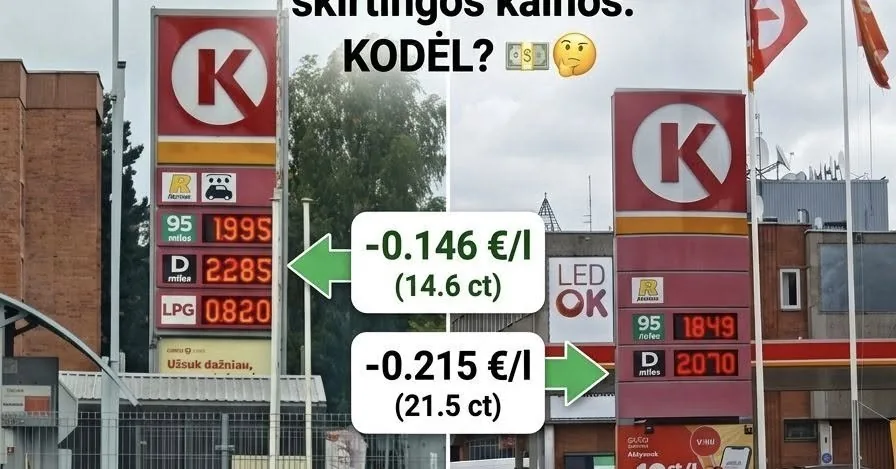









But that is not the only problem – refiner margins are also at a record high. This signals that the numbers on gas station boards will not please residents in the coming months.
Read more Coastal road raid: 52 offenders caught in one day
Refiner margins – at a record high
The final fuel price on gas station boards consists of several main components – crude oil, refiner margins, and taxes. The price of crude oil per barrel (which is almost 160 liters) is currently about 108 US dollars – about 80% higher than at the beginning of this year.
And although when talking about fuel prices we usually talk about changes in crude oil prices – this is not the only factor that determines the final prices for consumers. Crude oil is a dark and viscous mass that first needs to be processed into a much clearer liquid – diesel or gasoline – to be usable.
Refining margins, which show the difference between the wholesale price of produced fuels and the price of crude oil, have more than doubled since the beginning of the year and in recent months have reached the highest level in history.
Margins can change due to changing refining processes, the type of crude oil used, supply and demand changes. This time the main factor was the reduced supply of oil products. On the one hand, supply chains and oil product flows were disrupted by the closed Strait of Hormuz and reduced refining volumes in Persian Gulf countries due to damaged infrastructure.
On the other hand – successful attacks by Ukrainian fighters also disconnected a large part of Russia’s refining capacity. Just a few days ago, D. Trump stated that he has only one request for V. Zelensky – to stop disconnecting Russia’s oil refining capacities.
The US president also proposed that both countries agree on a ceasefire that would include energy infrastructure facilities. However, it does not seem that these attacks will end soon. Meanwhile, Russia, itself facing a shortage of oil products, recently introduced a diesel export ban.
Due to increased refiner margins, this year we have had situations where the crude oil price on the market fell, but the final price on gas station boards did not change or even increased. The European Central Bank calculates that the increase in fuel prices in recent months was mostly due to refiner margins, not crude oil.
Are fuel prices rising faster than they fall?
Drivers often claim to notice that if the oil price rises, the numbers on gas station boards also rise rapidly. On the other hand, if prices fall – the effect on prices is much slower. In fact, this phenomenon even has a separate name: the “rocket and feather” effect. Prices shoot up like rockets, but fall like feathers.
Some studies show that price decreases may indeed reach consumers more slowly. This may be related to delays in restocking, uncertainty about how long lower crude oil prices will last, or weaker competitive pressure when crude oil and refiner margins decrease. It should not be forgotten that consumers also tend to show asymmetry in price changes: we tend to notice and remember price increases much more than price stability or decreases.
Still, when trying to assess whether fuel prices rise faster than they fall, it is not enough to look only at the crude oil price – the final fuel price is currently greatly influenced by refining margins, stock changes, and other factors.
Less and less optimism
In recent weeks, optimism about a peace agreement between Iran and the US has decreased. The Strait of Hormuz remains closed (although some ships still travel through it with GPS signals turned off or with US Navy escort), and due to repeated attacks, Saudi Arabia has also stopped oil supply through pipelines to ports on the Red Sea.
Moreover, as countries’ oil reserves dwindle, and Iran likely aims to maintain pressure on the US until the midterm elections in November, the energy crisis is deepening. Futures contracts show that crude oil prices will remain above 90 dollars per barrel until the end of the year.
This signals that expecting fuel prices to fall this year would be optimistic, and further increases realistic. However, rising fuel prices have not yet affected the optimism of Lithuanian residents – we see that growing purchasing power allows residents not to change consumption habits, and the amount of fuel sold at gas stations has not decreased.
Moreover, so far the increase in fuel prices has remained concentrated and has not spread to other goods and services. However, as global oil reserves decrease and the situation in the Middle East does not improve, pressure on prices may increase.
Read more In the anniversary season of the Klaipėda State Musical Theatre – intriguing premieres