







How much do fuels really cost and why can you buy it much cheaper in one part of Klaipėda than in another?
Read more VTEK requests additional information regarding possible violations at Raudondvaris Manor
This question arose again in the group “What’s happening in Klaipėda?” after a Klaipėda resident shared a photo of prices at two “Circle K” gas stations.
And the difference is indeed impressive.
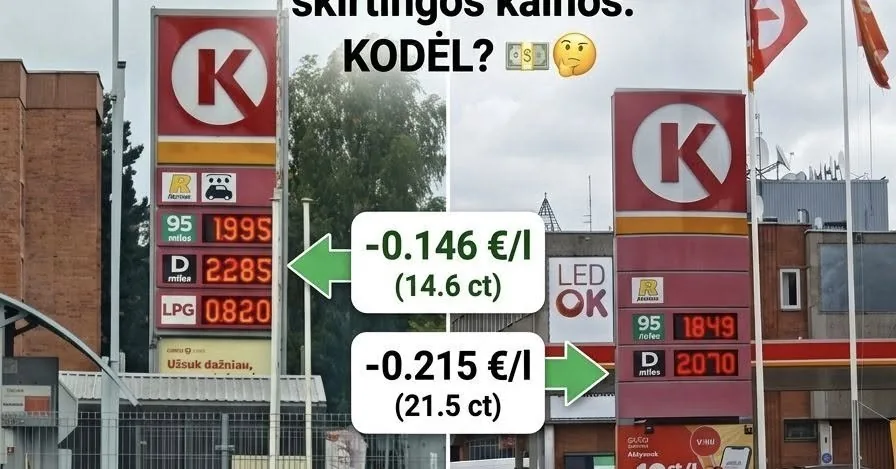
On September 14th, in Southern Klaipėda, a liter of A95 gasoline cost 1.995 euros, while in the Northern part it was 1.849 euros. That means for the same “Circle K” network product, one part of the city was charging 14.6 cents more.
With diesel, the “gap” was even wider. In the southern part of the city, a liter cost 2.285 euros, in the northern part – 2.070 euros. The difference was as much as 21.5 cents per liter.
Simply put, filling 50 liters of diesel at the more expensive gas station could cost the driver 10.75 euros more.
The same network – different math
Reactions from Klaipėda residents to such price differences were varied.
Some say this situation is a completely normal part of a market economy. Others wonder why prices at gas stations of the same network can differ so much on the same day. In social media discussions, it was noted that a 10–15 cent difference between gas stations of the same network on the same day no longer surprises anyone.
Klaipėda residents also shared other examples. One resident noticed that prices at “Neste” gas stations can change several times a day. Another pointed out that the price at the “Baltic Petroleum” gas station at the intersection of Šilutės highway and Tilžės street is often lower than at the same company’s gas station at the end of Tilžės street, near the Jakai roundabout.
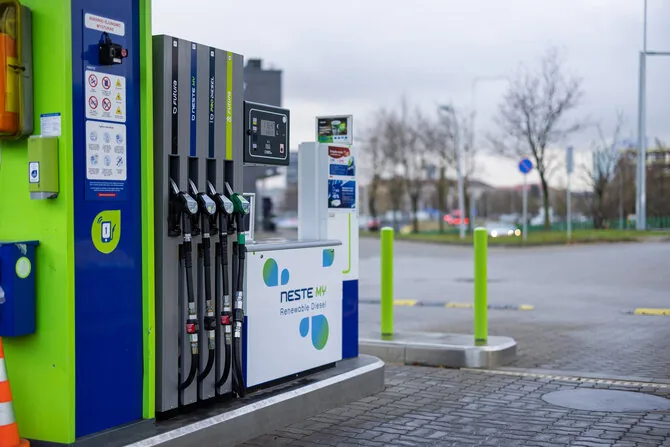
Another Klaipėda resident shared an example of “Neste” prices on September 14th: at one end of the city, a liter was 2.045 euros, at the other – 2.145 euros.
So, a driver needs to know not only which network has cheaper fuel but sometimes also which specific gas station in that network is worth filling up at.
What do wholesale prices show?
The most interesting part of this story is to look at what was happening in the wholesale market at the same time.
“ORLEN Lietuva” published prices for one-time transactions on September 14th. These prices were valid from 9 a.m. until 9 a.m. the next working day.
The price of A95 gasoline at the “ORLEN Lietuva” terminal in Juodeikiai, Mažeikiai district, including excise and VAT, was 1.79 euros per liter. Diesel was 2.13 euros per liter.
And here it really looks interesting.
On the same day, at the “Circle K” gas station in Northern Klaipėda, A95 cost 1.849 euros. That is only about 6.1 cents more than the “ORLEN Lietuva” one-time transaction price with VAT.
But with diesel, the situation is even more interesting: in Northern Klaipėda it cost 2.07 euros (if the photo was indeed taken on September 14th), although the “ORLEN Lietuva” one-time transaction protocol listed the price with VAT as 2.13 euros.
That means the retail price was even 6 cents lower than the publicly announced one-time transaction price with VAT.
Does this mean the gas station was selling fuel at a loss?
Not necessarily. And this is exactly where it is worth delving into the fuel pricing process.
The public wholesale price is not necessarily the price the gas station pays
“ORLEN Lietuva” itself states that the prices published on its website apply to one-time transactions. The company also states that for customers with valid purchase-sale contracts, prices are provided directly and may be set according to contractual terms.
Read more Where in Lithuania will another 500 km of new pedestrian and bicycle paths appear?
Therefore, the publicly visible wholesale price is not automatically the price paid per liter by a specific gas station network.
Large operators buy fuel in large quantities, have long-term contracts, receive commercial discounts, and their final cost may also depend on when a specific batch of fuel was purchased.
Moreover, gas stations have more than one way to attract customers.
One gas station can be used as a price magnet, another to maintain a higher margin where competition is lower, customer flow is more stable, or drivers are less likely to drive elsewhere for a few cents.
Why do prices change several times a day?
Fuel pricing is not frozen.
Prices can be influenced by changes in the wholesale market, competitors’ prices, and the sales results of a specific gas station.
Therefore, the observation by Klaipėda residents that prices at some gas stations change several times a day is not so strange. On social media, one resident joked that prices at the “Neste” gas station he watches change at least three times a day, although he has never seen a car fill up three times in one day.
This is essentially the essence of modern gas station pricing – the price is adjusted not only to the cost of fuel but also to location, competition, and consumer behavior.
We pay for location just as much as for fuel
Why does a driver agree to pay more in one part of the city?
The answer is simple – not all customers will drive to the other side of the city for a 10-cent difference.
If a person is running low on fuel, rushing to work, or driving on the highway, a detour of several kilometers can be more expensive than the possible savings.
And gas station operators know this.
Therefore, the same brand can compete on price in one location and exploit a convenient location more in another.
This is not an exclusively Klaipėda phenomenon. In social media discussions, Klaipėda residents shared similar examples from other cities and towns, also noting that prices at different gas stations of the same company can differ by several or even a dozen cents.
The driver is left to be a price detective
So the fuel price frenzy has a fairly rational explanation.
Prices at gas stations are not determined solely by how much oil cost that morning or how much the product costs at the factory. The final price is formed by a whole range of circumstances – supply contracts, fuel stocks, competition, the turnover of a specific gas station, location, promotions, discount programs, and customer behavior.
It is also important to note that gas stations often apply special discounts on weekends and holidays. On non-working days, business customers with regular contracts and larger discounts visit gas stations less often. Therefore, this aims to compete more for private customers.
Also, differences are very noticeable in the morning and especially on Monday, when weekend discounts end and new wholesale prices for that day become clear. Drivers sometimes experience price changes at the gas station while filling up the tank.
In any case, each time you need to calculate whether to hunt for cheaper fuel across the city or if your time is more valuable and you don’t need to pay attention to changing prices.
Read more Key facts: Chronology of the drone shot down in Lithuania