






The seaside “Jūratė” arrives much larger and more monumental than the one presented in the capital. A new edition of the score was specially created for the “Jūra” hall space, which will be performed by the KVMT symphony orchestra and the theater choir. The larger musical ensemble will allow the sound of the piece to unfold differently, and the hall itself will become a new space for the legendary amber palace story.
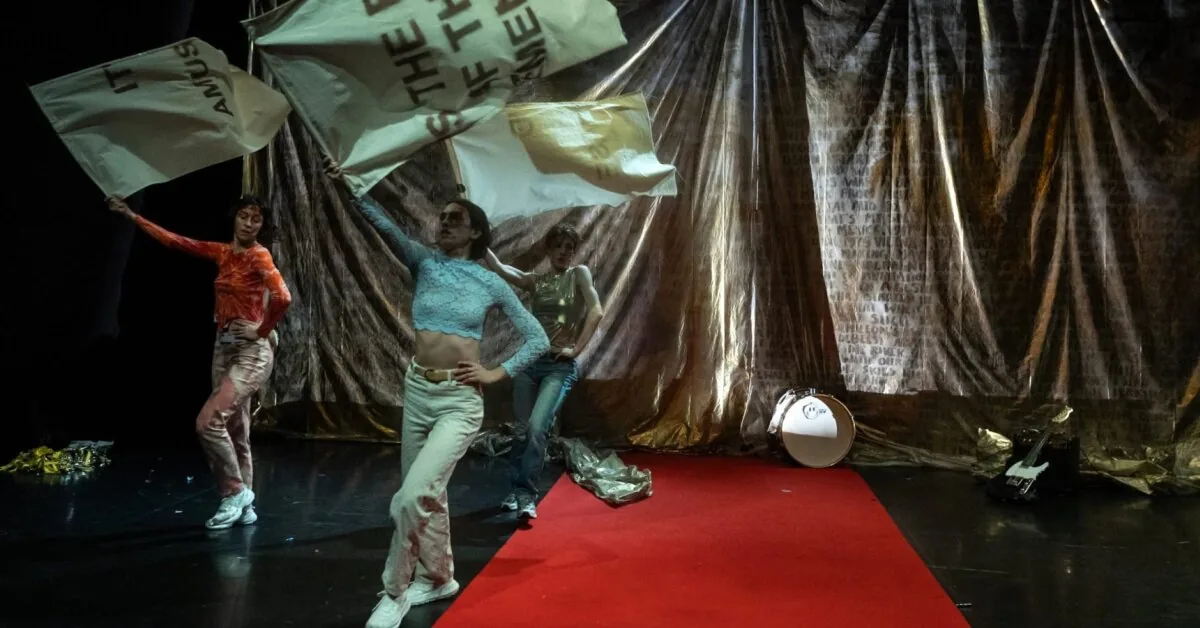
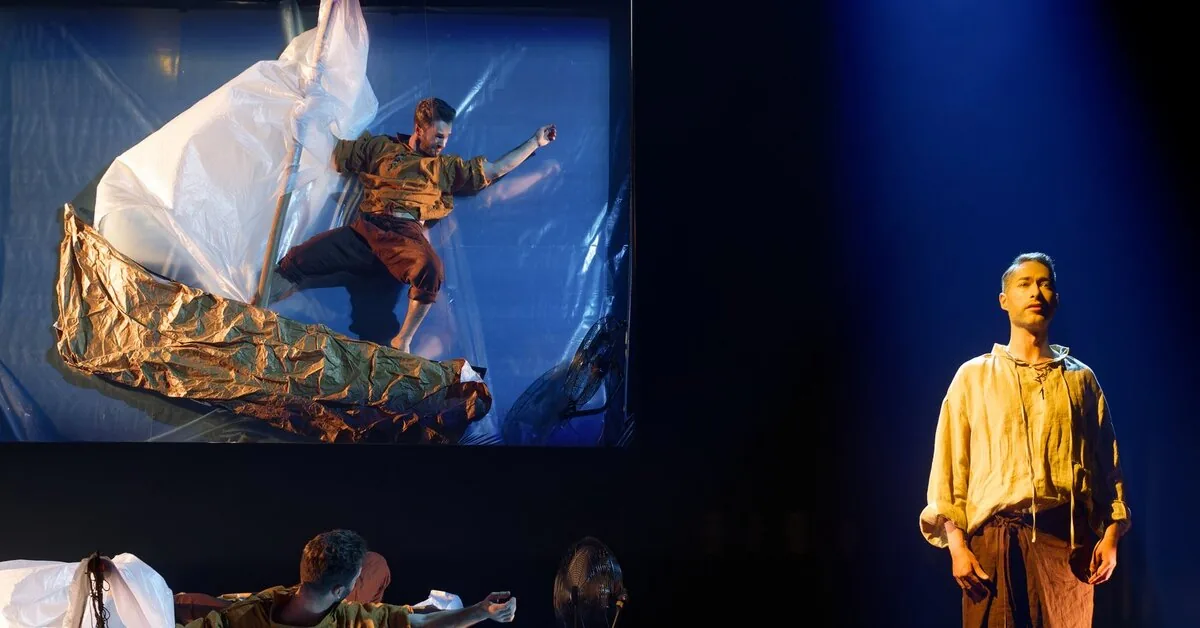
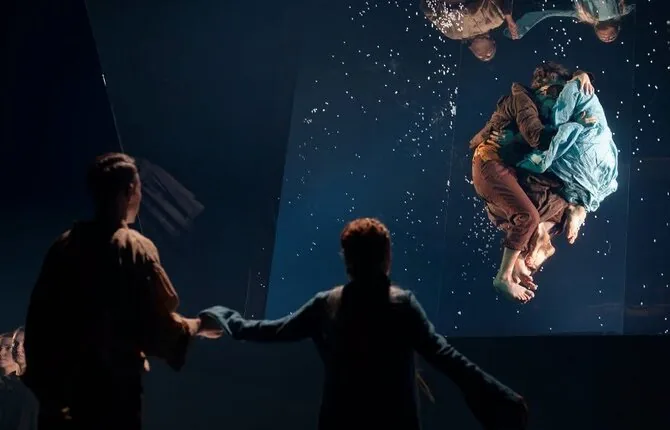
The visual aspect of the performance is no less important. A huge mirror construction created by scenographer Renata Valčik, hanging above the stage, reflects the movements of the soloists and the dancers doubling them, creating the impression that the characters are walking on the undulating surface of the sea. The actors-dancers Telman Ragimov and Sigita Mikalauskaitė, who embodied the couple Konstantinas and Sofija Čiurlionis, won the “Golden Stage Cross” for these roles.
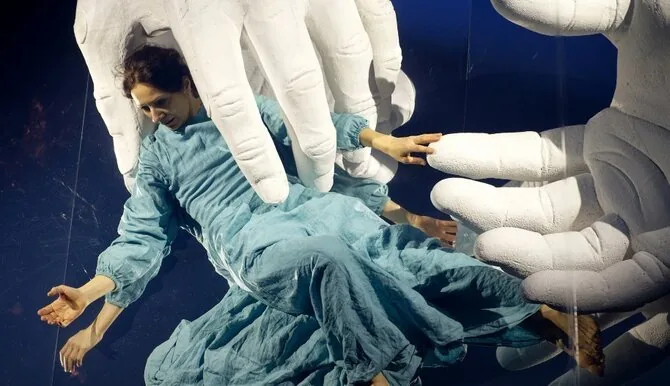
In the performance, Jūratė is created by soprano Lauryna Bendžiūnaitė, Kastytis by baritone Romanas Kudriašovas, Perkūnas by bass Raimundas Juzuitis, and together with Telman Ragimov and Sigita Mikalauskaitė, Viktorija Aliukonė-Mirošnikova, Nikolaj Antonov, Jauhenas Bakala, and Gina Busko appear on stage.
How will this “Jūratė” differ from the previous version of the performance? How will the larger orchestra change its sound, and what does artificial intelligence really do in this piece? We talked about the new version of the performance with conductor Karolis Variakojis and director Gintarė Radvilavičiūtė.
“Jūratė” will sound different in Klaipėda
According to conductor Karolis Variakojis, the main distinction of “Jūratė” shown in Klaipėda is its sound. In Vilnius, the performance was played with a small, chamber orchestra, while in Klaipėda the music was entrusted to a much larger orchestra. “In Vilnius, a very small, chamber orchestra played, so the musical material was quite restrained, intense, but did not unfold as it could. In Klaipėda, the main distinction will be precisely the orchestra’s sound. It should be much bigger, richer, fuller,” says K. Variakojis.
The larger orchestra allows the music to unfold more multilayeredly. There are more strings, timpani, more opportunities to highlight different musical voices. The large choir of the Klaipėda State Musical Theater also joins the orchestra. “I think this music presents itself much more organically in a larger orchestra mass. I still can’t fully say how everything will sound in the ‘Jūra’ hall because I haven’t played there with this program yet. But I am very much looking forward to it,” says the conductor.
A new edition of the score was also prepared for the Klaipėda version of “Jūratė.” According to the conductor, the larger hall and greater theater forces allowed not only to expand the orchestra but also to give the music more space. Therefore, this will not be just the same performance transferred from one stage to another – its musical form in Klaipėda will be different.
Like two love stories
The creative process of “Jūratė,” according to director Gintarė Radvilavičiūtė, is an attempt with today’s means to approach an unfulfilled idea from more than a century ago. Although it will never be possible to know exactly how Čiurlionis’s opera would have sounded and looked, the creators value the journey itself – how a new stage work is born from surviving letters, memories, musical fragments, and the imagination of today’s creators.
“Of course, we only fantasize, we will never know what the opera could have been. What it would have been like. How it sounded, how it looked. But I had the opportunity to observe inspired creators in the creative process and see how the work is born, how it sounds live for the first time, how it merges, grows, changes, is surrounded by sounds, words, meanings. How a huge complex organism begins to breathe,” says G. Radvilavičiūtė.
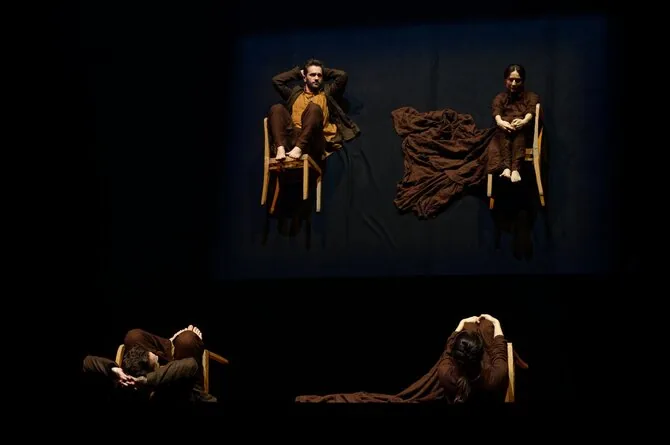
The director tells of discovering a beautiful love story: “M. K. Čiurlionis’s letters to Sofija inspired me a lot… A letter is like a journey to each other. It is a path between people that shows an undying, indestructible connection. It is walking, stopping, touching, hugging, and much more. How many meanings, feelings are there. It is probably the most intimate touch to the bond born between two people. The story of Jūratė is intertwined with their personal life.”
Read more North Korean leader’s sister criticizes US drills, threatens even more aggressive response
G. Radvilavičiūtė raises questions: “Two people lived in a world of ideas having nothing, but how does a modern person not lose the idea having everything? Is the love story of two people still a value? Is love eternal? Here parallels connect between Jūratė – Kastytis and two people just starting life, Sofija – Kostukas. ‘…Because although we will die, our bodies tired – we will meet in other lands, and so always You and I, because we are Eternity and Infinity. Remember? It was a long time ago and probably, we have changed our form more than once, only memory fades and special moments are needed to remember…’ ‘Yes, I am filled with your letter of today and “Jūratė” for life – and I feel so much energy and faith in myself that I will overcome the task that I even dare to write to you about it.’ (from Čiurlionis’s letters to Sofija).”
Čiurlionis’s idea and today’s technologies
“Jūratė” brings together two very different times – Čiurlionis’s idea and today’s technologies. Artificial intelligence was used to create and generate motifs of musical material, but the final work was shaped by people.
“Artificial intelligence was used here as a tool to generate motifs of musical material. That material was later developed by Mykolas Natalevičius and Mantautas Krukauskas, and Arvydas Malcys orchestrated it. Each composer had their mission,” says K. Variakojis.
Therefore, in his opinion, this performance should not be viewed as an “opera created by artificial intelligence.” Technology here rather became another tool in the creative process. “Many people are quite skeptical about any developments related to artificial intelligence. But here it did not write the music – everything was controlled by people. For me, it is a very interesting environment, one of the first attempts to see how it can participate in the creative process,” says the conductor.
However, the creators value not only the idea of the unfulfilled opera but also the person who once conceived it. G. Radvilavičiūtė says that delving into Čiurlionis’s letters, memories, and other texts, she was increasingly amazed by his personality – a sensitive, intellectual, very deep, and extraordinarily hardworking person. “Čiurlionis really lived in another world. A world where love and friendship reign and something else important without which one cannot live,” says the director. “I think that every time this work is performed, it sounds different. It depends on the day, the sun, the person’s mood, professionalism, and many other details.”
Why is this opera important?
Speaking about the idea itself, K. Variakojis emphasizes that for Čiurlionis, opera was not just another genre. At the beginning of the 20th century, it was closely related to the creation of national identity. “Čiurlionis dreamed of creating an opera and wrote a lot about it in letters. The libretto was already there, and there were musical ideas. I think that in his imagination, Lithuanian-ness meant a lot for the opera. He saw opera as a symbol of national identity,” says the conductor.
Today, according to the conductor, this idea also remains relevant. “Talking about Lithuanian identity today is simply necessary, and we should definitely continue to do so. Opera is one of the forms,” says K. Variakojis. And he wishes the audience to come to the performance with curiosity and without prejudice: “To see how new technologies together with Lithuanian-ness, people, and music can work as a whole.”
According to G. Radvilavičiūtė, M. K. Čiurlionis was a true creator who brought inspiration to people. “His personality, his work encourages us to fundamentally think about many fundamental values… When M. K. Čiurlionis lived, he had nothing and worked tirelessly without sparing himself… Now we have everything, all possibilities, each other… How not to lose inspiration. To strive, work, seek that true source of inspiration. The touch to the work touches the creators, performers, and I believe it will touch the audience as well. These are our roots, fundamental creative guides that nurture us creators, as well as every person nearby.”