Arriving at the center of Ramygala city (not a town – as the locals corrected us!), you are greeted by a somewhat unexpected bustle – around the church, a few shops, the former cinema, which now houses a hardware store, people stroll throughout the city square. Friday is market day.
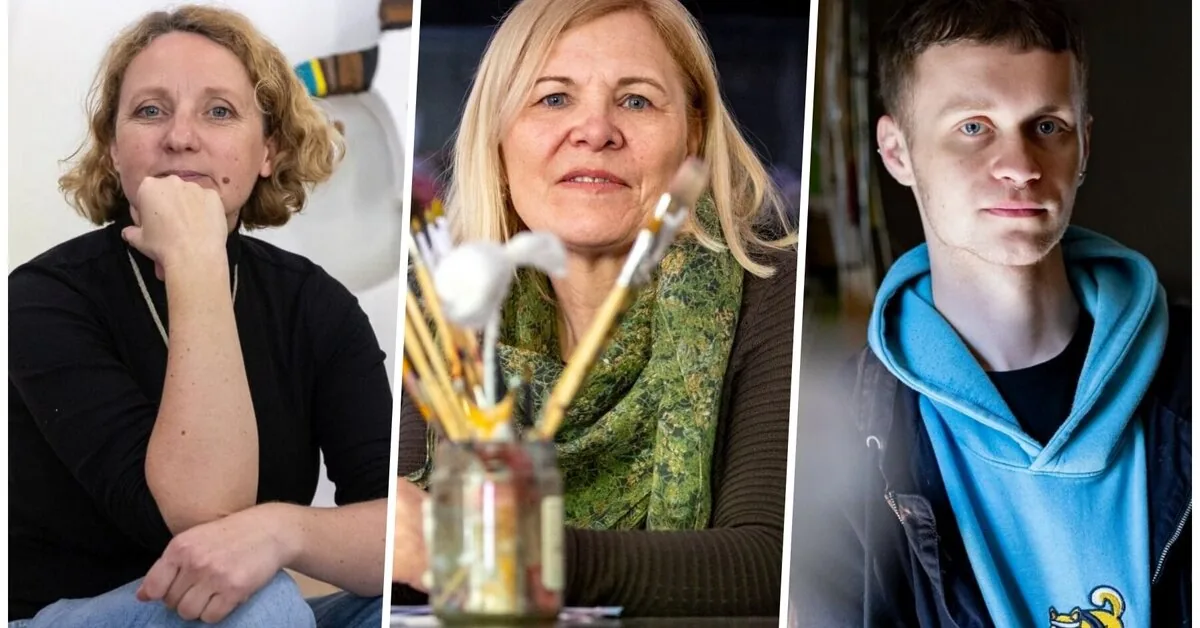
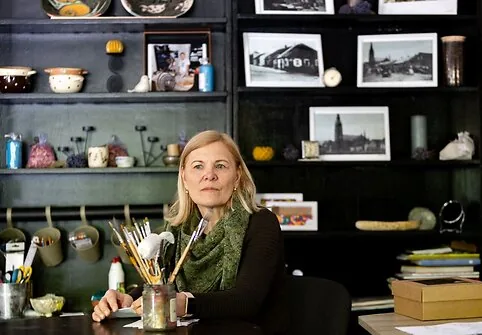
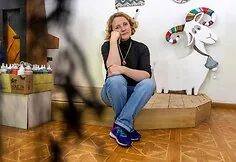
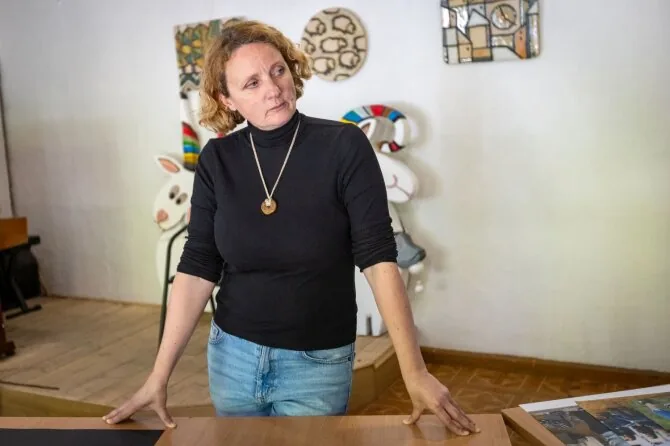
In the S. Šlevaitė educational space located in the center, which belongs to the Ramygala Cultural Center, we are also greeted by two other city cultural workers: Marytė Čeponienė, who has worked at the Ramygala library for 45 years (by the way – awarded “Librarian of the Year” in 2019), and 21-year-old Šarūnas Liepa, who started working at the Ramygala Youth Center a year ago.
This conversation is a way to understand how culture is created by the community of a small city (Ramygala now counts 1,147 inhabitants). During the conversation, it becomes clear that the most important thing here is initiative and knowing what kind of community each person would like.
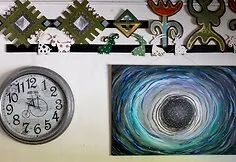
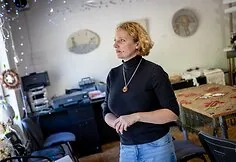
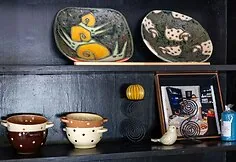
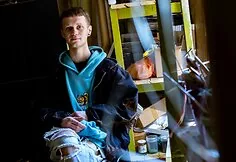

– Tell us about your daily work routine?
Marytė Čeponienė: The library in Ramygala is a cultural, scientific, and leisure institution. Most activities are related to literature: educational events, exhibitions, presentations of new books. The library also hosts computer literacy training, Safer Internet Week. We also do local history work – collecting material about notable city people, studying history. Local history work is inseparable from the library’s activities and culture in general.
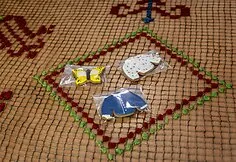
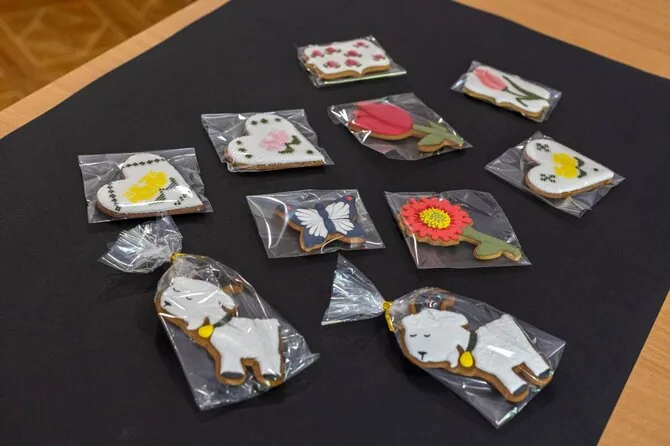
Since 2016, informal education has been conducted under the program “Ethno Afternoon.” In this program, children learn about traditions and customs, trying to learn as much as possible about ethnoculture – starting with Christmas traditions (for example, making lanterns or Christmas bouquets) and ending with decorating eggs in various ways. We try to involve even the youngest – from kindergarten.
It is important that education not only happens by learning how to make something but also through discussion. For example, when making gifts for Mother’s Day (this year we planted flowers), we also talk about the relationship with mom. Such diverse activities take place 8 hours a month, every Wednesday – two hours each.
– Are these activities only for Ramygala children, or can children from nearby towns and villages also attend?
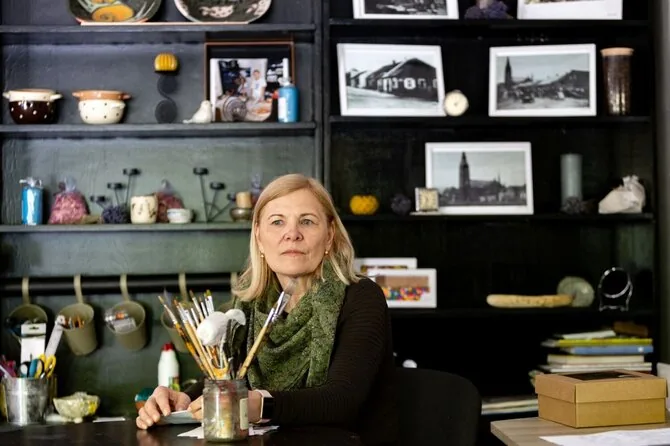
Stanislava Šlevaitė: Although informal education activities are intended for all children, mostly locals attend because it is difficult to coordinate otherwise – the activities take place in the evenings, so it must be convenient for children to return home. Especially in winter.
However, one girl who attended the activities moved with her parents to a village near Panevėžys but still attends.
M. Čeponienė: There are many ways for children to spend time in Ramygala. For example, Stanislava has two children’s groups, and the library has one. Maybe we could be considered some kind of competitors (smiles). There are also various sports activities, such as football.
S. Šlevaitė: Thanks to the Cultural Center, cultural and educational activities in Ramygala are dedicated to various age groups. The Third Age University activities are also organized, aimed at older people. Seniors travel together and engage in various activities. I recently heard they visited the “Lost Shtetl” museum (The Third Age University activities are supervised by Loreta Kubiliūnienė, former head of the Ramygala Cultural Center – 15min).
Another important group is youth, whose activities are managed by the Youth Center established ten years ago (The Youth Center is located on the second floor of the Cultural Center, and it has both board and computer games, musical instruments, and a place to spend time in this space – 15min). Youth are from 14 to 21 years old. We should not forget the school (Ramygala Gymnasium has 366 students in the 2025–2026 academic year – 15min) – there are also various activities for children and youth, for example, robotics is taught.
Returning to the very youngest – Ramygala also has a singing studio for children of various ages.
As for me, I am engaged in informal art education, as mentioned, I have two groups – one slightly younger, up to fifth grade, and the other a bit older. With the older ones, we focus on art as therapy. So far, there is no shortage of children (smiles).
With adults, I mostly do ceramics. Recently, I was encouraged to try leading art classes for adults, focusing on drawing and painting. I have been based in this space for about a year, so expansion of activities is possible.
I noticed that children like it here – they can put down their backpacks, eat food they brought. As they say themselves: “This is a good vibe.” Even outside of club time, children engage in something, communicate about their own matters. They just hang out with their “crew.” I think they are looking for an informal space where they can gather, be, and socialize.
In Ramygala, the community is divided – they participate in activities that are more acceptable to them.
– As I understand, a reorganization recently took place in Ramygala – the Panevėžys district municipality decided to start implementing centralization and optimization processes. How do you view this?
S. Šlevaitė: Yes, it is likely that we will become a branch of the Panevėžys district cultural center. But now we cannot answer anything – we are waiting.
I believe that if any reorganizations are made, it is thought that it would be better for us: both in Lithuania and locally. It is probably very difficult to say the results in a few days. We should wait and see the results after a couple of years.
– At the beginning of the conversation, you also mentioned that a new Ramygala community was recently established. What do you mean by “new”?
S. Šlevaitė: It was established only this year. The old community is already a bit “worn out,” though it did a lot of work and meaningful activities for the city in its time.
M. Čeponienė: The first community was established about 23 years ago. My colleague at the library was the chairperson, so much of the activity was related to publishing and local history. Now, the first community’s activities are not so many – during Mykolinės (St. Michael’s Day) there is a celebration where pancakes are usually baked, although it has changed over many years.
– The heart of smaller towns and villages is the communities that want to do something together. We recently visited Leipalingis, where the driving force of many activities is also the community and its chairperson.
Read more Medvedevas threatens: shut the straw!
S. Šlevaitė: Yes, indeed. The first community, as mentioned, is now somewhat less active, and the Cultural Center has long been a very active participant in the community and responded to many residents’ needs. The new community probably formed due to a new need. It is best when the initiative comes from the people themselves, from their needs.
I often ask myself why I do this job. One reason is that I can notice and help people who are a bit shy to express themselves. Since I graduated in pedagogy, I really enjoy working with children and youth. If we said and showed nothing in this area, a new attitude towards art, beauty, and aesthetics would not arise. We ourselves have to raise children: from a young age, little by little. Even when children may not be very interested or like what we show, it does not mean the seed is not sown and that it will not bear fruit later.
The more informal education and community activities – whether in a town, village, or city – the more our shared culture is nurtured. By the way, it is also important that children attend the clubs that suit them best and are most beneficial. We share children; we do not appropriate them – if a child will need robotics more in the future, I encourage them to go there. We are not financially dependent on the number of children.
– Šarūnas, you are a young person and have been working at the Ramygala Youth Center for a year – what does the Youth Center do and what attracted you to this work?
Š. Liepa: The Youth Center has various activities – from board games to event organization. One very successful project is the “Talent Ring.” Not only Ramygala youth participate, but others come from afar to perform. A big upcoming event is the 10th anniversary of the Youth Center, which we are preparing for.
The goal of such centers is to work with young people, not children, especially when they go through adolescence and face many different questions. We also want to empower young people. We accept young volunteers who, after volunteering at the Youth Center, can receive extra points when applying to university.
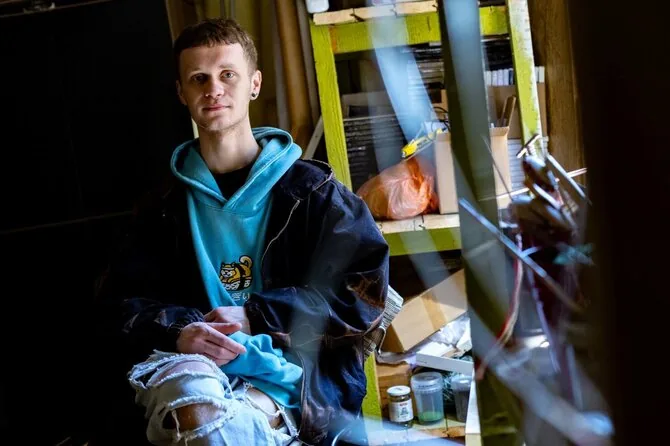
I am from Panevėžys and commute to work from there. Together with one colleague, we come from there. It is more convenient for us because we work with youth on a mobile work principle, i.e., we go to other towns or villages three times a week: on Mondays to Krekenava, Tuesdays to Ėriškiai, and Thursdays to Geležiai.
The essence of mobile work is to come where there is no youth infrastructure. For example, Geležiai is a rather remote town on the other side of the Panevėžys district, and a young person has little choice: church, store, cultural center.
It is important to say that we differ somewhat from clubs and informal education because participation in Youth Center activities is voluntary. It is not necessary to come. If a young person does not feel well and does not want to go out at all, we do not force it or say it is necessary. In my opinion, this is important at this age, and sometimes free choice attracts. Sometimes they just come to “hang out” and chat.
But if there is a desire, one can participate in some events. For example, when there is an activity at the cultural house in Geležiai, we try to coordinate with a colleague to participate and involve youth in various celebrations. In remote places, there is really an impression from the youth’s side that activities at the cultural center are only for older people.
– What do you do with young people – both at the Ramygala Youth Center and mobile centers?
Š. Liepa: Various things – some days only come to chat, sometimes we play board games, organize events – for example, the “Talent Ring,” camps, in summer there is a youth festival in Ukmergė district, so we go there. Sometimes there are hikes – last year, for example, we hiked with Krekenava youth in the regional park.
We try to do what young people themselves want. Every time we ask and request that they tell us what they would like to do next time when we come. We also encourage young people’s initiatives: for example, last week in Geležiai, a young man decided to spend time decorating a deposit box.
– Šarūnas, you are 21. There is a fairly small age difference between you and the young people you work with. Does this affect your work?
Š. Liepa: There are both advantages and disadvantages. A positive thing: it is easier to establish contact and find a common connection. Of course, there are challenges: young people often see me as a peer, not as an employee, but everything can be solved with a simple conversation. Young people understand very well if you speak sincerely with them. Everyone who attends the Youth Center understands that I am an employee and not a “friend” from the neighboring house, so mutual respect arises.
– What advantages do you see living and working in a small city or town?
S. Šlevaitė: Although it was not an advantage before that neighbors know a lot about each other, over time I began to appreciate it. It is much safer to live in such a city when neighbors are close people. It is much faster to find out if something happens, and you can trust each other more. Even if you buy flowers for someone’s birthday, you can ask in the store if someone else bought similar ones so as not to repeat, and the seller knows what flowers the birthday person likes.
My daughter graduated from Ramygala Gymnasium and she herself did not want to go to Panevėžys. I knew all her friends, their families, I knew where they went and what they did. All the mothers knew everything. And we were calm about that. For example, my father always chooses the store where people talk to him more pleasantly when going shopping. He not only buys bread but also wants to talk. Also – if you need a service, you will always get a recommendation.
M. Čeponienė: I think I would agree with many that communication in a small city is somewhat closer and more familiar. Even if they come to the library for books, I know a lot about those people. These people are not strangers; you rarely do not know someone.
– And how do you, Šarūnas, see the Ramygala community and its life rhythm from the outside?
Š. Liepa: It feels that the community is close. And I am not talking about the “official” community as an organization, but the people, the Ramygala residents.
For now, I would not choose to live in a smaller settlement; I like a bigger city, its hustle and bustle, more personal privacy. But it is nice to see that here people act as a fist, no matter what happens – whether misfortune or celebration.
In 2026, the project “The Invisible Side of Culture” received partial funding of 25,000 euros from the Media Support Fund.