Perfect timing traps
The arguments are usually the same: next year some models may travel further, some of their prices may decrease, and technology will continue to improve. However, neither a longer range nor a lower price is guaranteed. If you are waiting for the final version of the electric car, you are waiting for something that does not exist – the same applies to the final version of a phone or computer.
I know this behavior closely from banking. Some clients keep money in an account for years, waiting for a correction that will allow them to buy cheaper. Sometimes the correction comes, sometimes it doesn’t, and the missed return can only be assessed by comparing the result with the chosen market index. In the context of long-term investing, the often repeated rule is that it is more important to stay in the market for a long time than to try to accurately predict short-term fluctuations. In the case of buying a car, this is just an analogy: the cost of waiting for a car must be calculated separately.

The cost of waiting in the car market can also be roughly estimated in euros, but the result depends on the assumptions made.
Let’s calculate the years of doubt
Let’s start with fuel. According to the Lithuanian Energy Agency, in the second quarter of 2026, a 100 km trip by electric car cost on average 4.64 euros, and by petrol car – 10.03 euros. If these averages did not change, the difference in energy costs for a driver traveling 20,000 km per year would be 1,078 euros – or about 90 euros for each month of waiting. This would be only the difference in energy costs, not all ownership costs. For comparison: to earn such an annual interest amount in a deposit, one would need to keep tens of thousands of euros, depending on the specific interest rate and taxes.
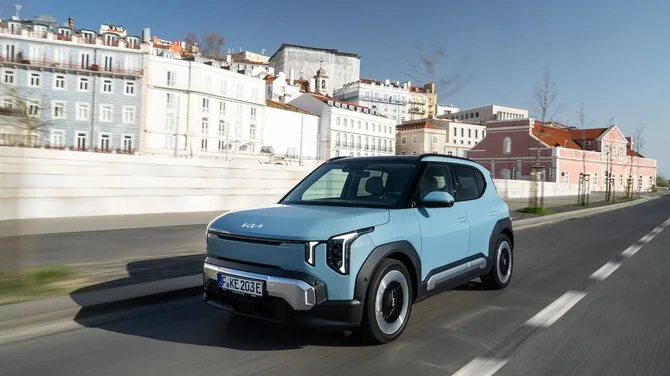
The current call for individuals provides a 5,000 euro compensation for a new pure M1 class electric car – in the case of the “Kia EV2” offered at a special price of 30,490 euros, this amounts to about one-sixth of the price. This is a limited budget call, not a permanent right. The previous 35 million euro call was completed when applications for the entire planned amount were received; more than 10.6 thousand residents took advantage of it.
The third line is depreciation, but it must be calculated for both alternatives. While waiting, the current car usually continues to depreciate, but a newly purchased electric car also depreciates immediately. Therefore, only the difference between these scenarios should be attributed to the cost of waiting, not the entire reduction in the value of the old car.
According to the average energy prices in the second quarter of 2026, one year of waiting for a driver traveling 20,000 km would mean about 1,078 euros higher energy costs if mileage and price difference did not change. However, the decision to buy now or wait should be based on a comparison of the total ownership costs of both scenarios – including purchase price, financing or cost of capital, insurance, charging equipment, maintenance, and depreciation of both cars – as well as the risk of support availability.
Lower energy costs – from the first kilometers
In financial terms, lower operating costs of an electric car can be compared to periodic returns, but this is not a dividend. According to the Lithuanian Energy Agency averages for the second quarter of 2026, 100 km by electric car cost 4.64 euros, and by petrol car – 10.03 euros. Therefore, the “Kia EV3” or “Kia EV4” can start reducing energy costs from the first kilometers, but the overall financial result is also determined by purchase price, financing, insurance, maintenance, and depreciation.
Read more Spanish Prime Minister: there is no solid evidence that Morocco planned the migrant influx in Ceuta
The math here is complemented by a warranty: “Kia” new car limited warranty is valid for 7 years or 150,000 km, and the high-voltage battery capacity warranty for electric and plug-in hybrid vehicles is 8 years or 160,000 km. According to its terms, costs necessary to restore capacity to at least 70% of the original capacity are covered. These are “Kia” warranty conditions, not a uniform warranty mandatory for all electric cars sold in the European Union. Warranty terms and exceptions apply, and the remaining warranty can be transferred to a future owner.
An important amount accumulates over time. Based on the averages for the second quarter of 2026, a driver traveling 20,000 km per year would save about 1,078 euros per year on energy, and about 7,500 euros over seven years if mileage and price difference did not change. This is simply the amount saved over the period, not a compound effect; insurance and tire prices depend on the specific car and driver.
The entry bar lowers itself
The supply of electric cars is expanding, and a more affordable model has appeared in the “Kia” range. The “Kia EV2” is currently offered in Lithuania from 30,490 euros at a special price; the 42.2 kWh version covers up to 317 km according to WLTP. Applying a 5,000 euro compensation for a qualifying buyer would reduce the net acquisition cost to 25,490 euros. The current special price of the “Kia EV2” is 6,500 euros lower than the special base price of the “Kia EV3” – 36,990 euros.
Competitor models also compete in the market, such as the “Opel Frontera” and “Peugeot E-2008”. Competition expands choice and can increase pressure on prices, but it does not guarantee that a specific model will be cheaper next year. Those who buy today get the current offer and start using the car; those who wait keep the option to take advantage of a future but unknown offer.
For waiting to become financially rational, the benefits of future lower purchase prices and other changes should outweigh the additional energy costs incurred during the waiting period and the risk of losing support. This cannot be guaranteed in advance: at some times, the price reduction of a car may exceed the annual energy savings calculated in this article. Therefore, the decision should be based on several scenarios, not the assumption that buying today is always financially better than waiting.
A question worth turning around
Therefore, the honest question sounds different from usual. It is likely that in two years there will be technologically more advanced electric cars, but that alone does not show when it would be financially most beneficial to buy a car. If we rely on the Lithuanian Energy Agency averages for the second quarter of 2026 and assume that mileage and price difference do not change, the difference in energy costs for a driver traveling 20,000 km per year over two years would be about 2,156 euros, not counting changes in support.
I would also include non-financial criteria in the assessment – comfort, space, and ergonomics, which each buyer should evaluate themselves. But the final word, as always, must be yours – mileage, current car costs and price, and what you are willing to pay for the illusion of the perfect moment. Calculate based on your own, not theoretical data – the result may surprise in both directions.
Read more Unethical and disgusting: flight attendant named places on the plane better not to touch