









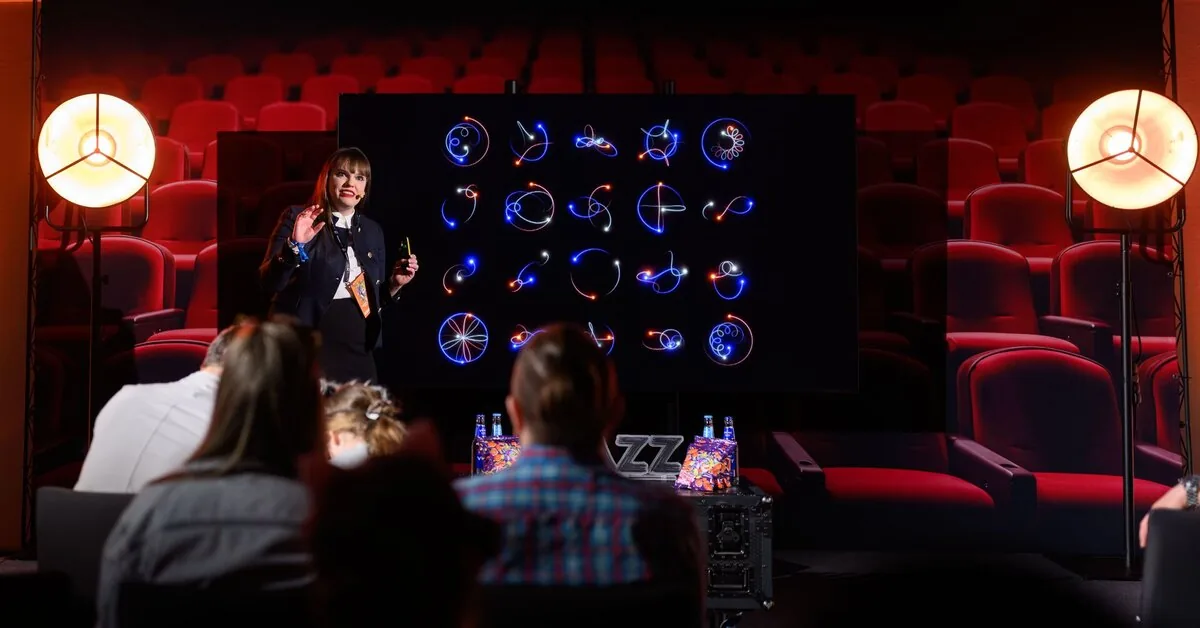
According to Dr. Mažena Mackoit-Sinkevičienė, a scientist from the Faculty of Physics at Vilnius University, the ideas explored in these works spark a desire to test them, expand upon them, or perhaps even refute them, thus contributing to the scientific process. At “Comic Con Baltics” in May, she held a kind of physics trial for Hollywood films, during which she invited the audience to ask a seemingly simple question – can it really be so?
The importance of emotions in the learning process
Popular culture is an indispensable part of our daily lives. We love films and TV series because they stimulate our imagination and open up the possibility of looking at the world a little differently. One of these different perspectives is the perspective of physics. According to Dr. M. Mackoit-Sinkevičienė, it can give us the opportunity to further enhance the pleasure we experience when watching an impactful work.
“Emotions are very important in the learning process. If we feel curiosity, enthusiasm, the desire to delve deeper and understand arises almost naturally. Why not use these emotions as a bridge to science? Next time, after buying popcorn and watching a good movie, be sure to discuss it with a physicist,” she urges.
The scientist provides several curiosity-provoking examples from well-known films. It would be hard to find someone who hasn’t seen “Harry Potter”. In the first part, the viewer’s attention is captivated by a scene where young wizards enter the Great Hall, illuminated by floating candles. What is it – magical fiction, or perhaps a phenomenon possible in reality?
“There is a branch of physics called acoustic levitation. It turns out that by precisely arranging ultrasonic speakers, we can generate a standing wave, and at its nodes – in the “pits” of acoustic pressure – hold objects. In 2006, Chinese scientists even kept live ants, ladybugs, spiders, and bees suspended in the air this way. In 2016, an international team showed that it is possible to levitate even a 50 mm polystyrene foam ball. So, keeping a small candle in the air is definitely possible,” states Dr. M. Mackoit-Sinkevičienė.
Is it possible to cry in space?
Another film series that everyone knows is “Superman”. This superhero is famous for his noble heart and his fondness for saving people, especially his love interest Lois Lane, who keeps falling from great heights, waiting for someone to catch her. The truth is, physics is merciless here. By the time Superman reached the falling Lois Lane, her speed could have increased to approximately 120 m/s, or more than 430 km/h.
Read more «I was scared to death»: shocking actions by Madonna at the concert
“That would no longer be a rescue, but a collision with a concrete wall. Even if Superman tried to soften the catch, he would have to do it just a few centimeters before the sidewalk. And sudden braking over such a short distance means the same deadly G-forces. It would be safer to just let Lois Lane keep falling. Unfortunately, Superman’s romance contradicts Newton’s second law,” says the scientist.
The laws of physics are sometimes contradicted by how emotions are depicted in films set in space. This does not mean that astronauts do not have them, but their expression must also obey the laws of physics. The film “Gravity” won an Oscar, but would it really have received such recognition if the audience had known that it’s not really possible to cry in space? In microgravity conditions, tears do not turn into drops rolling down the cheeks – they form into small spheres and cling to the eye.
“They would accumulate into an ever-growing ball of water until the astronaut would eventually have to “wipe” it away with a sleeve or cloth. If you want to see for yourself, just watch a short video by Canadian astronaut Chris Hadfield from the International Space Station. It clearly shows how a “tear” turns into an increasingly large ball of water near the eye. And another famous astronaut, Scott Kelly, even played “table tennis” in space with a 4 ml water ball using hydrophobic paddles,” recounts Dr. M. Mackoit-Sinkevičienė.
You can find more interesting physics, explained simply and without time limits, on the scientist’s “Youtube” channel.
Read more How not to get lost when choosing meat in a store: composition, labeling, and quality criteria


