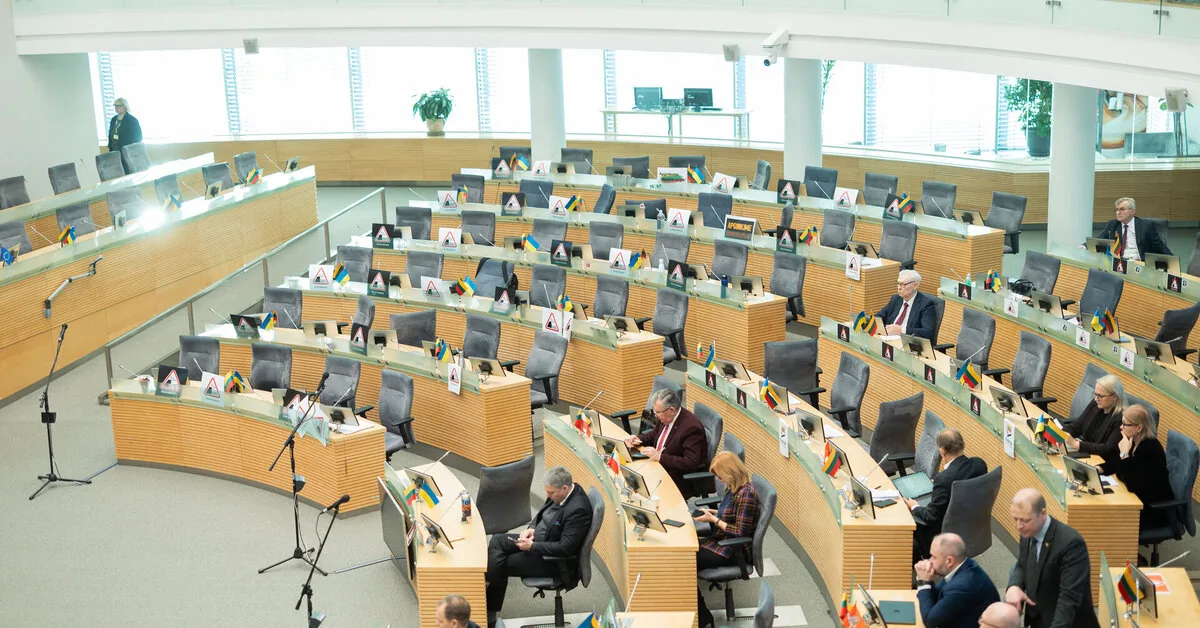
The decision was supported by 57 members of the Seimas, 27 were against, and 22 politicians abstained.
Read more Special Investigation Service raids «Mažeikių vandenys»
Conservative Mindaugas Lingė proposed to include in the resolution a request to declassify the material collected by the commission and to hand over the collected testimonies and documents to the archive for indefinite preservation.
At the consideration stage, the Seimas agreed to this, but the proposal was criticized by the parliament’s legal advisors, supported by the National Security and Defense Committee (NSGK). According to the lawyers, after the document on which the investigative commission was established and operated is annulled, the material of such a commission cannot be transferred for preservation.
On Thursday, the Seimas did not support the position of the lawyers and NSGK, but also rejected M. Lingė’s proposals. Thus, the adopted parliamentary resolution does not mention either the declassification or the destruction of the material.
It only states that the resolutions adopted by the previous term of the Seimas have lost their validity.
“It is clearly visible that the ruling party wants not only to annul the conclusions but also to destroy them,” said liberal Eugenijus Gentvilas.
According to conservative Arvydas Anušauskas, the investigative commission’s conclusions are based on real testimonies and documents.
“Only a part of the Seimas members took the opportunity to familiarize themselves with those conclusions. They contain truly intriguing, very important facts that testify about the actions of officials, the actions of politicians. (…) I believe that the geopolitical threats mentioned in the conclusions have not disappeared anywhere; they will probably activate soon, probably at the most unexpected moment for us,” said the Seimas member.
Conservative Matas Maldeikis, who worked in the investigative commission, emphasized that the conclusions should not be destroyed but read.
“If there is nothing there worthy of our attention, then they should simply be made public and shown that the commission did a poor job, it investigated nothing, and they are not worth any attention. But destroying them is a very strange genre, to be honest. And this should raise questions for you. And I would very much like each of you to go and read what is in those conclusions,” said the politician.
BNS reported that the ruling party of the previous term investigated information from former VSD officer Tomas Gailius about possible illegal data collection and their provision to third parties, possible influence of Belarusian fertilizer business on President Gitanas Nausėda.
After a five-month investigation, in March 2024, the Seimas commission concluded that President G. Nausėda is vulnerable and may have broken his oath by not answering the commission’s questions.
The commission stated it received data that several dozen people from then-candidate G. Nausėda’s environment were connected with the Belarusian fertilizer business, Russian and Belarusian intelligence services, maintained contacts with Russian and Belarusian diplomats, and similar. According to the investigators, this makes the president vulnerable.
The commission also announced it collected data that “some persons connected with the Belarusian fertilizer business tried to become and became heads of state institutions important for national security and advisors to the elected president.”
According to the investigators, the then VSD director Darius Jauniškis was aware of the connections of G. Nausėda’s environment and risky persons, “but he concealed this information from the commission and decision-makers.”
The conclusions also state that in 2019 D. Jauniškis assisted G. Nausėda in collecting intelligence information about his team and supporters, and the intelligence received the list of these persons from G. Nausėda himself or it was handed over on his behalf.
Moreover, the document states that the head of the Special Investigation Service (STT), Linas Pernavas, abused his powers by not providing data to the Seimas commission about the conducted criminal intelligence investigation, and D. Jauniškis provided misleading information to the Seimas commission.
The heads of the General Prosecutor’s Office, VSD, and STT accused the Seimas commission of bias, exceeding powers, and exerting pressure.
According to them, the Seimas commission, when making conclusions, did not consider some of the submitted documents and testimonies, ignored facts, demanded the submission of criminal intelligence material, although the law prohibits the services from doing so.
Because of this, the heads of the services complained about the Seimas investigative commission to the Seimas Ethics and Procedures Committee. It found that during the parliamentary investigation, the Seimas statute and the Code of Ethics for Politicians were violated.
G. Nausėda himself has always categorically denied requesting the VSD to check his environment.
Then opposition representatives, now in power, refused to participate in the work of this commission. After the Seimas approved the conclusions, they appealed to the Constitutional Court. It decided that in October 2023, the Seimas, when formulating tasks for the investigators and later approving their conclusions, violated the principles of constitutional responsible governance and the rule of law.
Based on this court decision, some NSGK members initiated the annulment of the previous term parliament’s decision.
Read more Kaunas police are searching for missing Simo Urbonas