Israel claimed to have carried out retaliatory strikes against an Iran-backed militant group, but the Lebanese Prime Minister stated that the seven people killed in one of the strikes were not “military targets” and urged Israel to stop the “extremely dangerous” escalation.
Read more Death toll from earthquake in Indonesia rises to 38
Israel early Saturday “intensified attacks in the south,” reported the Lebanese state National News Agency (NNA), stating that warplanes struck a house on the outskirts of Ansar village and carried out “a series of air strikes targeting Ali al Taher hill,” a strategic hill overlooking the Nabatieh area.
Later it reported a strike in the southern city of Deir Zahrani.
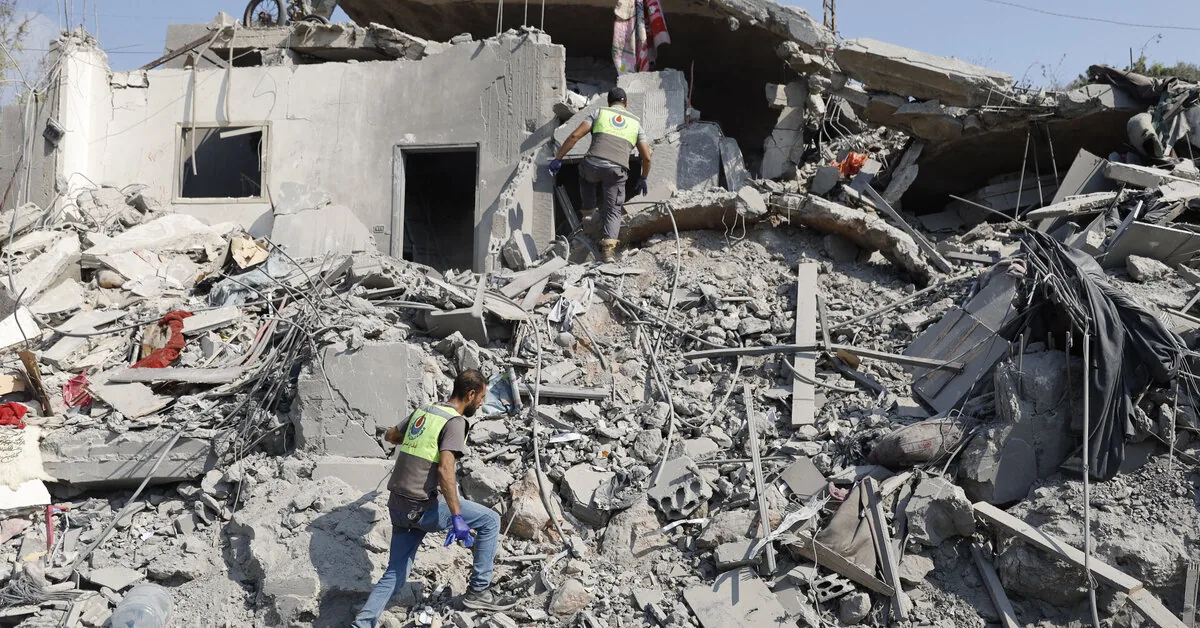
The Lebanese Ministry of Health reported that seven people were killed in Ansar, “including three children and two women,” while two more were killed and nine injured in Deir Zahrani. It added that these are preliminary figures.
An AFP correspondent in Ansar saw a destroyed building, with rescuers trying to pull bodies from the rubble.
A statement from the Israeli military said it struck “Hezbollah terrorist infrastructure in the Nabatieh and Ansar districts.” It stated that this was “in response to actions by the Hezbollah terrorist organization” against Israeli soldiers in the Ali al Taher hill area.
“Extremely dangerous”
Lebanese Prime Minister Nawaf Salam said that “the seven martyrs of the Israeli strike in Ansar village are not ‘military infrastructure,’ and the women and children killed are not military targets.”
“Israel must stop this escalation,” he said, adding that it “is extremely dangerous and harms efforts to establish stability in the south.”
Hezbollah has drawn Lebanon into the war in the Middle East by launching rockets into Israel, thus supporting its backer Iran.
Israel responded with intense air strikes and a ground invasion, during which, according to Lebanese officials, more than 4,300 people were killed.
Violence significantly decreased after a memorandum of understanding was signed in June between the US and Iran regarding a broader Middle East war, and later that same month a US-backed framework agreement was reached between Lebanon and Israel.
Read more The house owner was shocked: tenants raged from the heart
However, Lebanon still reports intermittent Israeli strikes and large-scale destruction of civilian buildings in southern villages and towns.
Negotiations
Lebanese President Joseph Aoun said that the Israeli strikes in the south of the country on Saturday were a “clear message” regarding negotiations between the two sides ahead of a new round of US-backed talks planned in Rome early next month.
According to his office’s statement, J. Aoun condemned the “ongoing Israeli attacks” in southern Lebanon and “continuous violations of the framework agreement (…) and international law regarding civilian protection, which caused the death of an entire family in Ansar village.” He added that “these violations are a clear message to the negotiation process.”
The Israel-Lebanon framework agreement includes the disarmament of the Hezbollah group, the gradual withdrawal of Israeli forces from southern Lebanon, and the deployment of the Lebanese army in the region, starting with “pilot zones.”
On Friday, Hezbollah leader Naim Qassem accused Lebanese officials of exerting undue pressure on the country’s armed forces while implementing the agreement.
Next month in Rome, Israel and Lebanon are expected to hold the eighth round of US-backed negotiations.
Earlier this week, Israeli Defense Minister Israelis Katz visited southern Lebanon and promised to keep troops in the so-called “security zone” and stated that the Israeli army in this area “destroys underground infrastructure” and “demolishes all houses.”
A US State Department official told AFP that “a permanent military presence in southern Lebanon does not comply with the commitments made in the framework agreement.”