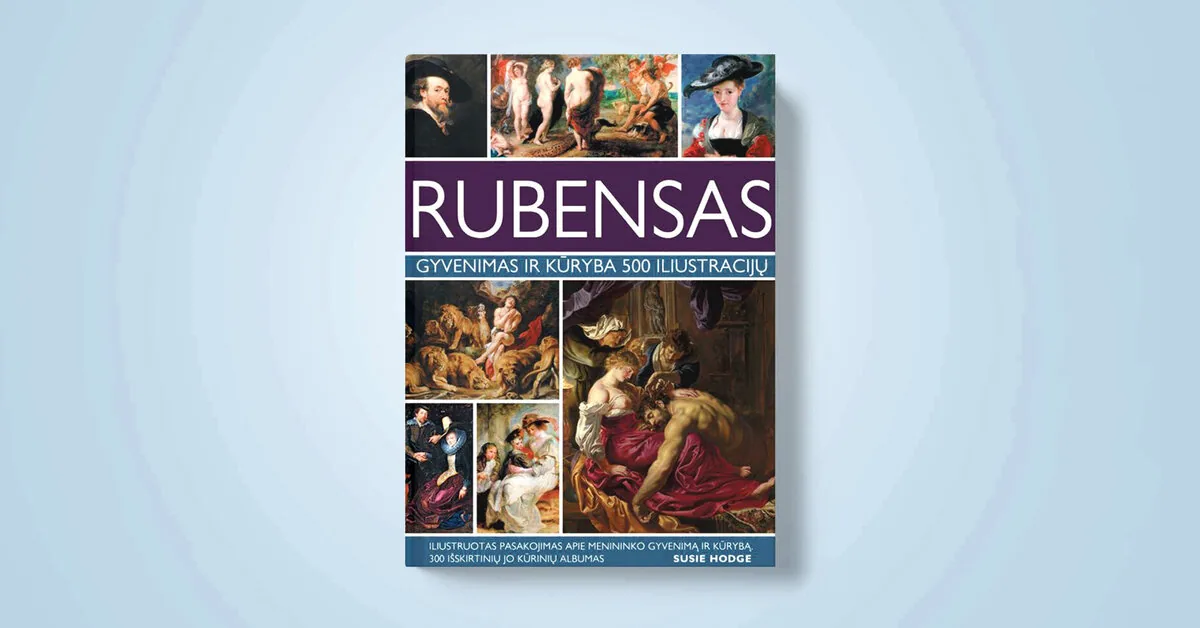
Today, even those who rarely visit museums know the name Rubens – it is because of him that the term “Rubenesque” has appeared in art history, referring to the masterfully depicted forms of plump women on his canvases. However, this album reveals that Rubens was much more than just a painter of this distinctive style.
Read more An SUV with a boat overturned in Panevėžys district
The first part of the album introduces the artist’s biography: from his apprenticeship years in Antwerp to his studies in Italy. It describes his path to international recognition, earning him the title of “prince of painters and painter of princes.” Rubens became a true star of his time, achieving universal fame while still alive, and contemporaries rightly called him “the modern Apelles.” The artist maintained very close ties with the most influential European monarchs, and among the greatest admirers and patrons of his talent was King Charles I of England himself.
The second part of the album presents a gallery of 300 of Rubens’ most important works. It reveals the unmatched versatility of the artist: Rubens was not only a brilliant painter but also a diplomat, scholar, collector, and teacher. The publication includes all the most famous masterpieces, such as “The Elevation of the Cross,” “Prometheus Bound,” and “The Garden of Love.”
The book, illustrated with 500 reproductions, provides a comprehensive overview of the work of one of the greatest artists in the world. Rubens’ energy, inventiveness, and exceptional talent have cemented his name in art history.
The publisher “Briedis” has released albums in the series about famous painters dedicated to the lives and works of L. da Vinci, Michelangelo, Rembrandt, P. Gauguin, V. van Gogh, F. Goya, E. Manet, and P. Cézanne. The book was translated from English by Rima Čeliauskaitė.
We invite you to read an excerpt from the book:
DESIRABLE WOMEN
Unfortunately, the peace that Rubens so arduously sought did not last long, and for nearly another twenty years, Europe was plagued by the Thirty Years’ War. This was a sad end to all these efforts, but Rubens now distanced himself from almost everything, enjoying life with his new young wife.
Elena truly gave Rubens a new impetus to paint beautiful and desirous women. She inspired almost all his future paintings: he depicted her as a goddess or a mortal, herself or embodied in another role. Her gentle, plump, and rosy body became one of the most recognizable details of Rubens’ work. Her full figure was considered the embodiment of fashionable beauty and health, a symbol of prosperity and elegance. There were so many different depictions of her that they became almost a personal signature of the artist.
Read more Chairwoman of the Board of Utenos trikotažas – SBA Group Vice President Jolanta Grašienė
TACTILE PAINTING
Although Rubens had already entered his sixties, his energy, warm nature, attentiveness, and endurance did not fade, and the glowing colors and dynamic painting style were even more masterful than at the beginning of his career. He created some of his most energetic works and expanded his style with a freer tactile painting manner, which was unusual for painters of that time, who usually painted delicate, meticulous, realistic images with invisible brushstrokes. At that time, Rubens’ influence across Europe was breathtaking, and many other artists began to imitate him, changing their style and painting more freely.
For Rubens, the female figure symbolized mystery, seduction, fertility, and coziness, but he was also attracted to other qualities: wealth, gracefulness, intellectual conversations, femininity, beauty, luxurious fabrics, and rich textures – all of which appear in his paintings.
Love of life is seen everywhere: in generously proportioned figures, expressively painted textures, love for humanity, the attraction of a gentle body, and the expression of feelings. All this was reflected in both large and small works, but intense emotions for Elena are especially felt in paintings created after 1630. After many centuries, some of his sensual images began to evoke uneasy feelings in viewers: plump women became unfashionable, but in the 17th century, full, voluptuous figures were still popular, and Rubens, depicting desire and passion, captured the spirit of the era.
UNOFFICIAL PAINTINGS
During their ten-year marriage, Rubens and Elena had five children: Clara Johanna (1632–1689), Frans (1633–1678), Isabella Helena (1635–1652), Peter Paul (1637–1684), and Constantia Albertina (1641–1709/1712). Paintings of the wife with the children are among the most affectionate and tender works of the artist. He felt happiest in the close family circle, and the unofficial portraits of the children and Elena were created with smooth, graceful brushstrokes, soft colors, and natural gestures. Elena’s portraits are also gentler than other images he painted.
CELEBRATION OF LOVE
Rubens admired Greek and Roman mythology, so he depicted many stories. These were mostly private commissions, giving him the opportunity to paint desirable women. The lyricism, eloquence, and sensuality of these compositions became even more powerful and open from the 1620s, and after his second marriage, he gladly painted mythological stories about the powers of love.
Read more A living head sentenced a Russian general who wanted to capture Kyiv in 3 days