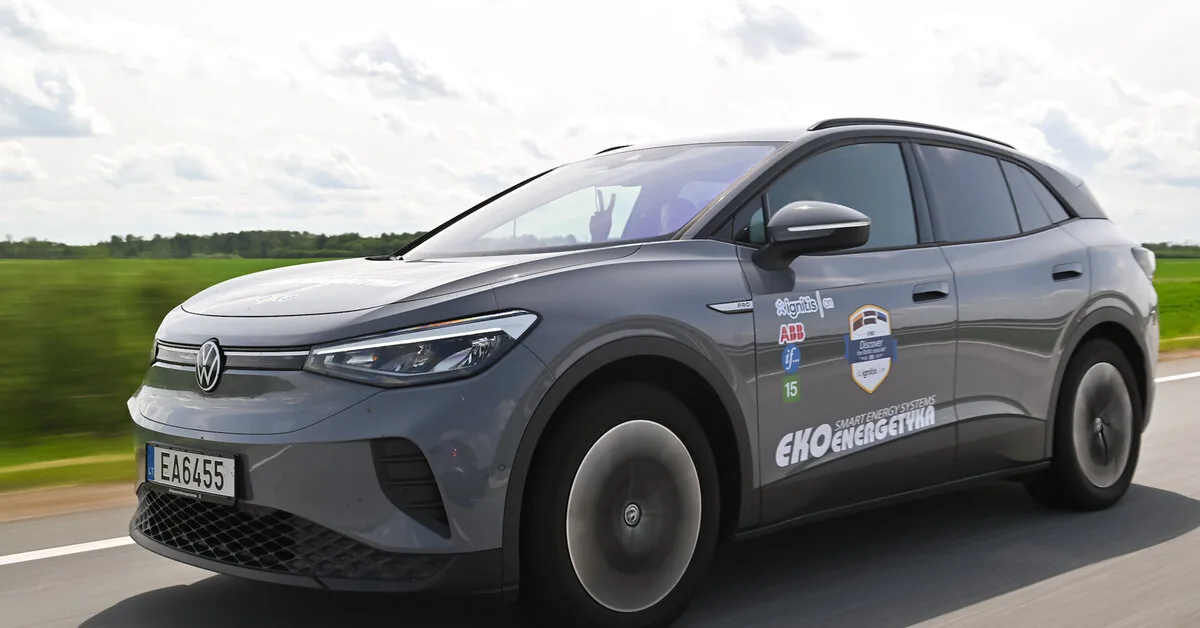
For several years now, state institutions and charging network developers have been taking into account the comments of competition participants.
Read more Abandoned garden plots are offered for sale at auction: here’s what would change
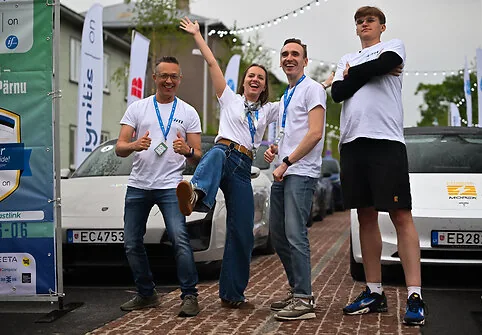
Almost 70 electric vehicles will set off on the Kaunas-Cēsis-Tartu route at the same time. They will not be able to exceed the permitted speed or violate other traffic rules. Those who manage to find the shortest routes and charge the fastest will win. Of course, such a number of electric vehicles will be a big test for the existing charging infrastructure, so before the competition, we talked about the future of charging with Eimantas Balta, the head of “Ignitis ON”, the largest charging network in the Baltic States.

– “Ignitis ON” currently manages the largest electric vehicle charging network in the Baltic States. In the coming years, will the main focus remain on the Baltic region, or are you considering expansion into other markets?
Currently, our main focus remains on the Baltic States – Lithuania, Latvia, and Estonia. Here we see a rapidly growing electric vehicle market and a great need for infrastructure.
Today, the “Ignitis ON” network covers more than 1,900 charging points and covers more than 90 percent of the Baltic States’ territory, and even 98 percent in Lithuania.
Our goal is to ensure that electric vehicles can travel comfortably both in cities and between different regions or countries. Therefore, we currently prioritize strengthening the network and ensuring a high-quality user experience in the Baltic region.
– In your opinion, how will the electric vehicle charging infrastructure change in the coming years? Will there be more high-power charging HUBs in strategically convenient locations in the market?
– We see that the market is moving not only in terms of quantity but also quality. In the early stage of electromobility, the most important thing was to ensure basic network coverage so that people could travel without range anxiety.
Now, high-power HUBs in strategically important locations – near highways, shopping centers, or places where people can comfortably spend time while charging – are gaining an increasingly important role.
Projects like the Vėjukai charging park demonstrate this very direction – fast charging, more simultaneous spots, and broader infrastructure for driver convenience.
However, regional stations also remain important as they ensure network accessibility throughout the country.

– How important is heavy electric transport infrastructure in “Ignitis ON”‘s strategy?
– Heavy electric transport is becoming one of the most important directions in electromobility today. We see growing interest from logistics companies, public transport operators, and businesses in electric trucks and buses.
Therefore, we are already designing next-generation infrastructure with not only passenger cars in mind. For example, the Vėjukai park is specially adapted for heavy transport – it features spacious charging areas, the ability to charge multiple vehicles simultaneously, and ultra-fast charging reaching up to 400 kW.
We see that highway HUBs will become an important part of heavy electric transport infrastructure in the future.
– How is the demand for electric vehicle charging changing in regions without significant transit traffic?
– We see that electromobility is growing rapidly not only in big cities. The number of electric vehicle drivers is also increasing in the regions, thus increasing the need for convenient infrastructure closer to people’s daily routes.
Today, electric vehicles are no longer just a city vehicle – people travel all over Lithuania with them. That is why we pay a lot of attention not only to highways but also to regional network coverage.
Currently, the “Ignitis ON” network covers as much as 98 percent of Lithuania’s territory, so usually, you don’t have to drive more than 30 kilometers to the nearest charging point.
We also see a consistently growing use of infrastructure – electricity consumption at public charging stations increased by more than 50 percent this year.
– In your opinion, how will the electric vehicle charging experience change in the coming years?
– In the coming years, the biggest changes will occur not so much in power itself, but in the area of user experience.
The market is moving towards a simpler and smoother charging process – more automation, more convenient payment methods, integrated apps, and fewer additional actions for the driver.
For example, today we are already implementing solutions that allow payment via mobile app, RFID key, bank card, or even an automatic charging function without additional actions.
High-power HUBs are also becoming increasingly important, where drivers can not only quickly charge their car but also comfortably spend time – rest, eat, or shop.
The ultimate goal is very simple – for electric vehicle charging to become a natural and as effortless a part of daily life as possible.
Read more Nissan is considering manufacturing Chery cars in the United Kingdom