This place famous for miracles is one of the several dozen churches on a small island. Moreover, it is one of the most well-known in the world. It is said that people who visited and prayed to the Virgin Mary here experienced miracles – some were healed, others had children, and others solved other problems that troubled them.
Pilgrims come here all year round. And most of them come to Ta’pinu already knowing about this place in advance.
As guide Iolanna Borg Lupan told, she has accompanied both tourist groups and individual travelers here, and over her years of work there have been many stories. Some are hard to believe.
“I remember a Ukrainian woman suffering from cancer approached me. Doctors had done everything they could. She was told she had only a few months to live. During that time, she decided to fly to Malta with her husband and come to Gozo Island and Ta’pinu.
I accompanied her here, saw how sincerely she prayed. She spent several hours in the basilica. After the trip, I kept in touch with her and her husband, so I knew how her health was. A month passed – she was still alive. Two, three – she continued to live. Now several years have passed since her first visit to Ta’pinu – she is still alive. After tests, doctors found no logical explanation – the cancer was gone,” the guide recounted one miraculous healing she witnessed, adding that the grateful Ukrainian returned here – she wanted to pray and thank for her recovery.
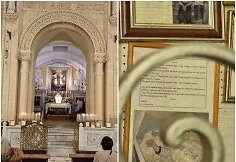
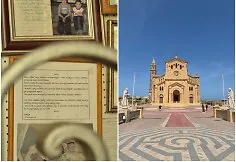
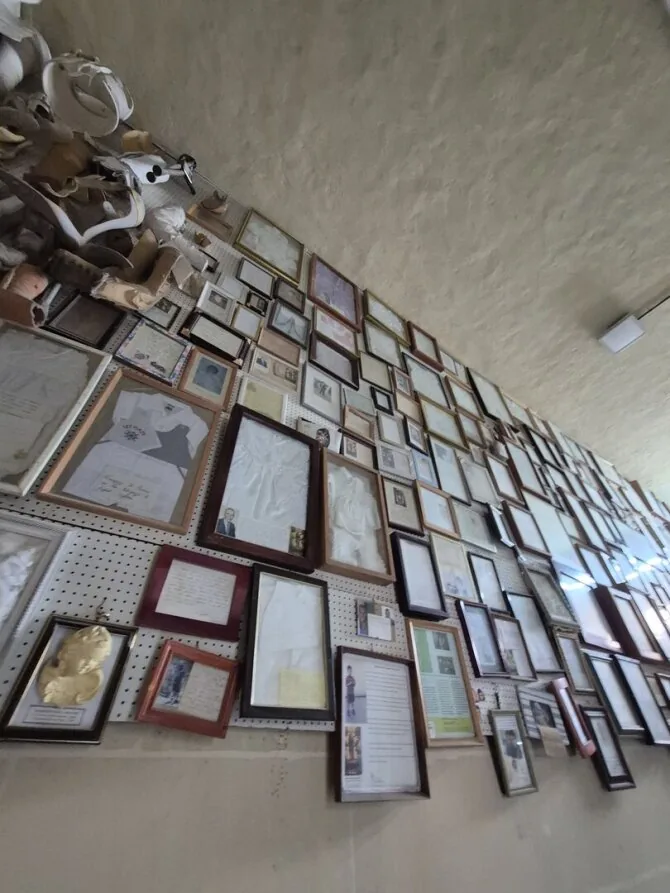
There are many such thank-you notes in the basilica. A separate room is dedicated to this, its walls covered with letters, photos, and even medical items, testifying that sincere prayers to the Virgin Mary at Ta’pinu were heard.
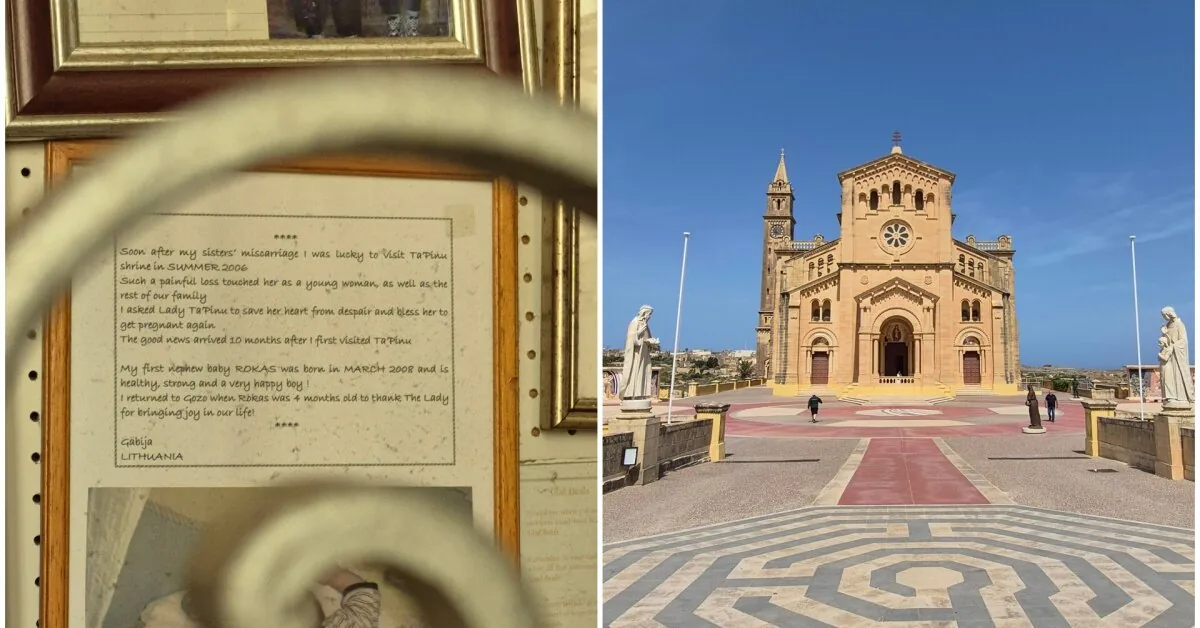
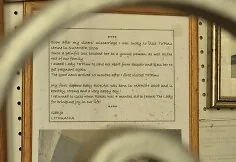
Among them are also several Lithuanian stories. One woman writes in English about how she prayed at Ta’pinu and asked for help for her sister who recently had a miscarriage and was broken because of it. From the letter, it is clear that shortly after, the woman became pregnant and gave birth to a boy – the son of the woman who prayed in the basilica.
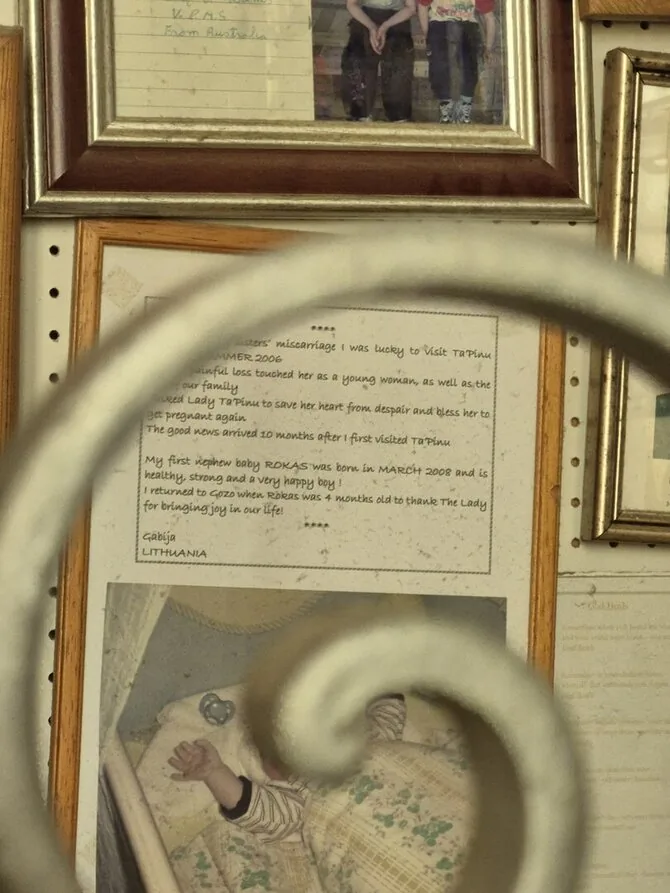
Her letter and other relics are votives – symbolic signs of thanks, vows, or requests that believers offer and hang next to images or sculptures of saints considered miraculous. This tradition is especially alive in Christianity, and the word itself comes from the Latin votum (promise, offering). At Ta’pinu basilica, votives are usually left as a sign of gratitude.
The legend dates back to the 16th century.
The history of the sanctuary is connected with a smaller chapel mentioned as early as the 16th century. Its name “Ta’ Pinu” comes from Pinu Gauci – a man who cared for the chapel at the end of the 16th century. In Maltese, “Ta” indicates the genitive case, so the chapel was named after Pinu – the man who cared for it. The name has remained unchanged to this day.
A local legend tells that in 1883 a woman named Carmela Grima praying in the chapel heard the voice of the Virgin Mary. In later years, it became clear that prayers directed to the Holy Virgin received her grace. It is believed that she helped protect Gozo Island from the plague that was ravaging the world at that time.
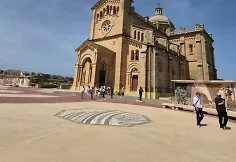
The current basilica was built between 1920 and 1932. It stands out with its neo-Romanesque style. Like all other churches in Malta, the basilica is made of local yellow Maltese limestone.
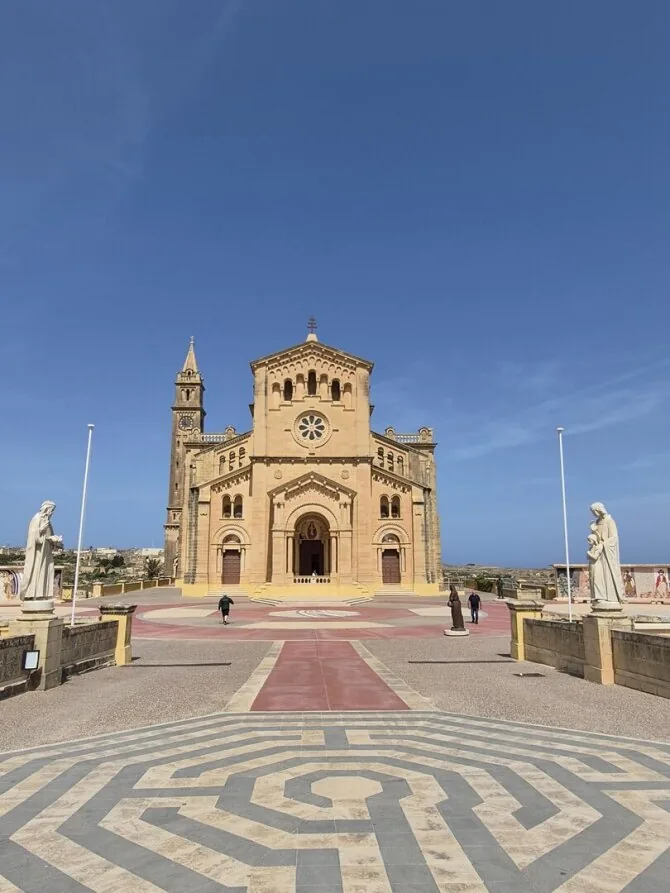
Visiting the sanctuary is free. However, it is an active church, so religious ceremonies also take place here. Therefore, for a more intimate visit, it is worth planning the trip here in detail and in advance.
Passions over the mosaic author
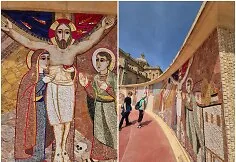
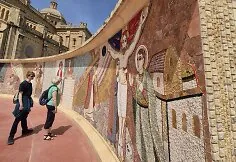
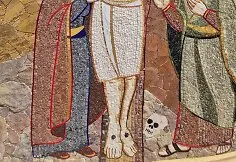
Ta’ Pinu basilica stands out not only for its architecture but also for the impressive artistic complex around the basilica. One of the most striking features is the huge mosaics in the basilica square and its surroundings. These colorful fresco and mosaic compositions depict biblical scenes.
Read more As Israel expands its ground operation, it has captured a medieval castle in Lebanon
The mosaics were created in the workshop of the famous Slovenian Jesuit and artist Marko Ivan Rupnik. His works are characterized by a style reminiscent of Byzantine iconography – large eyes, gold tones, and symbolic faces. These mosaics surround the basilica’s surroundings.
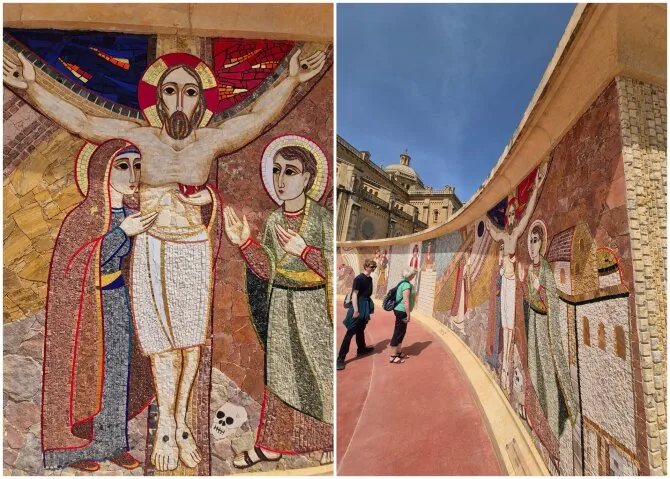
It is worth walking around and examining the details – the author left various hints and philosophical references in the mosaics. Despite the impressive work, these mosaics became the subject of a scandal a few years ago. The mosaic author, priest and artist M.I. Rupnik, was long considered one of the most famous contemporary Catholic artists in the world – his works are in the Vatican, Lourdes, Fatima, and other famous sanctuaries. However, later he was accused of psychological and sexual abuse of monks. Because of this, he was removed from the Jesuit order, and his art sparked huge discussions in the Church.
The Gozo diocese decided not to remove the Ta’ Pinu mosaics. Local clergy even compared the situation to Caravaggio, who was accused of murder – saying that the moral sins of a famous artist do not necessarily negate the value of art.
This decision sparked many discussions among believers: some think art should be separated from the author, others say it is difficult for victims of sexual violence to pray near such works. In any case, for now, the impressive mosaics still await tourists, travelers, and pilgrims visiting Malta and Gozo Island.
Visited by all popes
Another important site is the Ta’ Għammar hill Way of the Cross (Via Crucis), located in front of the basilica. Huge marble sculptures of the Stations of the Cross are installed on the hill. The idea for this project arose after World War II when believers began making penitential processions to the hill.
In 1970, the then rector of the basilica, Monsignor Lawrence Portelli, initiated the official creation of the Way of the Cross. The sculpture models were created by the famous Maltese sculptor Alfred Camilleri Cauchi, and the marble statues themselves were made by the Italian company “Temistocle Sarti,” supervised by the artist Gualtiero Luisi.
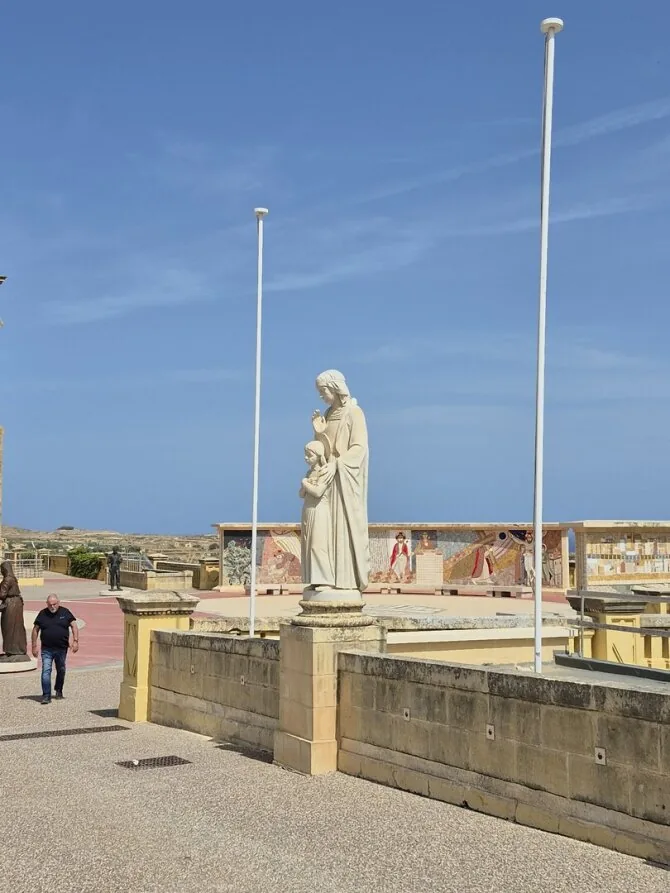
The project was later continued by Monsignor Benedict Camilleri – a path was extended, trees were planted, and an amphitheater was built at the top of the hill.
Ta’ Pinu basilica became an important place for papal visits as well. In 1990, Pope John Paul II celebrated Mass here during his visit to Gozo Island.
In 2010, Pope Benedict XVI gifted Malta a golden rose – a special sign of papal honor. It was dedicated to the Ta’ Pinu sanctuary.
In 2022, Pope Francis also visited the basilica, where he held services and prayed individually in the old chapel.
Because of these artworks, monumental sculptures, and important historical visits, Ta’ Pinu today is considered not only a religious sanctuary but also one of the most impressive cultural and artistic sites in all of Malta.