










The European Parliament’s Committee on Culture and Education approved the initiative report on the impact of social networks and the online environment on children and youth with 70 votes in favor. The document calls on the European Commission and Member States to introduce stricter protection measures for minors, provide age-appropriate access restrictions, and ensure that platforms are safe for children.
The rapporteur, Member of the European Parliament Sandro Ruotolo (S&D, Italy), emphasizes that this is an important political signal ahead of the European Commission’s initiative on unified access for minors to social networks across the European Union.
“Platform design is not neutral. Behind every feature lies a choice, behind every algorithm – responsibility,” says S. Ruotolo.
The European Parliament proposes combating addictive platform design, managing recommendation algorithms more safely, implementing privacy-protecting age verification, and strengthening the protection of minors online.
One of the most important expert recommendations is to establish a uniform rule across the European Union that children under 13 years old should not be able to use social networks independently.
“It is not families who must prove that their children can protect themselves. Platforms must prove that their products are safe. This is a paradigm shift proposed by our report,” emphasizes the MEP.
It is not families who must prove that their children can protect themselves. Platforms must prove that their products are safe.
According to him, minors do not yet have sufficient skills to critically assess the digital environment, so their protection must become one of the most important priorities. This report will be discussed at the European Parliament plenary session in September.
D. Žalimas: the goal is not to ban, but to reduce harm
Member of the European Parliament Dainius Žalimas emphasizes that social networks are an important means of information and communication, but their operating principles can significantly affect children’s development.
“If a person does not yet have enough critical thinking and does not recognize manipulations, content selected by algorithms can have a negative impact,” says D. Žalimas.
According to him, therefore, the European Parliament proposes limiting access to social networks for those under 13 years old, allowing access from 13 to 16 years only with parental consent, while also developing children’s ability to critically evaluate information.
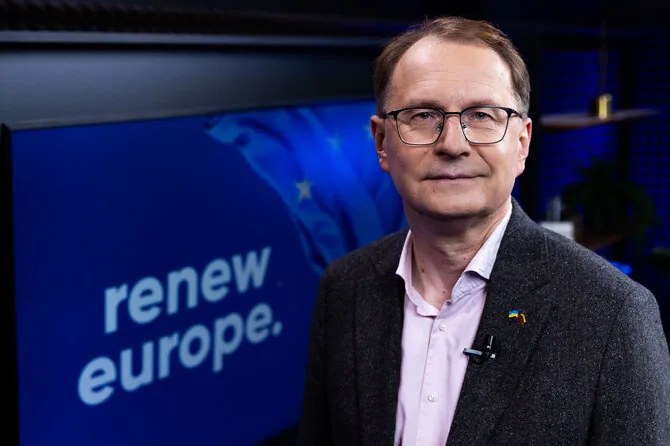
“The goal is not to ban social networks. They can promote knowledge and communication, but at the same time can increase addiction, hinder learning, create conditions for bullying and other threats. Therefore, the state has the right to regulate platform activities, guided by the best interests of the child,” says the MEP.
According to him, the platforms themselves must also take responsibility.
“Their business interest is to keep the user as long as possible. Therefore, it is necessary to limit addiction-promoting algorithms and require platforms to contribute more actively to child protection,” emphasizes D. Žalimas.
However, he points out that legal restrictions alone will not be enough.
“It is important to develop digital literacy among children and parents, the ability to recognize manipulations and harmful content, and to find time for open conversations with teenagers about their online life,” says D. Žalimas.
Read more Lithuanian Zoo’s rhinos predicted the World Cup winner: here is who they think will win
Lithuania: restrictions must be science-based
Advisor to the Ministry of Social Security and Labour Augustė Dudutytė states that Lithuania is moving in the same direction as the European Union regarding social network regulation.
“We see that social networks bring not only benefits to youth but also increasingly clear negative consequences for emotional and psychological health. Therefore, responsibility cannot rest solely on young people or their parents – coordinated action by the state and the European Union is needed. We support the discussion on the minimum age for using social networks, but such a decision must be based on psychologists’ recommendations and scientific research,” she says.

The ministry, together with the Youth Affairs Council, is preparing a national position that foresees not only a possible age restriction but also greater attention to media literacy, digital hygiene, and the creation of safe alternatives.
According to A. Dudutytė, changing the operation of the platforms themselves is no less important.
“Endless content scrolling, algorithmic recommendations, and automatic video playback encourage addiction, so platforms must ensure a safer environment for children and adolescents,” says the ministry representative.
She also emphasizes that Lithuania supports the introduction of a unified European age verification system and stricter application of the Digital Services Act to major platforms.
Psychologist: we cannot expect a child to be stronger than technology
Medical psychologist Virginija Grikšaitė-Šukė views the European Parliament initiative as a timely step, as until now too much responsibility has been shifted to children and their parents.
“There is increasing talk that platforms themselves must take responsibility, as they create environments and solutions that encourage keeping users’ attention as long as possible,” says the psychologist.
According to her, in practice, it is often heard that teenagers themselves would like to spend less time on social networks, but find it difficult to do so.
“We cannot expect a child to be stronger than technologies created by entire teams of specialists to keep their attention as long as possible,” emphasizes V. Grikšaitė-Šukė.
We cannot expect a child to be stronger than technologies created by entire teams of specialists to keep their attention as long as possible.
The psychologist positively evaluates proposals to limit manipulative platform design, increase algorithm transparency, and pay more attention to children’s privacy. According to her, this can reduce the risk of young people being exposed to harmful content streams and contribute to better emotional health.
However, she stresses that regulation alone will not be enough: “It will not change already formed habits and will not replace the role of parents, schools, and specialists. At the same time, it is necessary to strengthen digital literacy and develop self-regulation skills.”
In her view, the greatest strength of the European Parliament initiative is the clear message that children’s safety online cannot depend solely on their self-control or parental vigilance – responsibility must also be taken by the technology giants who create and manage the digital environment.
Read more The town where burying the dead is prohibited: revealed the reason for the unusual rule