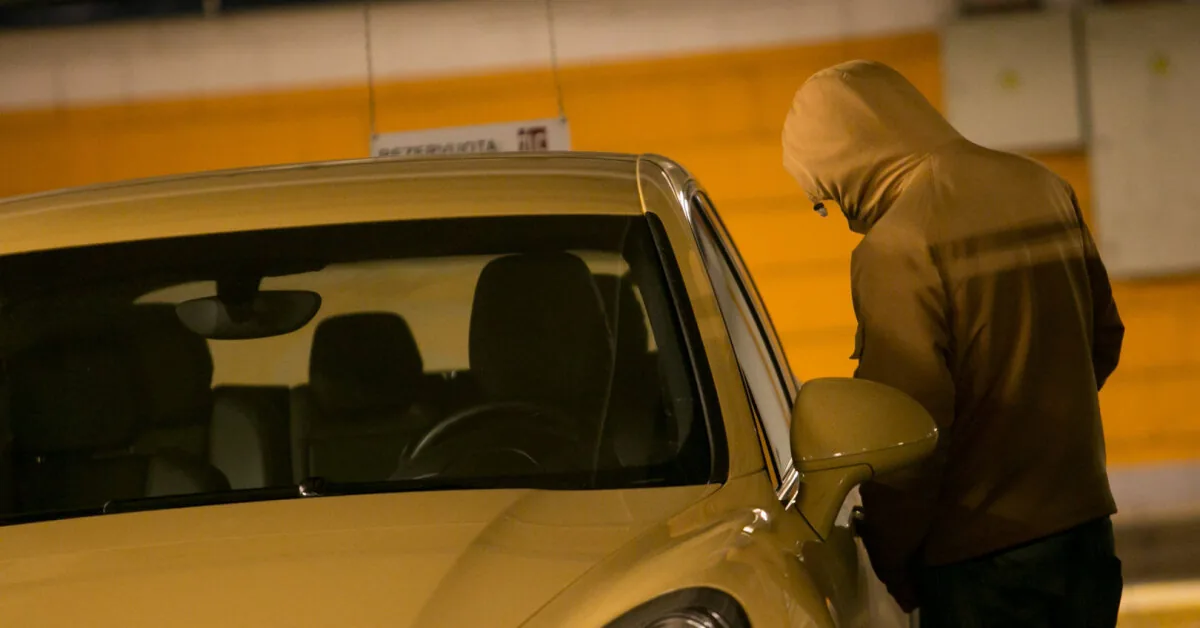
The “Security Business Group” Association notes that modern car protection should not be limited to factory alarms or standard immobilizers. Cars are becoming technologically more complex, but at the same time, methods of theft are also becoming more sophisticated.
The latest data from the Department of Informatics and Communications show that 180 car thefts were registered in Lithuania during the first half of 2026. During the same period in 2025, there were 229. This is a positive change, but a general decrease in statistics alone should not be considered a long-term improvement in security or a reason to abandon additional security measures.
Understand instantly
Thieves strip a vehicle in a minute and a half: they steal not only BMW and “Porsche” parts
Stolen BMW M5 and “Porsche Macan”: powerful car content creator Andrey asks for help
In 2025, a total of 457 car thefts were registered in Lithuania, and in 2024 – 397. This means that the number of car thefts increased last year, so additional protection for newer and in-demand cars remains relevant.
Theft targets are expanding
In recent weeks, “Toyota RAV4” cars have been repeatedly mentioned in police reports. Such thefts were registered in Kaunas, Kaunas district, and Vilnius. Cases of “Lexus”, “Kia”, “Hyundai”, “Land Rover”, “Mercedes-Benz” and other car thefts were also recorded.
The latest signal is the appearance of “Tesla” thefts in police reports. In one day, two cases of “Tesla” car thefts were registered in Vilnius and Vilnius district. This shows that the problem is not limited to traditionally more frequently mentioned SUVs or hybrid cars. Newer electric cars and other in-demand models on the market can also become targets for criminals.
These events are not an official ranking of the most stolen models in all of Lithuania. In Lithuania, a single general table by each make and model is not publicly announced.
However, such summaries allow us to see a trend: criminals are interested in cars that can be sold as a whole, exported abroad, or whose parts can be used in the secondary market.
The examples of “Toyota” and “Lexus” have recently stood out as popular, value-retaining, and in-demand cars on the market. However, it would be inaccurate to state that the theft problem is related only to one or a few brands. The risk of a car is determined by its value, prevalence, demand for parts, electronic architecture, storage location, and what additional security measures are installed.
Similar trends are observed in neighboring countries. For example, in Poland, “Toyota” models have recently stood out among the cars most frequently deregistered due to theft. This indicates that popular SUVs, hybrid cars, and other liquid models are relevant not only in Lithuania but also in the wider region.
Not only cars are stolen, but also their parts
Car owners face risk not only from the theft of the entire vehicle. Criminals are also interested in expensive, quickly realizable parts: headlights, mirrors, rims, steering wheels, airbags, multimedia equipment, radars, cameras, bumpers, and other components. Such thefts can cause significant damage, as the owner has to replace not only the stolen part. Often, the bodywork, fasteners, electrical wiring, sensors, or other systems are additionally damaged. Therefore, even the theft of a single part can result in expensive repairs.
According to insurers’ data, in 2025, several hundred cars were affected by car parts thefts. Most often, such thefts are associated with more expensive and in-demand models on the market, whose original parts have high value in the used parts market.
KASKO insurance alone is not enough
KASKO insurance is an important financial risk management tool. It can help compensate for losses from car theft or damage, and in some cases, for additional equipment or personal items in the car, if specified in the particular insurance contract.
However, KASKO is not a security system. Insurance does not stop theft, does not report an attempt to steal a car, and does not complicate the actions of criminals. If a car is stolen, the owner loses the vehicle immediately, and the administration of the insurance event, document processing, waiting for a decision, and issues of replacement transport take time.
In addition to financial damage, there are also practical and emotional losses: personal belongings, work tools, children’s items, documents, or other items important to the owner may be in the car. Even if some losses are later compensated, theft means time, worries, inconvenience, and psychological discomfort.
Therefore, KASKO insurance and additional security systems should not be opposed. Insurance reduces financial consequences, while security systems reduce the likelihood of theft itself, extend the time criminals need, and, if theft does occur, can help determine the car’s location more quickly.
Modern theft – not just breaking a lock
In newer cars, security has long ceased to be just a matter of mechanical locks. Keyless entry and start systems, electronic control units, diagnostic access, and communication modules provide more convenience for the driver, but at the same time require a more serious approach to security.
Criminals may try to exploit the keyless entry signal, simulate legitimate access to the car, or look for weaknesses in electronic systems. In Europe, so-called “relay” attacks are still relevant, where the car is tricked into believing that the legitimate key is nearby. The circumstances of each theft are determined by a pre-trial investigation, so not all cases can be attributed to one specific method. However, the general trend is clear: a factory alarm or a standard immobilizer in a newer car is not always a sufficient single security solution.
Recommendation – several independent layers of protection
The Car Safety Committee of the “Security Business Group” Association recommends a comprehensive approach to car protection. It is important to consider not only the car’s make or year, but also its value, equipment, keyless entry functions, storage location, and usage habits.
It is recommended to install at least one additional, independent security measure alongside the existing factory or professionally installed certified audible security system with motion sensors that meets applicable requirements.
This could be a driver-identifying immobilizer, controlled by a separate transponder – a card or a token. Another solution is a GSM/GPS communicator, which transmits alarm messages via SMS, email, or call. For higher-risk cars, a car security-tracking system that helps determine the vehicle’s location in case of theft may also be relevant.
For higher-risk cars, it is worth combining these measures. An additional immobilizer can complicate unauthorized car starting, a communicator allows the owner to learn about danger more quickly, and a tracking system can be important in the first minutes after a theft.
No single system can guarantee absolute protection. However, several independent layers of protection extend the time criminals need, increase the risk of being noticed, and can lead to a decision to abandon the chosen car.
Special car security system kit “AVG 3”
Members of the Car Safety Committee of the “Security Business Group” Association have prepared a car security system kit “AVG 3”. It is designed for cars for which factory protection alone or an audible alarm alone is not sufficient.
Depending on the car model, equipment, and owner’s needs, the “AVG 3” kit can be composed of several solutions. Its basis can be a factory or EU-certified audible security system with motion sensors. Additionally, a driver-identifying immobilizer, a GSM/GPS communicator, or a car tracking system can be installed.
Members of the Car Safety Committee, after installing and evaluating the “AVG 3” security system, issue a certificate confirming this and include it in the electronic register. This allows the car owner to have a clear document about the installed security system kit and its compliance with the established security level.
Car Safety Committee and Certificate System
The Car Safety Committee of the “Security Business Group” Association unites specialists working in the field of vehicle protection and forms the principles for evaluating car security systems.
Companies evaluated according to the procedure established by the Association can use the electronic certificate filling system. Such a certificate documents what security measures are installed in the car and what level of protection they meet.
The certificate is not a guarantee that the car will never be stolen. Its purpose is to clearly show what protection is installed. This may be relevant to the owner, insurance company, or leasing partner if the contract terms require confirmation of the car’s security level.
What can the driver do now?
For owners of cars with keyless entry and start systems, it is especially important to ensure additional driver identification independent of the factory system. This could be a separate transponder – a card or a token – without which the car would not be allowed to start even if the cabin is accessed with a factory key or one security link is bypassed.
An additional security system should be chosen so that it not only triggers an audible alarm but also genuinely complicates car starting, informs the owner about danger, or helps quickly determine the vehicle’s location. Convenient factory functions alone in a newer car should not be considered sufficient protection.
It is safer to leave the car in a well-lit area with video surveillance and higher pedestrian traffic. Spare keys, registration documents, garage remotes, or other visible valuable items should not be kept in the cabin.
If a theft is noticed, it is necessary to immediately report it to the police. If a tracking system is installed in the car, the available location information should be transmitted to the officers as soon as possible.
“The decreasing overall statistics are good news, but they should not be misleading. Recent months’ theft cases show that in-demand and newer cars continue to be targets for criminals. Moreover, police reports now include not only “Toyota” or “Lexus” but also electric cars and other newer models. KASKO insurance can reduce financial consequences, but it does not stop the theft itself. Therefore, the most important thing is to assess the real risk of the car and add at least one independent layer to the factory protection – a driver-identifying immobilizer, a GSM/GPS communicator, or a car security-tracking system,” says Konstantinas Lavrinovičius, President of the “Security Business Group” Association.
Car protection today is not just an additional comfort feature or a luxury. It is a rational risk management solution, especially for owners of newer, more valuable, and in-demand cars on the market.