This is the latest story in the “Time Travelers” book series, set at the turn of the 19th and 20th centuries. A young Icelander, Sigurlina, lives in Reykjavik with her father – an eccentric collector and antiques expert. Her daily life is filled with housework, embroidery, manuscripts, and duties, but inside, a desire to escape the narrow life planned for her is growing.
Read more Bank of Lithuania: digital euro would allow card payments without internet connection
One day, Sigurlina disappears from home along with a valuable relic from her father’s collection. After incredible events, the historical artifact ends up in the Metropolitan Museum of New York, and a theft investigation begins in Iceland.
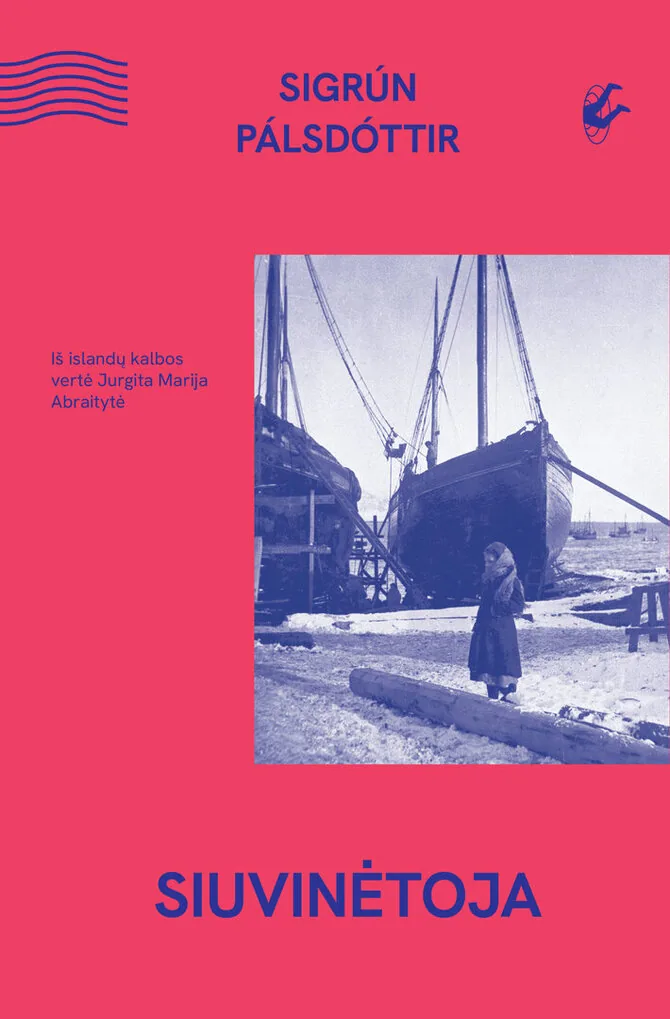
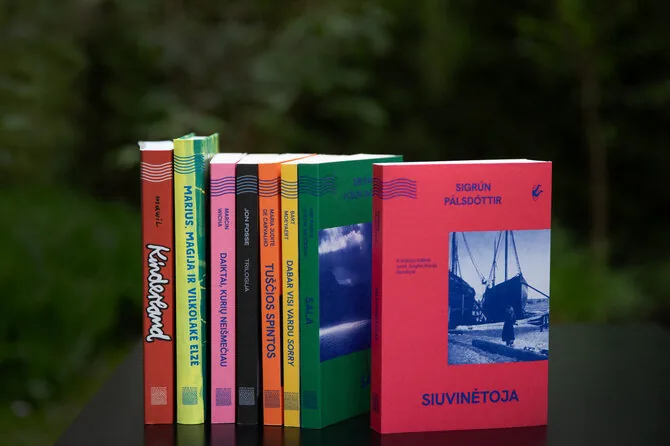
In 2021, Sigrún Pálsdóttir’s novel “The Embroiderer” won the European Union Prize for Literature. The judging panel praised it as a work showing “mastery of form and style,” and the story itself is “concise and precise” – original, modern, yet accessible and engaging.
The novel was translated from Icelandic by Jurgita Marija Abraitytė.
We invite you to read an excerpt from the novel.
Picnic. Late summer of 1896
Early in the morning, there was a knock on the door of Baldur’s house. Outside stood a distressed Silvia Pop. Unable to find her place, she waved her hands frantically in all directions. She needed help carrying bundles and baskets for the picnic. The outing was intended for several Americans who, in half an hour, accompanied by her father, were preparing to ride out to the countryside, to the valley – Etlidardalur; Susis Tordarsen changed her mind at the last minute. Time was running out, so Silvia understood the broad smile of her own Lina as a sign of agreement and hurried towards the town. Sigurlina went outside and looked at her friend hurrying down the road, waved lively to her, although she knew Silvia could not see her. Then she closed the door and, smiling, leaned her back against it. Then she jumped up and hurried to get dressed, but stopped at the room door, turned around, and looked down at the kitchen table. On it still lay the lamb shanks brought by Gudmundur.
– To hell with them! – she whispered quietly and shoved them into the pantry, then remembered everything else she had not yet done.
Unwashed clothes, embroidery for Tordisei, all the kitchen floors, a whole pile of papers on her father’s writing desk. Also two letters written in English that she had to rewrite by tomorrow. “They’ll have to wait,” she thought. She was preparing to go to the countryside – to meet strangers.
About fifteen minutes later, she was already dressed in riding clothes, holding a folded piece of paper in her palm. She placed it on the table, pushed away thoughts about her father’s reaction, and thought about her mother – that her death day was approaching. Leaving the house, she headed towards the city and was almost galloping along the main street when she finally reached Adalstraiti Street. Some drunken vagabond shouted at her – she couldn’t even say exactly what – but she paid little attention because at that moment she saw Editor Jonas Jonson walking west down the street. Handsome and lost in thought. She caught herself wondering where he was coming from so early, but continued walking on the same side of the street without raising her eyes, and so they met; she did not want him to know where she was going.
After passing Austurstraiti Street, she saw two men near the merchant’s house. They were saddling horses, and Silvia and her father were standing nearby. Soon three handsome, bearded men arrived, followed by two young women. Beautiful, adorned with dome-shaped hats and fitted jackets covering impressive dresses. Sigurlina, brushing her riding clothes, felt they were somewhat shabby, made of poor material and a bit wide. Like a tent around her slender boyish figure. But she had no time to think about it because Mr. Pop was already giving orders left and right, and instructions about the horses had been given. The riders were already in their places, and the whole mounted troop immediately lined up in the square and continued moving east across the bridge, accompanied by shouts from the American guests and questions addressed to Mr. Pop and little Pietur, the assistant, about everything they saw as they left the city. Most of the talking was done by Mr. Watson, a businessman from America who led the group; the friendly-faced gentleman Mr. Wilson and his partner – a middle-aged man Mr. Watson was the owner of the ship that brought people to Iceland. The third man, Mr. Johnson, was much younger. And overall, it seemed his mind was elsewhere. One of the ladies was Mrs. Wilson, the other Miss Baker. Sigurlina had no idea how these people were connected.
The Americans rode first. Through the cloud of dust raised, she examined the backs of both women, their elegant hats on their heads, and the shoulder pads of their jackets, so fluffy that the women’s waists looked strangely slim. As the group moved away from the city, the surrounding landscape shook from the rough rocky road. Sigurlina passed the time by crafting herself a new riding outfit from wool and velvet.
Read more Dressed-up famous guests gathered to party on the luxurious Vilnius terrace: celebrated an occasion
From Skolavordurstigur Hill, everyone turned through Oskuhlid, and from there north along Bustadarholt. As the group approached their destination, it had warmed up; when they stopped by the Kermoafoss waterfall, the sun was high. The strangers explored the surroundings, and Sigurlina and Silvia quickly began pulling bundles from the chest. They spread a white tablecloth on the ground, prepared coffee, and laid out food on the cloth: bread, pies, and a little meat. Also sausage rolls. The American women settled on the ground and, like little birds under pretty umbrellas, pecked at the food, and soon they headed to the river. All three men, including Mr. Pop and Pietur, followed quickly.
After strengthening themselves and tidying up the picnic spot, Silvia decided to join the group, but as she sat on a mound, Sigurlina pulled out her belongings. An ornamented embroidery for Tordisei. The golden threads shone beautifully in the scorching sun, but the heat under the skirts was so unpleasant that she almost wanted to lift them and scratch. Suddenly, a shadow fell on her. Looking around, she stared at large white toes in the grass.
– Hello! – said a rich voice, immediately followed by laughter.
She raised her eyes. In front of her stood the man who had led them up. Mr. Watson, tall and stocky, with lush mustaches, dark-haired. You wouldn’t say he was unattractive. According to his words, he came to Iceland to have a good time with a group of good friends. He crouched down and for a moment was much too close to her when, stroking golden flowers on a black velvet ribbon clumsily with his index finger, he whispered:
– Treasure. For sale (A real treasure. For sale)? – But before Sigurlina could answer the question, the man suddenly straightened up, stroked his beard, and looked up at the sky. – The western world is obsessed with ancient ruins and artifacts. And has been for a long time now (The Western world is simply obsessed with ancient ruins and artifacts, and has been for a long time). – Then stepping slightly aside, he stretched out, lying on the grass with his hands behind his head. He took a deep breath and continued: – Museums and collector cabinets are filled with classical remains, Roman and Greek marbles of all shapes and sizes, vases and bowls and statues (Museums and collectors’ cabinets are stuffed with antique remains, Roman and Greek marble works of all shapes and sizes, vases, bowls, and statues). Then Watson raised his other hand and pointed with his index finger. – But as these remains continue to prevail all around us, they will eventually give rise to interest in other cultures, more remote and peculiar. Like Icelandic culture (But around us there are still many of these remains scattered, so eventually they will awaken interest in other cultures – distant and unique. For example, Icelandic culture)!
Sigurlina did not know how to react to the guest’s lofty dithyrambs, but before she could gather even a few words into a short but coherent reply, people began to gather. The youngest member of the group, Mr. Johnson, giggling, approached Watson and lightly tapped him on the shoulder with one foot. Watson pretended to be asleep.
The return trip went smoothly, and when everyone finally stood in front of the merchant’s house near Laikjartorg Square, Watson politely said goodbye to Sigurlina and added that he intended to visit her tomorrow. To her, to her home – to buy embroidery and all sorts of other Icelandic items.
The trip’s goal was achieved. Returning in the twilight, she mentally sifted through the contents of her chest: embroidered bands – two of them promised to Tordisei and almost finished, also tablecloths, pillowcases, sofa covers, old balls of yarn for needles. Woolen socks? Yes, Watson had mentioned those too, she understood well. Besides, she still had quite a few gloves. After all, it was better to sell those items to strangers than to just sit and knit everything for the local townspeople all the time.