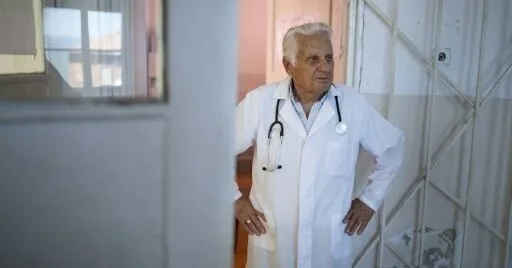
K. Apostolovas works in the village of Skrat, located at the foot of the Belasica mountains, near the borders of Greece and North Macedonia. Despite his advanced age, he climbs the same hill almost every day, visiting local residents.
Read more ICC prosecutor Karim Khan dismissed for ‘gross misconduct’
His story is not unique in Bulgaria. Many family doctors in the country work well past retirement age, as there is simply no one to replace them, especially in rural areas, AFP writes.
As of 2023, as many as 54.5% of Bulgarian doctors were 55 years or older – the highest rate in the entire European Union (EU), according to Eurostat statistics. The average age of family doctors currently exceeds 61 years.
At the same time, Bulgaria records the shortest life expectancy in the European Union – in 2024, it was 75.8 years, while the EU average was 81.5 years. According to the Organisation for Economic Co-operation and Development (OECD), the country also has one of the highest rates of avoidable deaths.
Experts indicate that one of the reasons for this is the shortage of doctors. Due to this, diseases are often diagnosed too late, and chronic diseases are treated insufficiently effectively.
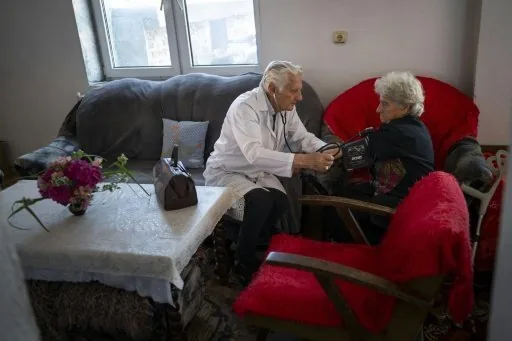
One doctor supervises more than 1,500 patients
K. Apostolovas’s patient list alone includes more than 1,500 people living in several surrounding villages.
“How are you feeling today?” he shouts over the fence to two elderly women talking in the yard of a house.
After a brief consultation, 88-year-old Milka Umlenova has nothing but good words for her doctor.
“He’s even older than me, but he walks without a stick. And I have two. May he live long and continue to take care of us,” the woman says.
Work day starts at seven in the morning
The doctor’s day begins around 7 AM. Then he gets into his 20-year-old Peugeot and drives about 16 kilometers from the town of Petrich to Skrat.
Often, patients are already waiting for him. Some come for high blood pressure, others for diabetes or other health problems.
“So far, I feel good. Work doesn’t tire me. I will work as long as I feel capable and patients are satisfied,” the doctor says, sitting at a massive wooden table.
Read more «Fantazijos.lt» co-founder — about fear, failures, and a business few people believed in
Dressed in a white coat and light blue shirt, he opens the office door at 8 AM.
In the old brick building, medicines and syringes are stored in display cases dating back to the mid-last century.
At noon, the doctor leaves to visit patients who can no longer come to the office themselves, and in the afternoon, he drives around the surrounding villages.
“Young doctors don’t come here”
K. Apostolovas says he would gladly give his place to a younger colleague.
“I would gladly step aside if there was someone willing to work here. But there are no young doctors,” he laments.
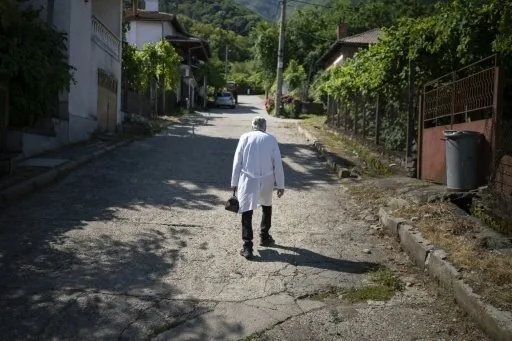
He began his medical practice in 1962 as a district doctor. Later, he headed a hospital department in Petrich, worked as a cardiologist, and settled in Skrat only in 2000, already past 60.
Over more than six decades, medicine has changed significantly, but, according to him, knowledge and accumulated experience remain no less important.
Family doctors are aging, and there is no replacement
According to OECD data, although the number of doctors in Bulgaria is not small overall, the primary healthcare system remains underdeveloped, underfunded, and undervalued.
Gergana Nikolova, vice-president of the Bulgarian National Association of Family Doctors, says that family doctors bear the greatest responsibility.
“We are the Atlas holding everything on our shoulders. Only this Atlas has grown old,” she says, referring to the hero of ancient Greek mythology.
According to her, young doctors avoid choosing family medicine as a specialty, especially in the regions. They are deterred by the heavy bureaucratic burden, limited career opportunities, and relatively low salaries.
Nevertheless, G. Nikolova is pleased that she has managed to inspire more than one young medic.
“I am proud that I ignited a spark in several young doctors who are now studying with me. I myself studied with Dr. Apostolov more than twenty years ago,” she says.
Read more Cardiologist pleads – give up these 3 habits: they only provoke stroke