The same feeling came over me during the Youth Theatre’s play “The Brothers Lionheart,” which I watched with my sons five times. Karolis Junatanas and Matas Dirginčius’s Toast became not just characters for the children, but true heroes of the heart – brave, warm, and real. Their story lived on in our home for a long time: in the evenings at the table, in drawings, and in children’s conversations.
Read more In Vilkyčiai, European autocross machinery roared: the first training sessions began
And later, watching him masterfully parody Oskaras Koršunovas on the show “Stonkus gyvai,” I laughed out loud – it was true mastery of parody, witty, accurate, and very persuasive. However, I understood Karolis as a phenomenon when I learned about his Ironman: an actor who not only plays strong characters but also overcomes one of the toughest physical challenges in the world – that’s something more than a profession.
And he finally won me over the day he arrived on a scooter to film at my house. Following the tradition of the podcast “Mizanscenos. Theatre Stories with a Maine Coon,” I asked him to bring his favorite mug. Karolis brought two: one with a blood donation emblem, the other from the “Tu esi” (You Are) suicide prevention organization. Because he not only talks about meaningful things but also acts – he is a blood donor and an active ambassador.
At that moment, I realized – before me stood a person with whom it was easy and natural to talk, as if we were old friends who had overcome more than one half-marathon together.
You can hear more of our conversation in the podcast “Mizanscenos.” And there, of course, it happened that the Maine Coon cat decided to wash Karolis’s hair…
K. Kasparavičius is interviewed by Aneta Anra.
– Karolis, Elektrėnai is a city that many first associate with ice hockey. Legends grew up here: Darius Kasparaitis, Dainius Zubrus, rest in peace Mindaugas Kieras… And you yourself later became an “Ironman,” overcoming one of the toughest physical challenges in the world. Athletic strength seemed to be written into your DNA. And yet, theatre appeared in your life. How did it get there? How did the path from the Elektrėnai ice arena lead to the theatre stage?
– Theatre in my life is, first and foremost, my mother. She works as a Lithuanian language teacher at school, but in her youth, she studied theatre directing and Lithuanian language with Povilas Gaidys in Klaipėda. After returning to Elektrėnai, she started teaching.
Perhaps I became her unfulfilled dream. She never specifically pushed me onto the stage or into theatre, but she organized the “Felicija” theatre festival at school and took us to recitation competitions. I always felt a quiet but clear guidance from her: that such a path also exists.
Although until the twelfth grade, I had seen very little real theatre, just two plays.
One of them was Gintaras Varnas’s “Crime and Punishment” with Gytis Ivanauskas at the Kaunas National Drama Theatre. I was fourteen or fifteen, had a laser pointer, and shone it into Gytis’s eyes for half the play. Many years later, we met, and I sincerely apologized to him (laughs).
The second play took place at the Elektrėnai Culture House; a play with Rolandas Kazlas came to visit.
At that time, I had a band at school and was firmly convinced that my path was music. However, a year before applying to the academy, my friend Darius Petrovskis enrolled in acting. He became a living example for me. I used to visit him in the dormitory, watch how they lived there, and I found it incredibly interesting.
Initially, I planned to fly to London to study music. But I thought: “I’ll try acting too.” It seemed like it would be easy, fun, and I’d have a good time. I went to the entrance exams, got in, and decided to stay in Lithuania.
And then the studies began… I quickly realized that everything would be completely different from what I had imagined. After the first year, I seriously considered leaving the academy. But then the course leaders changed, and Eglė Gabrėnaitė came to us. We had a very long and important conversation. I told her: “Eglė, I’m leaving.” And she replied with many beautiful and wise words. “Go for a walk, think about it, and if you want, come back anytime.”
During that conversation, something changed within me. I saw that there was a wider world, that not everything was so dark and fateful. That we act about this world. Eglė showed me the light. From then on, I started to look at the profession differently, to be more interested in theatre and literature.
Suddenly, it became very interesting. Because in this profession, we constantly think about people. And thinking about people is a great privilege. Trying to understand and justify people whom you initially don’t understand at all – that’s very interesting.
That’s how I ended up in theatre.
– When you started studying, were you already actively going to the theatre? Were you trying to fill those gaps?
– I attended plays as much as the academy schedule allowed. I was very busy, but I tried. Most of my classmates were already well-versed in theatre, could talk about everything, and I felt a bit on the sidelines. So I went wanting to understand what they were talking about. Watching plays, I saw that theatre could be very diverse, and I discovered things that were truly interesting to me.
– And did actors seem like some unearthly beings to you before your studies? For example, when I was in school, I used to ride the trolleybus with Regimantas Adomaitis and couldn’t believe he was a real person with a red scarf.
– I didn’t feel such deification, perhaps because I didn’t know the actors. When they said that Eglė Gabrėnaitė would be joining our course, I didn’t even know who she was. I only knew she was an actress. Later, Eglė and I discovered an interesting thing – we had met in school. She had come to a recitation competition and invited me to apply for acting, and I boldly told her then that I definitely wouldn’t (laughs).
Now that I am in this profession myself, I know how much it costs, how difficult it is to create a good role. I have great respect for actors who are professionals in their field.
– Do you have any favorite plays?
– Eglė Gabrėnaitė once said: “We are always preparing for something big.” One such play is “Othello,” staged by Gildas Aleksa at Teatronas. We performed in an apartment for about ten to twelve spectators. Together with Matas Dirginčius, Milda Naudžiūnaitė, and Milda Jonaitytė. We would sit in a circle, as if at a table, eat potatoes, drink champagne, and just live that life. We performed the play for about three years. It was a very interesting journey, because acting when the audience is so close, and the material is difficult and full of challenges – that’s a special experience. We had a very meaningful time.
At the Youth Theatre, “The Brothers Lionheart” is a very dear play to me. Through it, I truly got to know theatre and met a person who became a very good friend of mine – Matas Dirginčius. Of course, one of the most important is “Stand-up for Meaning and Meaninglessness,” released last year. The theme of this play is personal and important to me, something I’ve wanted to talk about my whole life.
– And how did “Stand-up for Meaning and Meaninglessness” come about? Did Eglė Švedkauskaitė find you herself, or was there an open audition process?
– There was an open casting call. I thought: “Well, I’ll go say hello, I have nothing to lose anyway.” I sent a video and was invited to the audition, where we performed tasks, and then Eglė said that the play would be about suicide. My eyes immediately lit up, my concentration completely changed. At the end of the casting, I approached Eglė and said: “I must be here. Even if I don’t act, I want to be close, I want to help, I want to talk about this topic.”
Later, there were second and third rounds, which I passed. That’s how I ended up in the play.
– “Stand-up for Meaning and Meaninglessness” has become one of your most frequently performed plays – you’ve performed it about 40 times in two seasons. Compared to the Youth Theatre – is this an exceptional case in your career?
– Yes. I also have very dear plays at the Youth Theatre. Now I am in very good acting shape, it’s my time to act, and I can’t afford to sit and wait. Therefore, I am glad that I have the opportunity to create in other theatres as well, and for that, I am grateful to the Youth Theatre.
– And after such an intense and emotionally difficult play as “Stand-up for Meaning and Meaninglessness,” do you manage to fully “exit” the role? Is it even possible for an actor to completely separate from what they experience on stage?
– I don’t know. Maybe we never fully exit the role, or maybe we never fully enter it. It’s hard to say. When I’m rehearsing a play or preparing for a premiere, my fiancée Guoda is ready, because she knows I’ll be somewhat different. These aren’t very obvious changes, but small micro-things that sometimes you don’t even feel yourself.
– Do you remember your last “Stand-up for Meaning and Meaninglessness”? What do you do after such a performance – how do you return to reality?
– After the last performance, Vitalija Mockevičiūtė and I went to eat. We ate, talked, tried to clear our heads, shared how we felt. Vitalija has become one of the closest friends in my life. I thought it was harder to find true friends at this age, but it happened. Vitalija and I talk not only about the process but about life in general. We care for each other, share what we’re experiencing.
Of course, it’s not easy after a performance. Then I try to calm down, talk to someone, exercise, do something… At the same time, it also heals. The more bravely you bring such things into the public, the more open and free you are.
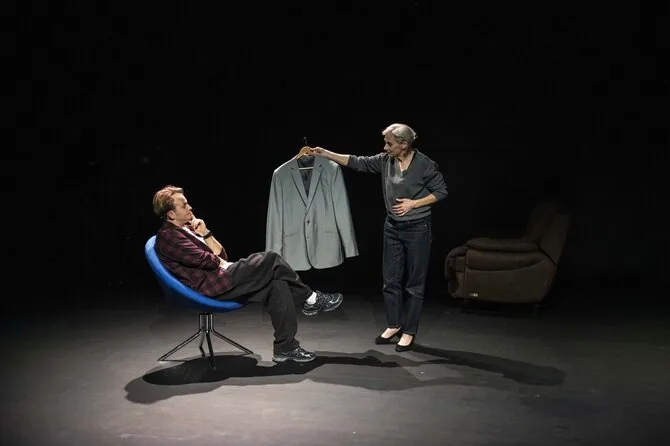
– Today, you actively speak about emotional difficulties and suicide prevention: you have become an ambassador for the national initiative “Tu esi” (tuesi.lt). This platform, initiated by the Hygiene Institute, is intended for those experiencing a crisis, their loved ones, and specialists. It encourages open sharing and seeking help. You yourself have publicly said very warm and humane words: “Hold on, talk, and don’t give up. Life is beautiful, and after darkness comes light. I know these are just words. But if you feel this way and have no one to talk to, you can confidently write to me. I don’t promise to help, but I will definitely listen and share my experience. You are not alone. Hugs.” Is it easy for you to speak so openly about this topic publicly, or do you sometimes feel an internal desire to protect it somewhat?
– I can talk about it openly. I had very close people who took their own lives. I also have friends who passed away. This topic has accompanied me my whole life, and I’ve been dealing with it since I was about 15. My mission is simply to share. Initially, it was more an online activity, but now we plan to hold discussions, go to smaller towns. In cities, people already talk somewhat about feelings and inner things, but in smaller towns, that’s often not the case. It’s very important to reach men over 60, as the suicide rate is highest among them.
– What should you do when someone next to you opens up and shares such difficult thoughts? What’s the best way to talk to them, how to comfort them, and most importantly – how not to make things worse?
– First of all, listen. I wouldn’t give advice in this case, especially if the person is in crisis: that’s a job for professionals. If someone approaches and asks “what should I do?”, it’s best to say: “I don’t know, but if you want – tell me.” Just talk to them as a person, not as a “case.”
My sister is also very deeply involved in this topic. She is currently studying for a master’s in psychology and works at Jaunimo linija (Youth Line). We talk about this topic in our family.
– Thank you, Karolis, for speaking so openly and bravely about these things. It’s certainly not an easy topic. Let’s return to theatre. I want to continue about your relationships with colleagues. Your friendship with Matas Dirginčius, which seems very real and warm on stage.
– Yes, Matas and I are very good friends. When it’s time to move, we help each other. Last summer, the three of us, with director Adomas Juška, went to northern Sweden for three weeks – we did a 200 km hike.
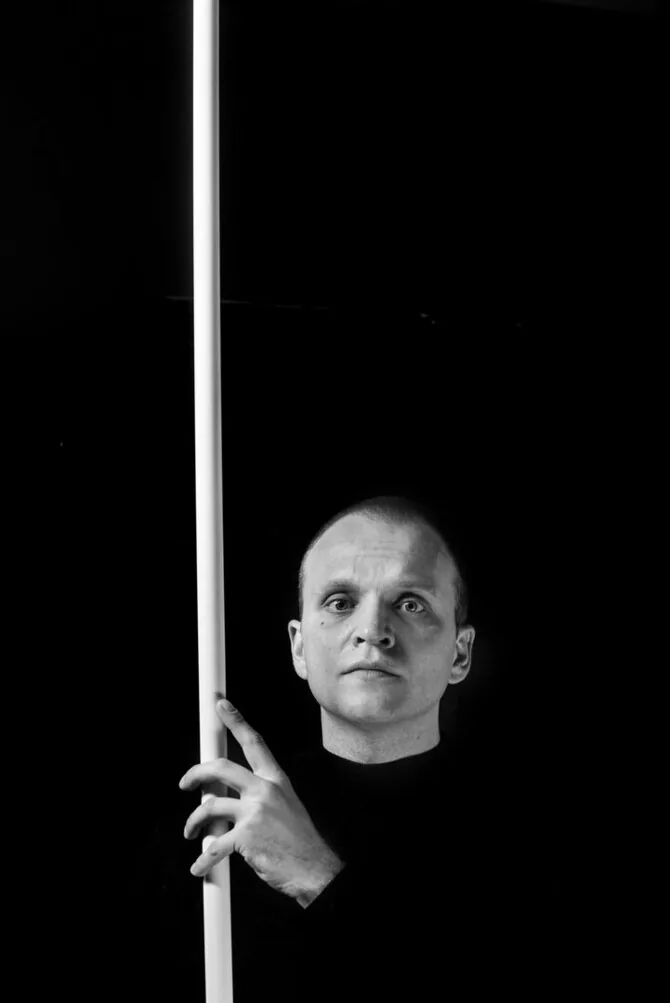
Together, we have already performed about 11 plays – not only at the Youth Theatre but also in others. We started with “The Brothers Lionheart,” then “Othello” appeared, and so it grew. We call each other brothers.
There are such precious processes that bring people very close. Matas is the person to whom I can tell everything. And there aren’t many such people.
– Theatre is often talked about as an environment full of envy and competition – “why did he get the role and not me.” How do you manage that? Have you had to go through this internal challenge?
Read more Sinkevičius: if the party thinks my position is wrong, maybe they didn’t elect the right chairman?
– Yes, at first it was relevant to me. The more you envy, the more you poison yourself. And when you start to be happy for others, to understand why he got the role and not you, and to accept who you are – then life becomes much easier.
I have almost eliminated that moment of competition from my life. I really dislike those negative emotions created internally. They only unbalance you. Then an inner voice says “why, why do you need that,” and you have to heal yourself until it’s gone. I try to avoid that.
– It seems that a conscious lifestyle helps you find this internal balance. I notice that theatre is changing – there’s more and more talk about a healthy lifestyle. How do you see this change yourself, and what is your position?
– That’s true, everything is changing. I’m very glad it’s changing. A healthy lifestyle is fashionable in the world now, and theatre cannot lag behind. In theatre, we think, create, talk about important things: meaning, death, everything. But why act about death if you yourself are not living life? That’s my opinion. Of course, everyone is very different, but I would like theatre to be a creative process that brings pleasure and meaning to the creator themselves. Because otherwise, what’s the point of creating?
Most of my life is not performances, but rehearsals. I spend about 50 percent of my life there. And if I live that half in darkness – I don’t want to. That’s why balance is very important to me. Sports help a lot here. When you rehearse difficult topics, daily for four months you smash a baby imitation against a wall and dive into darkness, after that you need to go home and live. Sports bring blood back to the brain, reminds you that everything is fine.
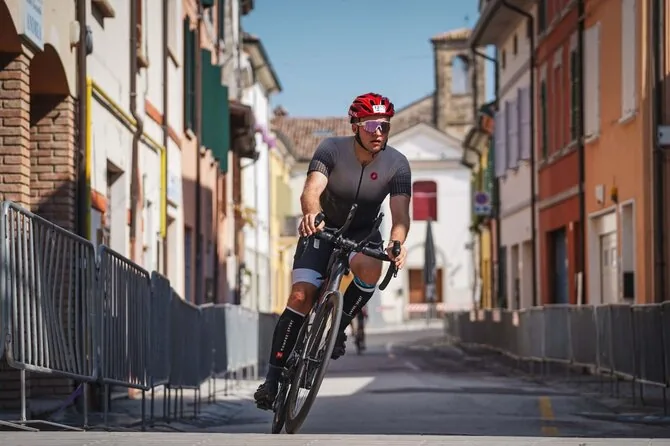
– And what helps you maintain this balance the most – running or the gym?
– Routine helps me the most. I can’t say exactly which sport is best, but running is exceptional. I’ve tried many sports, but after running, I get more dopamine than after anything else.
After a run, I immediately grab my phone, reply to emails I haven’t replied to for two days, call people. Anxiety disappears, motivation to act appears. If I’m very angry – I go play ice hockey. There’s contact, men push each other around, and you calm down (laughs).
The gym is more like a toothbrush to me: you need to take care of your body. It’s monotonous, many people, noise… It’s not my favorite thing, but I have to do it. I can’t do otherwise.
– So how many times a week do you exercise?
– I try to exercise four to five times a week. Including running, strength training. I try to plan it like this: one day rest, two days exercise.
Of course, nutrition is a very important thing, because when you’re preparing for an Ironman, you need to calculate calories and micronutrients as precisely as possible. When you get used to it and understand how it works, then you get used to feeling good. And if one day you sleep not 7, but 6 hours, you already feel that something is wrong. Then you become addicted to the feeling of feeling good (laughs).
– I understand that those deep conversations over wine often drain twice as much energy. And speaking of discipline and inner strength, your story about the Ironman really stuck with me. Tell me, how did the idea to take on such an extreme challenge come about?
– It all started because of a failed theatre project. I was sitting in a wine bar with a friend and he said: “You know, I’m doing an Ironman.” I knew what it was. I said: “Me too.” We shook hands. He did it that summer, and I didn’t.
At that time, I had reserved half a year for rehearsals with Krystian Lupa – I had gotten into the casting and was waiting for a role. But in the end, I didn’t get into the play. And then I thought: “Well, okay… Half a year of free time suddenly appeared.” I asked ChatGPT how quickly one could prepare to complete this triathlon – it told me from six months to two years. Six months suited me! And I registered for the Ironman.
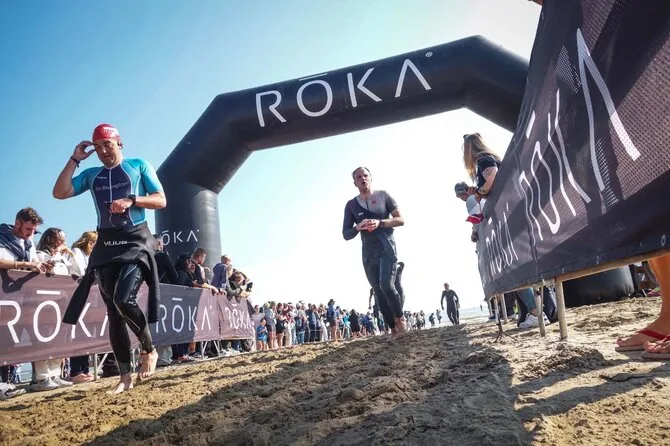
– And then everything started to snowball?
– Well, one day I went to the sauna and met a producer. I said: “Maybe we can make a documentary about me preparing for an Ironman.” He said: “Let’s do it.” And a week later, he brought me a GoPro camera: “Here, film.”
That’s how it all began. A six-month journey that I hadn’t planned at all initially. At the same time, I was rehearsing “Stand-up for Meaning and Meaninglessness” and preparing for the Ironman. Finally, I did the Ironman, and three weeks later, the premiere of “Stand-up” took place.
That six months was important to me. I grew a lot. I understood what kind of person I want to live with, what kind of life I want to create. I got many answers.
You ride your bike at five in the morning to the Belarusian border and back, and then to rehearsal. All the time alone. A lot of time to think about yourself, about what’s happening, and what you really want. I’m not afraid of suffering. I’m only afraid of meaningless suffering.
– And how did the competition itself go in Italy?
– The competition is the icing on the cake. The hardest part is the preparation. I think I dedicated about 250 hours to training in total.
The competition took place in Italy. We fly in, I unpack my bike – it turns out something is broken. It’s raining, bike repair shops are closed. Maximum stress, not knowing if we’ll manage to fix everything, or if it will even happen…
On the morning of the race, at five o’clock, I’m driven to the start zone. Sunrise. I stand, smoke a cigarette, and realize – it’s going to be a beautiful day.
I got into a huge queue, waited for the start for about an hour. They let five people at a time to avoid congestion.
– Where did you swim and how did the first event go?
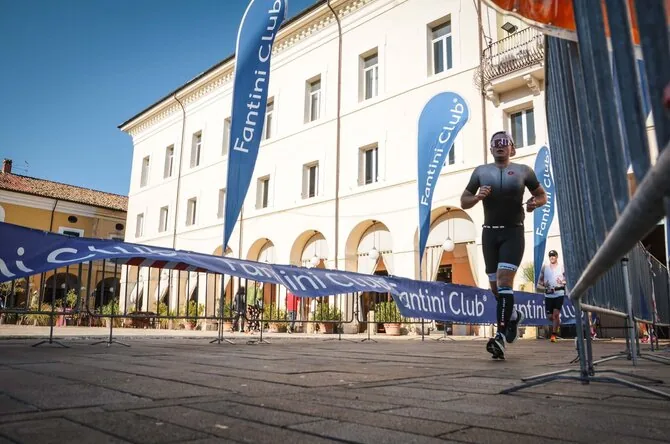
– In the Adriatic Sea, 4 kilometers. The start was quite far from the shore, you swim, swim, then turn back. It was such chaos there. I made a mistake – I stood too far back. Everyone around was slow, so I had to overtake many people. And overtaking someone in the sea is a real meat grinder. But somehow I managed and swam it in an hour and a half.
– And were the waves big while swimming?
– Very calm. The sun was just rising, complete calm – ideal for swimming.
– Then the cycling event began. How did 180 kilometers in the Italian mountains go?
– I get out, jump on the bike and ride 180 kilometers. I rode for 6 hours. Italy, mountains, only two serious climbs. Very beautiful.
– Were there moments when you felt like you were going to die?
– Not yet. Since I was very well prepared, swimming and cycling went smoothly. The most important thing is to control the average speed and heart rate. With the coach, we agreed that my pulse should not exceed 140bpm. I had a belt and a watch, I monitored everything in real time. If the pulse rises, you slow down a bit. It’s a game with your body.
I swam in an hour and a half, then – 180 km by bike. When I returned to the end of the track, where you leave your bike, I saw my people: my sister, fiancée, cousin, friends. It was a real celebration there. Out of joy, I started running too fast. For the first few hundred meters, I ran happy, elated. I look – I’m running too fast, my pulse jumped to 190. The coach had said: “After getting off the bike, don’t rush.”
And then it started… My intestines started to hurt inhumanly. I suffered for a whole hour. Apparently, sitting on the bike for a long time compressed all the organs. I ran and thought: “I’m going to die, explode, I’ll stop soon.” But after an hour, I broke through the wall.
The running track – four laps of ten kilometers each. On each lap, I would meet my people. Sometimes someone would join to run together, talk – that helped a lot. With ten kilometers left until the finish, everyone went to the finish zone to meet me. Then the most psychologically difficult part began.
You see people sitting, walking, I saw paramedics resuscitating a man in an ambulance. My body and brain scream: “Stop!” But with five kilometers left, I saw three Ukrainians with a flag. I joined them, we chatted, and it got a little easier again.
Finally, I run to the finish line. There’s that famous bell for first-time Ironman finishers. I run up, and there’s such a small bell. I ring it and break the string. Emotions overflowing.
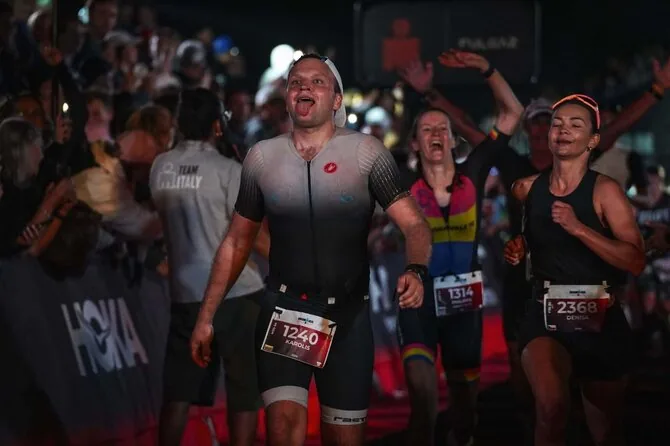
After the finish, I go to the tent to recover. And that’s when it starts: shivers run through my whole body, my legs buckle, cramps begin. I look around – people are lying on the ground, some are shivering in foil blankets. It looks like after a war. I realized I didn’t want to be there. I went outside, met my people, lit a cigarette, and thanked those who were there.
The next day, we learned to walk again. I finished in 11 hours and 48 minutes. Such a short story.
– And now there are concrete plans for a documentary about your Ironman journey?
– Yes, everything is in process, the editing is moving, but in life, not everything happens as quickly as we would like. But I have wonderful editors and now I know that the documentary will be fun.
– How many episodes are you planning and what is the working title of the film?
– An eight-episode documentary series, each half an hour long. We are thinking about the title. One option is “Karolis, Master of Follies,” another is “Iron Art” (Iron Menas – a play on words, “menas” means art in Lithuanian).
– Would you repeat such an Ironman journey?
– No, probably not. Unless someone invited me to do it together – then maybe. But not alone. There are still so many things untried in life, and so little time. I want to climb mountains, cross deserts, fly – I want everything. I want to live. Ironman was one of those big challenges.
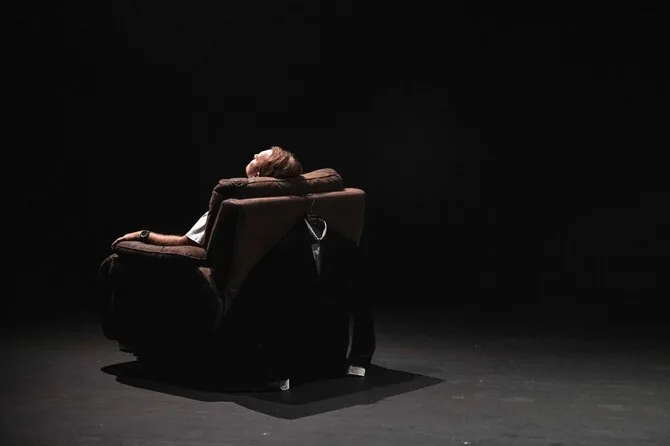
– You just finished filming a short film with students, where you had to learn figure skating. How did you manage to combine theatre, performances, and night filming? And why do you generally like working with young creators?
– Sports are always a part of my life, so it was very interesting. I play ice hockey often, and I always viewed figure skating as something very beautiful and fragile. It turns out it’s an incredibly difficult and very creative sport.
We filmed like this: rehearsals in the theatre in the mornings, performances in the evenings, filming at night. For three nights in a row, I slept 2–3 hours, driving Kaunas-Vilnius.
I like working with students. That desire overcomes a lot. And when everyone tries, searches, and takes risks – that’s when interesting things are born.
– How do you imagine yourself at eighty?
– Calmly, at my homestead, grandchildren running around, and I sometimes return to the city to act, participate in a concert, an exhibition, watch a play. I really hope I can exercise and enjoy my well-deserved rest. Most importantly, that my conscience is clear.
Read more Parisians will be able to swim in the Seine river again this summer