









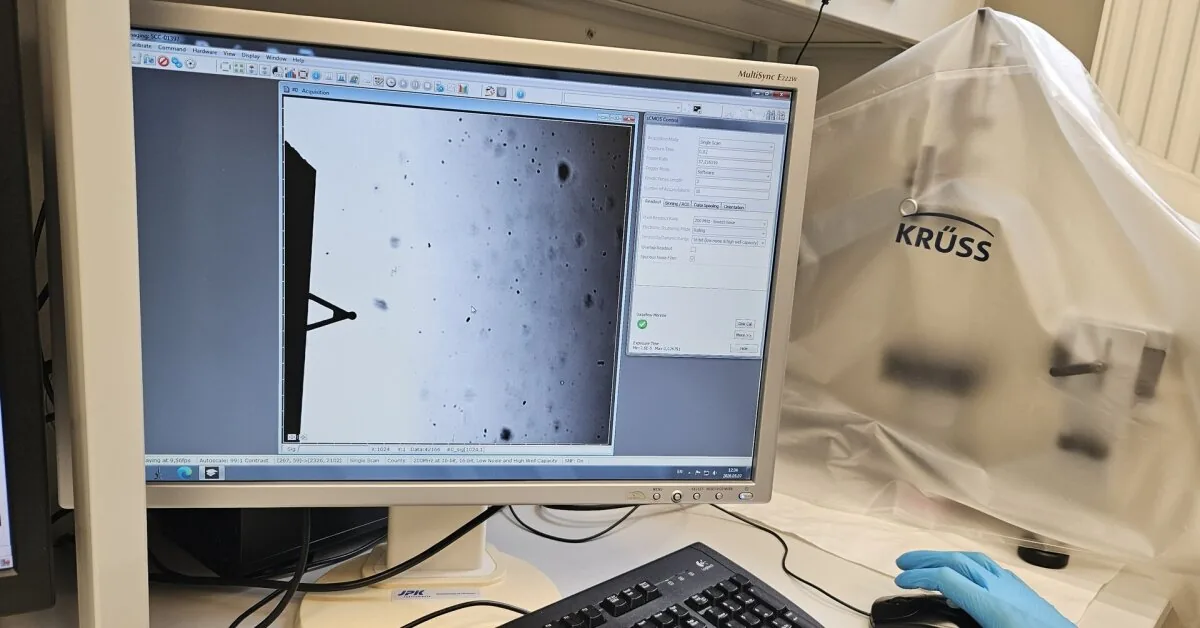
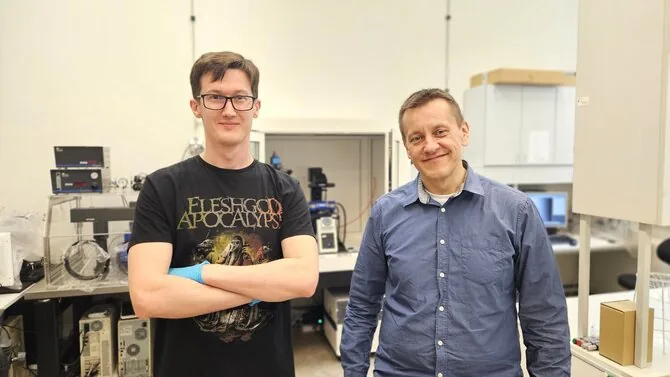
Scientists Dr. Artūras Ulčinas and PhD student Tadas Jelinskas from the Nanotechnology Department of the Center for Physical Sciences and Technology (FTMC) are contributing to the solution of this problem. They are carrying out a European Space Agency (ESA) project, during which they are researching human cartilage cells – growing them in the laboratory, testing them with microgravity experiments, and literally pressing them with an atomic force microscope, observing cell changes. All of this is necessary to better understand how astronauts’ cartilage changes in space.
Read more As the dispute over US visas continues, the Iranian football team departed for Mexico
According to the interviewees, these experiments are the first of their kind in the world, and the initial results already provide a lot of valuable information.
Cells also feel pressure
In the Nanoforming and Biochip Technologies Laboratory of the FTMC Nanotechnology Department in Vilnius, scientists are looking for answers to how materials “behave” in dimensions smaller than a living cell. They investigate the chemical properties of materials, molecular structure, as well as mechanical properties such as stiffness, surface roughness, or relief. All of this determines how a material functions.
“Our goal is to understand how the combination of different properties at the nanoscale determines the final function of a material, and to learn how to form these materials to achieve a specific result. This could be, for example, superhydrophobic coatings – self-cleaning glass or surfaces. Conversely, it is also possible to create highly wetting surfaces over which water flows easily. Another important application is locally activated reactions, where, using light or other stimuli, the surface acidity is changed in specific areas,” says Dr. Artūras Ulčinas, head of the laboratory.
One of his team’s main tasks is how to apply these methods to human body research. For this, scientists use mechanobiology – a developing branch of science that you probably haven’t heard of. Mechanobiology investigates how cells change due to pressure, tension, vibrations, and other mechanical forces acting on them. It is stated that cells actually directly feel all these processes and react accordingly by changing their “behavior.”
An everyday example of this is exercise: when we perform exercises at the gym, muscle cells experience pressure and tension – they then “understand” that they need to strengthen and begin to produce more proteins.
The fact that cells are affected by external forces can also be understood from the scientific world: to grow heart tissue from stem cells in the laboratory, it is not enough to place them in a certain medium – the cells need to be stretched and released so that they “think” they are a beating heart.
The body reacts this way not only to physical activity but also to inactivity: if we move less, muscle cells “no longer want” to work, receive a signal that the body no longer needs to be strengthened, and they simply shrink.
And this applies not only to muscles but also to practically all tissues, including the object of FTMC’s scientific research – joint cartilage.
Fundamental knowledge will also bring practical benefits
“Cartilage tissue is constantly being compressed and pressed, especially when we walk or run. Our tissues are accustomed to receiving one kind of physical load or another, but astronauts in space do not experience such loads. And not only them – if a person is paralyzed or suffers from another disease that forces them to lie in bed constantly, the tissues will also not receive the necessary load.
Muscles are able to regenerate faster, but cartilage is a tissue that regenerates very slowly. Therefore, it is important to find out why this is – and how we might be able to stimulate cartilage regeneration.
Science has long observed that muscle and cartilage structures change when gravity is lost. However, it has not yet been answered what specifically happens to individual cells,” says FTMC doctoral student Tadas Jelinskas.
The opportunity to examine these questions arose when ESA announced a call for Lithuania, as an associated member of the agency, to participate in a project by submitting ideas for doctoral studies. Thus, the project is also part of Tadas’s dissertation work.
According to A. Ulčinas, his doctoral student’s research will not immediately offer concrete solutions for astronauts, but it will provide valuable knowledge to scientists worldwide:
“Pure science is about creating new understanding of our surrounding environment. When that succeeds, then engineers who create devices, pharmaceutical manufacturers, physiotherapists join in… New opportunities open up. And in our case, the accumulated knowledge can be widely used in the desired direction.
The world is already looking for ways to transfer tissue stiffness measurements into clinical practice. This would allow for faster and less invasive detection of early tissue changes than currently. In addition, these methods can be combined with the cultivation of organoids or cell cultures.”
Swinging and poking cells
In the FTMC Nanoforming and Biochip Technologies Laboratory, experiments are carried out in several stages: after purchasing human stem cells, scientists grow them into the desired cartilage tissue. These cells, depending on the conditions, can become bone (if in a hard environment), cartilage, or adipose tissue.
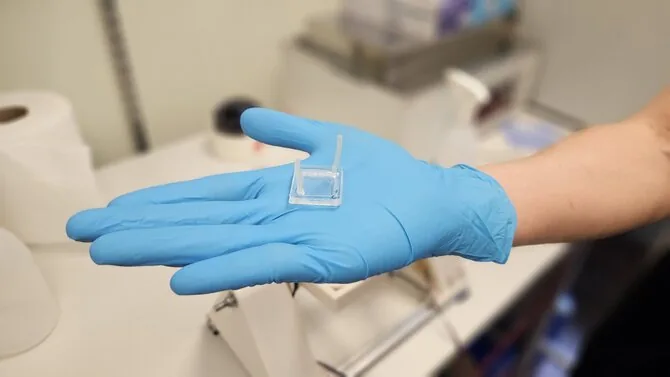
T. Jelinskas and A. Ulčinas place the cells in a jelly-like medium called hydrogel. 95% of this medium is water, and it is special because it mimics the natural environment of cells. Water and nutrients – vitamins, amino acids, and other beneficial substances – flow in the hydrogel. And for the cells to grow into cartilage, they are also fed with appropriate proteins.
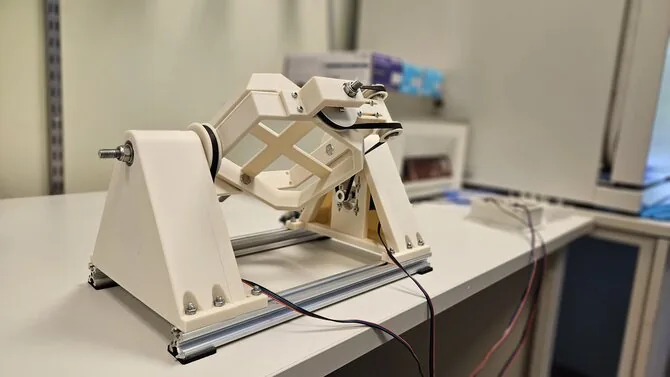
When the cartilage is sufficiently formed, the scientists place the cell (a small container) with these cells into a clinostat – a laboratory device that rotates in various directions, thus making the cells “feel” as if they are no longer affected by Earth’s gravity, similar to space. Tadas Jelinskas constructed the clinostat himself and jokingly calls it a carousel for cells.
“Essentially, this apparatus constantly rotates the cells around two axes. As a result, gravity affects them in one direction, then another. If we look over a longer period, all directions seem to equalize – there is no single dominant one, so the cells do not receive a constant signal and cannot settle in one position.
We can imagine it this way: if you hold a spoon with honey, it slowly drips down. But if you constantly rotate the spoon, the honey will continue to move but will not drip in one direction. Cells “behave” similarly.
Read more Friendly matches – Portuguese strikes and Belgian anger
Under normal conditions, their cytoskeleton – the internal “framework” – forms and reaches a certain stable structure. Of course, it can change if the cell moves or changes its state, but it usually remains quite constant. Under microgravity conditions, such a stable state is not achieved – the cytoskeleton constantly reorganizes and tries to reorient itself,” explains A. Ulčinas.
Cells that have been in “space” are finally placed under an atomic force microscope. This device has a thin rod with an even thinner needle, invisible to the naked eye, which can be sharpened to a radius of 20 nanometers – an area that can accommodate from several tens to several hundreds of atoms. Such exceptional sensitivity allows individual cells to be “probed,” pressed, their stiffness measured, their response to vibrations, and other changes observed. And to prevent the needle from piercing the cell, a rounded ball can be added to its tip.
“Therefore, we aim to study not only the altered cell cytoskeleton but also its other structures – the so-called organelles. For example, we can see how the nucleus changes: whether it becomes more compact and stiffer, or, conversely, less compact and softer.
We hope to measure such parameters and then correlate them with other observed changes – cell shape or biochemical signals. This is precisely why this topic seemed relevant to the European Space Agency,” says A. Ulčinas.
Speaking about atomic force microscopy, he gives another everyday example. To check if a basketball is sufficiently inflated, we squeeze it with our hands or bounce it on the floor, observing how it rebounds. Similarly with cells: in one case, the microscope needle is pressed into the cell, and its resistance to deformation is observed – from this, using physical models, the so-called Young’s modulus, which describes the cell’s stiffness, is calculated.
In another case, the microscope rod constantly vibrates and acts on the cell at different frequencies, as if “kneading” it. This allows evaluating how energy behaves in the system – how much is returned, how much is dissipated. This way, the stiffness and viscosity of the entire cell and its individual organelles can be determined, and each such change can be significant for human health.
Such studies have not been done before
FTMC doctoral student T. Jelinskas has been carrying out this work for a year and a half. During this time, the effect of microgravity on cells has been tested, and the latest results prove that cells soften under space conditions.
“This recently completed experiment essentially confirmed that the year and a half of work is effective and can provide answers to the questions raised by the European Space Agency. We see that microgravity indeed reduces cell stiffness – they become softer.
The stiffness of living cells in various contexts, using atomic force microscopy, has been studied for 15 years, perhaps even more, and now it seems we have found an answer to the “cosmic” question.
Tadas’s experiments suggest that cell softening may also be related to other changes – biochemical signals or cell phenotype, i.e., their shape and interaction. These connections will still need to be confirmed by further research, but our initial result on cell softening has already been achieved,” says A. Ulčinas.
According to the scientist, T. Jelinskas’s main work until now has been to prepare the scientific equipment, experimental process, and methodology to obtain the desired results: “This is truly a huge undertaking, as such experiments have never been done anywhere in the world before.”
Another important study conducted was Tadas’s observation of how three different surfaces on which cells are grown influence their reaction to microgravity.
“We used glass as a standard because it is widely used in many laboratories. We also studied two hydrogels: one of them from natural protein collagen, extracted from pig skin, and the other a completely synthetic hydrogel, made from a collagen-mimicking peptide (a short chain of amino acids).
I compared how the natural hydrogel works and how it differs from the synthetic one. The advantage of the latter is that its properties can be very precisely controlled. Meanwhile, biological materials exhibit greater variation – for example, collagen can differ depending on the organism from which it was extracted. In addition, natural materials may contain endotoxins or other impurities associated with viruses or bacteria. These problems are essentially avoided in synthetic materials,” says T. Jelinskas.
The doctoral student obtains the synthetic hydrogel from the Lithuanian company “Ferentis,” which is FTMC’s commercial partner in the ESA project. This aims to ensure that, even after the project ends, the work continues and becomes real innovations.
During his research, Tadas observed that cells adhere better and maintain a more stable shape on the natural collagen surface, and microgravity affects them somewhat less. Meanwhile, on the synthetic hydrogel, cells more often change their shape and tend to detach from the surface.
Incomprehensible scales
“Cosmic” cell research is taking place at a time when our gaze is once again turning more frequently to the sky after several decades: the world’s attention has been captivated by the successful “Artemis II” mission flight around the Moon, discussions are underway about a new human landing there, permanent bases; Mars, which humanity also seeks to visit, has not been forgotten. Do FTMC scientists feel that they are doing something important?
“It’s quite fun to fantasize that one day someone might even fly our hydrogel to the Moon’s surface,” shares T. Jelinskas, who has already been approached by specialists from various fields during his doctoral studies, having learned about the microgravity research being conducted.
“Otherwise, all this seems somewhat comical. When we think about the Universe, we imagine those endless expanses, where there are as many stars as grains of sand on a beach. Unfathomable grandeur.
Meanwhile, we work on scales that are difficult to comprehend in their smallness. And this contrast prevents us from completely ‘flying off’ into space,” smiles A. Ulčinas.
Read more After the storms – great news: pleasant summery weather will pamper us