








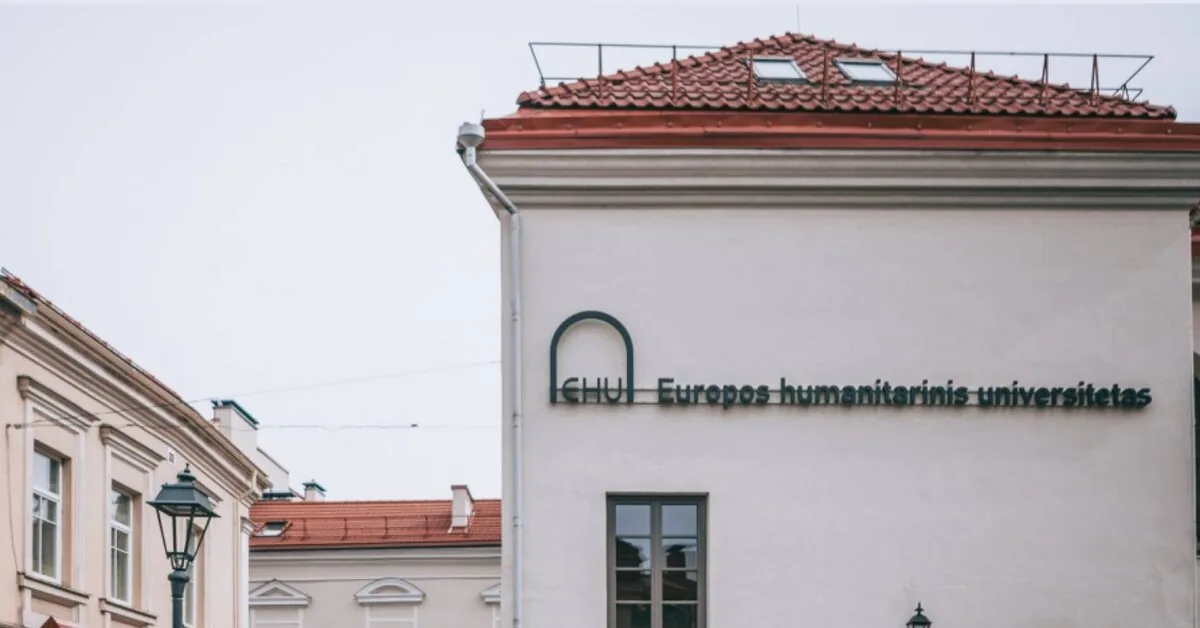
Located in an 18th-century Augustinian monastery in the heart of Vilnius Old Town, which is listed as a UNESCO World Heritage site, EHU is a unique higher education institution. Established after the collapse of the Soviet Union, the university was one of the first private universities in Belarus to offer Western-style studies based on the principles of liberal arts and humanities.
Read more Police are searching for missing Giedrius Dagys: last seen in Kaunas
From Minsk to Vilnius: a university in exile
In 2004, after the Belarusian authorities revoked the university’s license, its activities in its home country were halted. However, the institution did not disappear – accepting an offer from neighboring Lithuania, it relocated to Vilnius the same year and continued its academic mission there.
Supported by the European Union, Nordic countries, and various international funds, EHU has become an academic bridge between Belarus and Europe. Every year, hundreds of Belarusian students study here, seeking a free, modern, and pluralistic education.
A vibrant and Europe-open university
Today, EHU offers nine bachelor’s, six master’s, and one doctoral study programs. These cover various fields – from social and humanities sciences to the arts.
Read more What are those mysterious cars near the railway?
In the 2024–2025 academic year, the university community was joined by more than 300 new students from about twenty countries. EHU presents itself as a meeting place of East and West, promoting mutual understanding and cooperation among different nations. This mission is especially relevant in the current geopolitical context.
A symbol of cultural continuity
EHU is more than just a higher education institution. It is a symbol of the continuity of independent Belarusian intellectual and cultural life.
In Vilnius, which was already an important center of Belarusian cultural revival in the 19th century and early 20th century, the university continues the tradition of academic freedom, openness, and critical thinking. Its history reminds us that knowledge and culture, even when expelled from their homeland, can survive, find new space, and be passed on to future generations.
Read more LFF responded to the complaints of the «Kauno Žalgiris» coach