



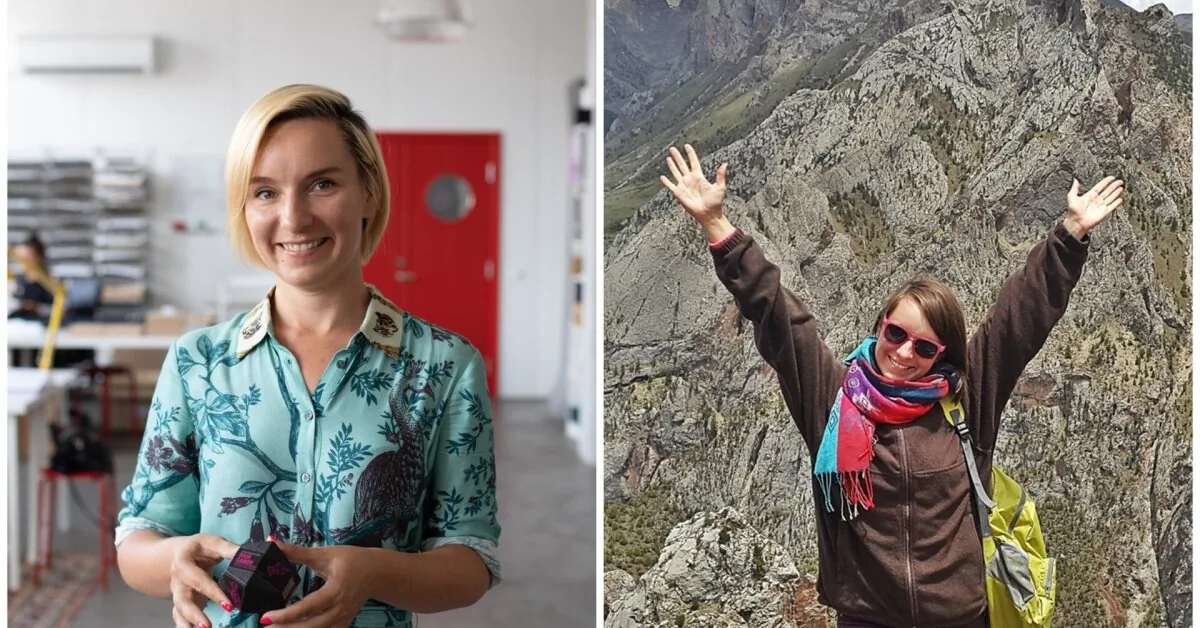
Because she spoke a rare language – Chinese – while still studying at the VU Faculty of Philosophy, Institute of Asian and Transcultural Studies, she would attend exhibitions, participate in negotiations, and accompany official delegations. This allowed her to see various aspects of business and encouraged her to start an organic cosmetics business, and today, having stepped away from her established brand “Solidu”, Vaiva is looking for new paths in life, according to a press release.
Read more Iran condemns discriminatory US behavior over unissued World Cup visas
– When a person’s story encompasses several countries, different cultures, business, and changes, the person themselves often remains hidden behind the facts. What would you like the reader to understand about you first, before getting to know your activities?
– I am just a person who knows nothing but is constantly learning. I don’t even know which label to attach to myself – I haven’t been in the academic world for a very long time, so I’m not a sinologist, and I also recently left my established “Solidu” business, so I don’t know if I’m still an entrepreneur.
– From the outside, your path seems very colorful – sinology studies, life in China, sustainability ideas, business creation. How do you see this path yourself: was it a consistent plan, a chain of coincidences, or the courage to follow curiosity?
– Even now I am in a phase of change and searching for a new identity, so I understand better than ever that life is not a clear straight line leading to a predetermined goal. Perhaps that happens to some, but now I truly know that I am not that person. I have always loved learning new things, changing, discovering something new. Coincidence also plays a big role. At the time I applied to Vilnius University, the sinology course was only offered every other year! If a group hadn’t been formed in my application year, I wouldn’t have waited until the next year and would have studied a different specialty. Who knows what that would have changed.
– When you applied for sinology at VU, did you already have a clear vision of where these studies would lead you? Or was it more a choice driven by curiosity, intuition, and a desire to get to know the other side of the world?
– Since childhood, I’ve dreamed of living in New York, but I couldn’t imagine how. However, I found my New York – Shanghai, which was my home for many years. And where Asian studies will lead, I don’t know even now, because my journey is not over yet and there will be all sorts of turns. When applying to VU, I most wanted to learn languages, and I knew absolutely nothing about China. I remember how, before the first year of studies began, we met with our future groupmates and wondered if a brush was necessary to write Chinese hieroglyphs (which we thought we would have to draw). We had no idea!

– Often, a person fully understands the value of their studies only later, after leaving the university walls. What did sinology studies give you, not only as knowledge about China, but also as a way of thinking, seeing, or acting?
– At the time I was studying, I didn’t understand what these studies offered; I could only appreciate practical knowledge, such as the Chinese language. Perhaps the most important thing was the assured knowledge that I would go to China and live there for a shorter or longer period. Who knows if, by studying something else, this country would have so certainly appeared in my life, not just as a one-time trip, but as a home. Another thing I didn’t fully grasp at the time was how special all the lecturers I had the opportunity to study with were – people, of whom there are only a few in the entire country, who had chosen an unusual path for most so long ago and possessed unique experience which they shared with students.
– Life in China often becomes not only a cultural but also a very personal experience. What moment most changed your perspective on yourself, Lithuania, or the world?
– I probably couldn’t pinpoint one specific event or moment, or even say that I changed in China – because I went to live in China when I was very young, so my perspective on the world, people, and myself was not so much changing as it was forming there. Living in China as a European is different from living in China as a Chinese person, especially in such an international melting pot as Shanghai, where I spent most of my years. What it gave me, I only understood when I returned to Lithuania after seven years spent in China. I realized that not everyone my age sees life as so flexible and constantly changing. For many, work and profession are associated with a rather clear, predefined path from university to one specialty and a stable life, but that was not the case for me.
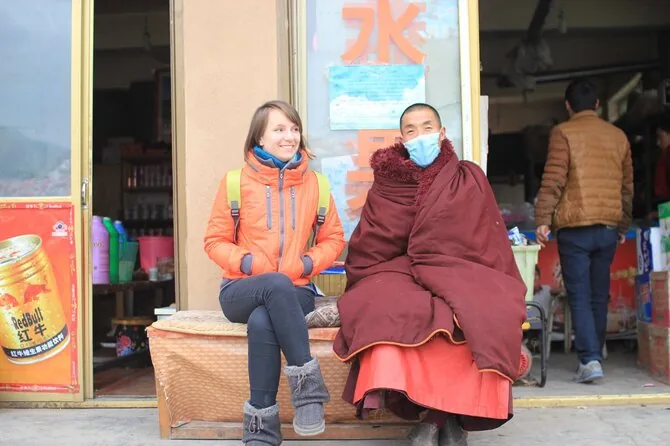
I believe that the most important “lesson” that life in China taught me is that each of our ways of acting and perceiving the world is not the only and correct one, but subjective. We often forget to question what we consider universal truth. However, Europe is not the center of the world; it is the center of the world only for Europeans, while for the Chinese, the center of the world is China, as their maps also show, and this is reflected in the Chinese name for China (“Middle Kingdom”). If I think that a polite personal distance should be at least a meter, that doesn’t mean that another person thinks the same. If my favorite food is potatoes, that doesn’t mean that this food is objectively the tastiest. What seems beautiful, polite, right, or acceptable differs.
Every person sees the world through their own prism, and this can best be understood by being among people different from yourself, and without trying to impose your perception of the world on others. Life in Shanghai shaped my view of scale, speed, change, identity, and human capabilities. The speed at which this city changes, the extent to which technology develops, and the diverse people I got to know, irrevocably changed how I see the world today.
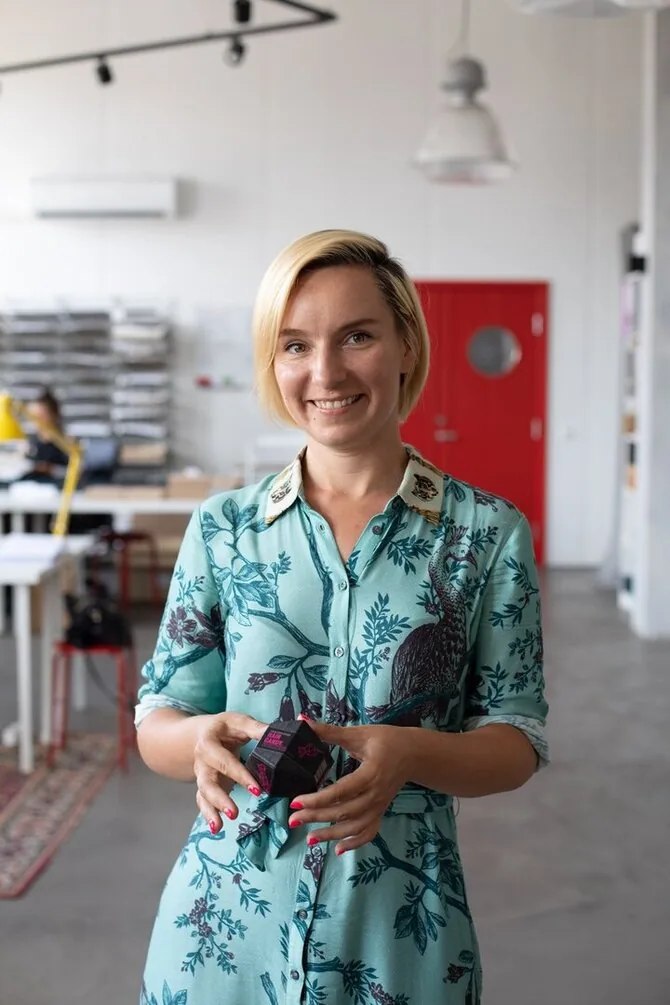
– Let’s move on to “Solidu” – how would you introduce this activity to someone who hasn’t heard about it yet?
– My established brand is sustainable cosmetics without water and plastic packaging. For example, a regular shampoo bottle contains as much as 80% water, while my solid shampoo uses only concentrated ingredients, so it works exactly like liquid shampoo but doesn’t pollute the environment with packaging and is very compact. When I started the business, such cosmetics were completely new in Lithuania, so I had to educate the public and convince people that such a solution works. Now, in Lithuania, it has become synonymous with solid cosmetics.
– How did the idea come about? Was it a long-matured plan, or rather a natural intersection of your experiences, values, and circumstances?
– As a young Chinese language specialist, I had a very unique experience. Since knowing both Chinese and Lithuanian is very rare, even before finishing university, I started helping various businesses from Lithuania that needed assistance in China. I had to attend exhibitions, participate in negotiations, visit factories, accompany official delegations, and find myself behind closed doors where company executives conversed. This was a very interesting and comprehensive job, allowing me to get a close look at various aspects of business.
When creating my own business, it seemed natural that it should reflect my own values, which were – to create something that would leave the world better, rather than contribute to the myriad problems caused by consumption.
– When creating an activity based on the idea of sustainability, one inevitably has to ask oneself how well one manages to live according to the values one communicates. How did you manage to find a balance between a conscious lifestyle and a real, not always ideal, everyday life?
– There’s no need to imagine that there are people who do everything perfectly. That’s not the case for me, nor for most other people, even those who claim to fit a lifetime’s worth of trash into a single jar. Of course, we are limited by how the global system and economy operate. We can only strive to choose a more sustainable and responsible path whenever possible.
Not everything can be given up, and at the same time, not everything needs to be bought. Having lived in China, which is very polluted, I appreciate clean air and water more than ever. I no longer buy bottled water when I know that we have such high-quality drinking water running from our tap. I don’t buy unnecessary things; even if an item I use isn’t ecological, but I already own it – I’d rather use the old one until it’s completely gone. I believe that when creating “Solidu,” I didn’t try to find a balance – it was an area where I strived to implement all communicated values to the maximum, even though it wasn’t always the easiest solution.
– Your story shows that the path doesn’t necessarily have to be straight: studies can lead to China, China – to a broader view of the world, and from that, business or creative ideas can emerge. What does your experience say to young people who worry that their choice of studies must immediately determine a clear profession?
– Although I finished my studies a very long time ago and don’t plan to return to university, many people my age in my circle are now choosing to study a completely new specialty. Often, once we start adult life, we understand what truly attracts us most, where we want to improve. So no choice is final; the most important thing is to remain open to life’s lessons, constantly strive to improve, and stay curious. Moreover, the worst thing is indecision: when we make any decision, it’s easier to move forward. Therefore, never be afraid that you will make the wrong decision, because all decisions are correct.
Interviewed by Almantas Kunskas