However, hopes for a rapid breakthrough in autonomous cars did not materialize – major manufacturers showed little interest in Lithuania, and significant investments did not appear.
Senior lawyer at the law firm COBALT, Juras Žymančius, states that after a longer break, Lithuania is returning to the topic of autonomous transport – but this time under different circumstances.
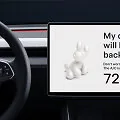
“Tesla” FSD – supervised autonomous driving
VIDEO: “Tesla” Full-Self Driving (FSD) Supervised function test: what works well and where improvements are needed?
“Tesla” Full-Self Driving (FSD) Supervised function test: what works well and where improvements are needed?
In 2026, the Ministry of Transport and the Lithuanian Transport Safety Administration decided to legalize the temporary EU type approval issued by the Netherlands vehicle inspection authority for Tesla’s “FSD” (“Full Self-Driving Supervised”) system.
The decision was made according to European Union rules allowing countries to recognize approvals of new technologies issued by other countries.
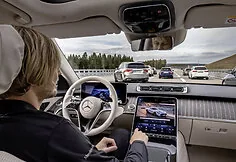
However, the system’s grand name can create a misleading impression. “Despite the name ‘Full Self-Driving,’ legally it is not a fully autonomous system,” notes J. Žymančius. “In reality, it is more of an advanced driver assistance technology – the driver remains responsible, must constantly monitor the traffic situation, and be ready to take control of the vehicle at any time.”
Lithuania has already tested the idea of autonomous transport
Although discussions about autonomous transport sound new today, the first trials in Lithuania took place soon after the legal possibility arose.
In 2022, the retail chain IKI, together with the Estonian company “Clevon,” tested autonomous transport solutions in Vilnius, using autonomous delivery vehicles that operated on public roads and fulfilled real orders.
Understand instantly
“Bolt” plans autonomous car trials: when will it offer driverless rides?
The Netherlands will be the first in Europe to allow “Tesla” cars to drive in autonomous mode
“Tesla” autonomous driving feature does not please everyone: money paid 7 years ago does not guarantee anything
In dense city traffic during 136 days of the pilot project, autonomous cars traveled more than 5,000 kilometers. “Vilnius became the first European city where a fleet of autonomous delivery vehicles operated on public roads,” notes Nijolė Kvietkauskaitė, General Director of the retail chain “Iki Lietuva.”
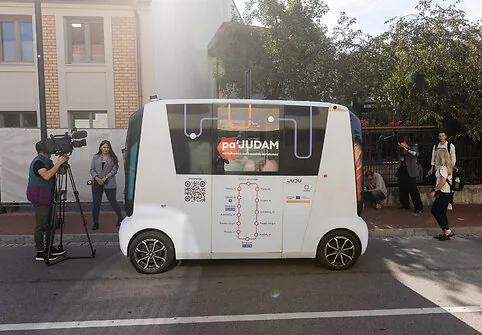
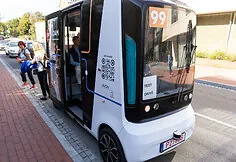
In 2024, autonomous bus trials also took place in Vilnius. Loreta Levulytė-Staškevičienė, head of the municipal company JUDU (“Transport Services”) that organized the autonomous public transport project, says the experience was successful – the goal was achieved that at least 90% of the route would be driven in autonomous mode.
This not only assessed how autonomous transport would work under real city traffic conditions but also introduced the technology to the public.
Autonomous bus in Vilnius begins carrying passengers
+39
When testing the bus, JUDU relied on the public transport network so that it would function as a “last mile” solution – complementing existing routes and making it more convenient for passengers to reach important locations from stops and combine trips with different sustainable mobility options.
“The results confirmed that autonomous buses could move through Vilnius streets even under complex, heavy traffic conditions. Moreover, residents positively evaluated this technology. After the trials, 80% of respondents said they would use such transport, and Vilnius residents rated it as reliable and attractive,” recalls L. Levulytė-Staškevičienė.
Not all “autonomous” cars are truly autonomous
However, according to J. Žymančius, the most important result of the 2018 decision was not specific projects but a signal to the international market.
“Lithuania wanted to show that it is a flexible, responsive, and innovation-friendly country. At that time, there was a kind of race among European countries to be the first to create a legal basis for such technologies,” explains J. Žymančius.
According to the lawyer, the topic of autonomous cars often causes confusion because different systems have very different capabilities.
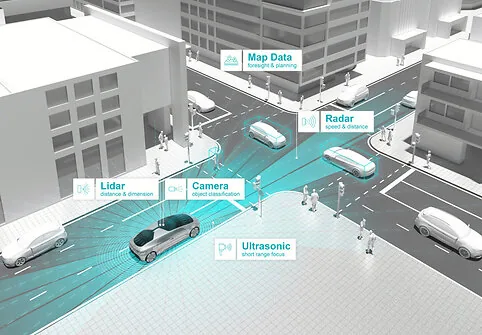
Automated driving is divided into six levels – from 0 to 5. Level zero means full human control, levels one and two include various driver assistance functions – speed maintenance, lane keeping, or automatic braking. The “Tesla FSD Supervised” system is classified as level two.
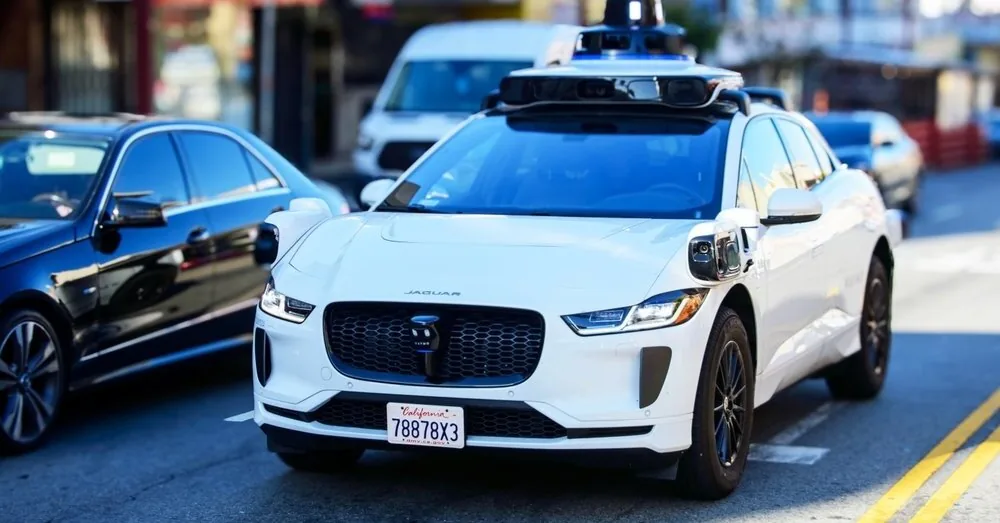
Level three already allows the driver to briefly divert attention from driving under certain circumstances. Level four vehicles can drive fully autonomously in certain areas or routes – this principle is already used by autonomous taxis “Waymo” in the USA.
“Level five would mean that the car can drive independently under any conditions – in the city, countryside, rain, or snow. In such a case, theoretically, the car might no longer have a steering wheel or pedals. However, currently, there are no legally operated systems like this in the world,” explains J. Žymančius.
Europe’s approach is much more cautious than the USA’s
One key difference between the USA and Europe is the regulatory philosophy. In the USA, the manufacturer can self-certify that their system meets requirements, and authorities conduct inspections after the product is on the market. In Europe, the system works the opposite way – without official approval, the technology cannot be used on roads.
“The European Union prioritizes prevention and safety. Therefore, the ‘Tesla’ system in Europe is not identical to the one used in the USA. The Dutch authority that issued the approval clearly states: the driver must be ready to immediately take control of the vehicle,” emphasizes J. Žymančius.
For this reason, driver behavior is also monitored – systems check whether the driver’s gaze is directed at the road and if they remain attentive.
Who is responsible if the car causes an accident?
Perhaps the most frequently asked question in discussions about autonomous cars is who is responsible in case of an accident.
According to the Lithuanian Civil Code, a vehicle is considered a source of greater danger, so its operator is subject to strict liability. “Practically, this means that if a car with the ‘FSD Supervised’ system engaged crashes into another vehicle, the responsibility primarily lies with the driver. For level two systems, this is natural – the person is still considered an active participant in the driving process,” comments J. Žymančius.
However, the situation could change as higher-level autonomous cars appear on roads.
“If in the future the system truly makes decisions independently, questions could arise regarding the responsibility of manufacturers or software developers. In such cases, vehicle data would play an important role – the so-called black box would show whether a human or the system controlled the car during the accident,” says the lawyer.
Technology in cars is rapidly advancing, but the law remains more cautious than marketing promises. Therefore, at least today, autonomous cars in Lithuania return to roads not as driverless transport but as another driver assistance tool.