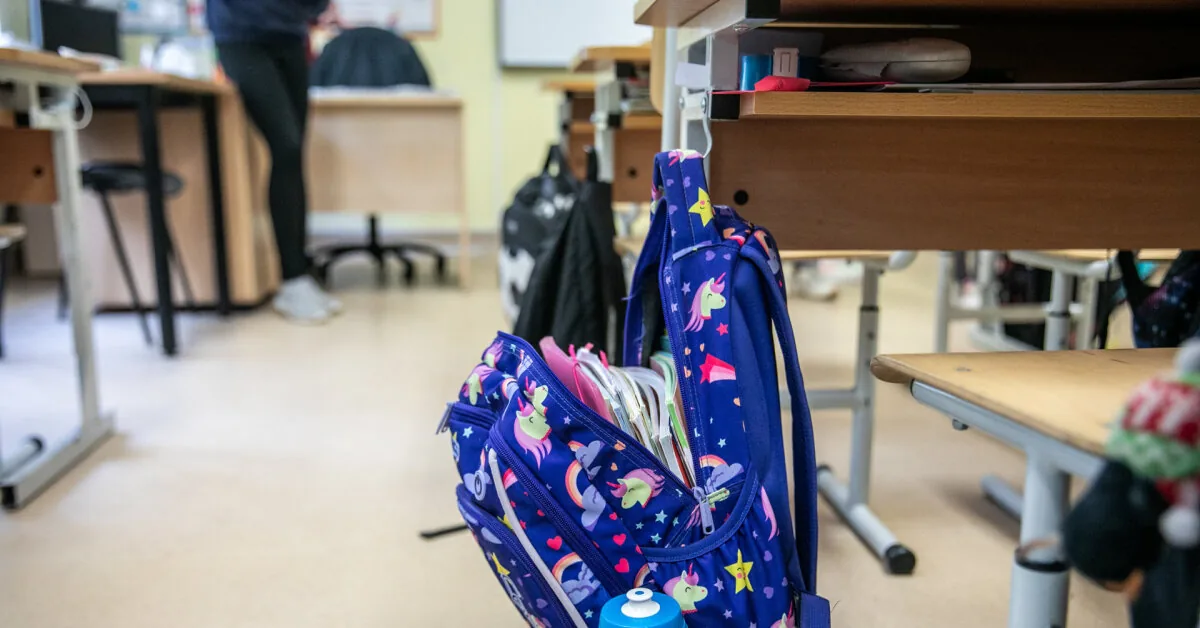
„This is a solution that addresses the consequences, not the causes. Therefore, together we must ensure that students in smaller classes receive the highest quality education, necessary informal education, and appropriate conditions for socialization,“ Švenčionys district mayor Rimantas Klipčius told BNS.
Read more Psychotherapist Brigita created the perfect man with AI: revealed what happened after a month
In turn, Trakai district mayor Andrius Šatevičius says that these changes do not solve the much-discussed problem faced by the national minority schools in his municipality.
According to him, in all national minority schools in Trakai district, except for Paluknys Longinas Komolovskis Gymnasium, the number of students currently exceeds the previously valid limit of 12 students.
„At the same time, the number of students graduating from the 10th grade at Paluknys Longinas Komolovskis Gymnasium does not even reach the newly established limit of eight students, so it would not be possible to form the 11th grade even under the amended legal regulation,“ A. Šatevičius told BNS. „Considering this, the adopted legal amendments do not solve the examined problem in Trakai district.“
Pressure to preserve Polish schools
In 2022, the Trakai district municipality decided to reorganize the Senieji Trakai Andrzej Stelmachowski Primary School and Paluknys Longinas Komolovskis Gymnasium into branches, attaching them respectively to Trakai Gymnasium and Lentvaris Henrikas Senkevičius Gymnasium.
According to the mayor, the decision to turn these schools into branches was driven by the decreasing number of students, the increasing cost of maintaining these institutions, and their non-compliance with current legal acts.
This situation caused outrage among the communities of these schools, representatives of the Electoral Action of Poles in Lithuania-Christian Families Alliance, and Polish politicians. They saw discrimination and claimed that children and teachers would suffer inconveniences because of this.
The head of Lithuanian diplomacy, Kęstutis Budrys, said that this situation harms bilateral relations, while the Speaker of the Seimas, Juozas Olekas, this week urged the municipality to reconsider decisions regarding school restructuring.
The situation was also commented on by Radoslaw Gruk, advisor to the President of Poland Karol Nawrocki, who visited the country this week and promised to support actions aimed at preserving Polish schools in Lithuania.
In turn, the mayor emphasized that the Trakai district municipality had already submitted a concrete proposal – to transfer these educational institutions under the Ministry of Education, Science and Sports, thus creating opportunities to preserve their current legal status, but it was not approved.
„Therefore, a reasonable question arises: if the real goal is to preserve the legal status of these educational institutions, why was the decision that would have allowed achieving this goal rejected?“ said A. Šatevičius.
Moreover, earlier this week the mayor stated that public or political pressure will not change the municipality’s decision to reorganize two Polish schools into branches and emphasized that the legal disputes initiated over this situation ended in favor of the Trakai district municipality.
Lowered threshold
This week, the Cabinet of Ministers allowed national minority and sole Lithuanian schools in Vilnius, Šalčininkai, Trakai, and Švenčionys districts to reduce the number of students.
According to the amendments, if these schools are the only ones in the area, the number of students in graduating classes may be reduced from 12 to eight starting in September. Also, a smaller number than 60 students will be allowed for a school providing secondary education, regardless of the language of instruction.
Read more Latvian triumph at the championship – recognition for Jasikevičius
The final decision on the smaller number in classes will be made by municipal councils.
The chairman of the Electoral Action of Poles in Lithuania-Christian Families Alliance (LLRA-KŠS), MEP Waldemar Tomaszewski, says that this government decision is a success for the voters who supported his represented political force in the last elections.
„These victories were later used actively to defend national minority education and to join the ruling coalition. One of our main demands was to end discrimination against national minority education and to restore abolished benefits for national minority schools when forming classes,“ the politician is quoted as saying in a party statement.
The politician thanked the organizations, parents, members of the Seimas, as well as Polish politicians and diplomats who contributed to preserving Polish schools, and also Prime Minister M. Sinkevičius for, according to him, reliable coalition work and the promptly adopted important decision for national minority schools.
„The change will not affect the preservation of schools“
According to Švenčionys district mayor R. Klipčius, the decision to lower the threshold to eight students for national minority schools is a prompt political decision aimed at reducing tensions regarding the reorganization of national minority schools.
According to him, this will make it much easier to form classes in the only national minority school operating in the district – Pabradė Žeimena Gymnasium.
„All classes remain at Pabradė Žeimena Gymnasium. The changes gave us a guarantee that secondary education classes will definitely be available this academic year and for several more years,“ R. Klipčius told BNS.
However, according to his data, for the 2026–2027 academic year, 12 parental requests have already been registered for the III gymnasium classes, where education is provided in Russian and Polish, so even without the rule change, the gymnasium should have these classes.
According to the mayor, the adopted decision tactically shows flexibility and understanding of the importance of national minority education in Eastern Lithuania, but strategically the main problem – demographic decline – cannot be solved by exceptions alone.
„This rule change is more relevant for those municipalities that have many small primary or basic branches in rural areas and want to preserve them. Meanwhile, the situation in Švenčionys district is stable, the school network is organized, so this change will not affect the preservation of schools,“ emphasized R. Klipčius.
The mayor also stressed that local government best sees educational problems and should solve the arising issues.
Last academic year, there were 57 gymnasiums in Lithuania where instruction was in the language of national minorities. Of these, 33 were in the mentioned district municipalities.
It is estimated that maintaining smaller gymnasium classes with 8–11 students will require about 1.03 million euros from the state budget over 2026–2027.
In spring 2025, the government allowed town gymnasiums to form III and IV gymnasium classes if they have not 21 but at least 12 students, with the municipality contributing 50% of the teaching funds. This change did not apply to national minority schools.
Read more Sunday «Group»: can you group 16 words into 4 categories?