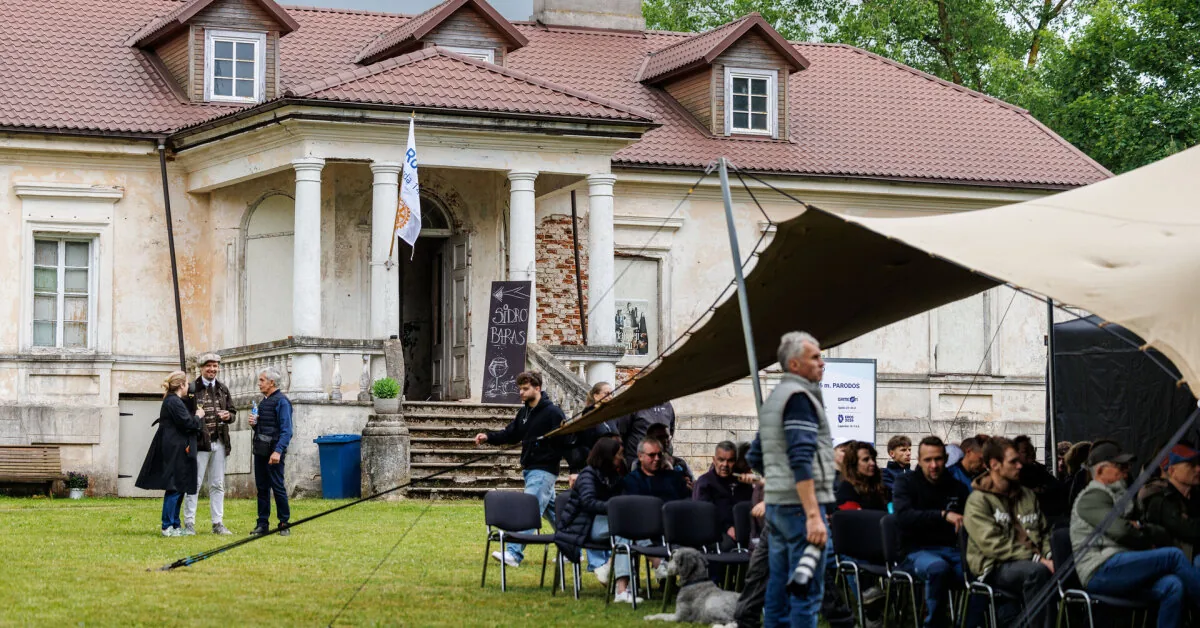
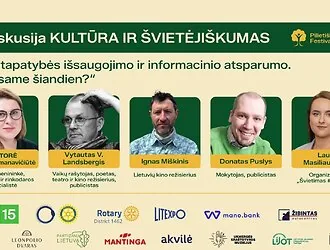
The power of culture, the responsibility of schools, the role of creators, and the younger generation were discussed at the “Citizenship Festival” discussion “Between identity preservation and informational resilience. Where are we today?”, moderated by Dovilė Filmanavičiūtė.
The discussion was attended by poet, publicist, theater and film director, and children’s author Vytautas V. Landsbergis, teacher and publicist Donatas Puslys, film director Ignas Miškinis, and Laura Masiliauskaitė, head of the organization “Švietimas #1”.
The discussion participants agreed that identity and citizenship cannot be fostered solely through declarations, curricula, or patriotic slogans. They require a living relationship, community, personal experience, and a determination not only to speak but also to act.
Culture Protests Showed That Talking Alone Is Not Enough
At the beginning of the discussion, D. Filmanavičiūtė drew attention to the culture protests and asked what they had changed and what should happen next, after the public actions concluded.
I. Miškinis, who became one of the participants in the culture protest initiatives, stated that he did not want to be called either the leader or the soul of the protest. Nevertheless, according to the director, the protests once again showed that discussions alone are not enough – to achieve change, concrete actions are needed.
The idea to organize a film festival, which arose together with film director Laurynas Bareiša, grew into a Film Club, whose creators travel around Lithuanian cities and towns, meet with audiences, and present their films.
“Everything sounds nice, but as long as we do nothing, nothing happens,” said I. Miškinis.
The initiative managed to involve 42 film directors and visit as many Lithuanian locations. Nevertheless, the director emphasized that such activities cannot end with the protests. There is still an expectation in society that someone else will take responsibility, while people themselves can remain on the sidelines.
According to I. Miškinis, the protests also revealed another important thing – culture gained greater power in society. However, for it to persist, a one-time mobilization is not enough. Consistent work, meetings, and activities in the regions are needed.
Citizenship Cannot Be Learned Solely Theoretically
Culture, according to the creator, is not just a story about an individual “I”. It helps a person feel part of a larger community – “we”.
V.V. Landsbergis recounted working with children in camps, which are also attended by children who have experienced very difficult situations, grown up without parents, or in vulnerable families. By creating films about partisans, singing folk and partisan songs, they experience a vivid inner transformation.
The director calls this transformation “the Lithuanian experience”.
“It is impossible to become civic or cultured theoretically. A person must experience that this is part of their identity, that it is important to them,” said V.V. Landsbergis.
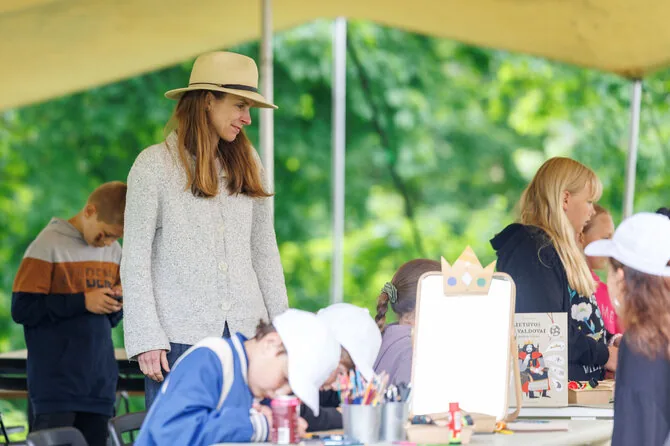
According to him, the teacher’s task is not just to transmit information. It is no less important to help a young person experience culture and the state personally. Such an experience can awaken responsibility, the desire to belong to a community, and the determination to defend it.
D. Puslys: Pedagogy Begins with Relationship
In the discussion, D. Filmanavičiūtė raised the question of why the view that a young person supposedly cannot have a clear civic position, be guided by their values, or fully contribute to the creation of the state is still prevalent. She emphasized that the state and the government are not identical.
According to D. Puslys, when educating a young person, one should first look not for another program or formal method, but for a relationship.
“Pedagogy begins with relationship,” said the teacher.
According to him, a teacher must hear the students’ expectations, anxieties, and concerns, as it is impossible to write down all life situations into educational programs. The school should also not be a detached, hermetic space from society, where the most important thing is merely to implement a set program.
“Sometimes they thank me for teaching, but I myself say: thank you for allowing me to teach,” he stated.
The teacher joked that for a student who left classes to participate in a culture protest, such activity could be counted as social-civic hours. However, behind this joke lies a more serious thought – citizenship is not fostered solely in the classroom. It is essential to create conditions for young people to participate in real public life.
According to him, a person acquires identity through relationships with others. A teacher’s authority is also created not by an entry in an employment certificate, but by their connection with students and community responsibility.
School Culture Begins with Its Leader
According to L. Masiliauskaitė, the greatest influence on a young person comes from the people around them, and in school – primarily teachers.
That is why the organization “Švietimas #1” focuses primarily on education management and the leadership of school principals. According to the head of the organization, the tone prevailing in the community, how teachers are valued, and whether they are encouraged to cooperate depends on the school principal.
A good leader should trust teachers, reduce their bureaucratic burden, and create conditions for them to do what they do best – teach and build relationships with children.
“If the principal trusts the teachers, the teachers also trust the principal,” said L. Masiliauskaitė.
In the discussion, she cited data from a study conducted by Mykolas Romeris University, according to which up to 30 percent of teachers reported experiencing bullying from colleagues or school administration. According to her, such an environment is toxic from a management perspective and inevitably affects not only teachers but also the entire school community.
“If students see that educators act as a team, support each other, and are not afraid to communicate, such behavior becomes an example for them. However, when school staff themselves feel fear, distrust, or constant pressure, it is difficult to expect them to be able to educate brave, critically thinking young people,” said discussion participant Laura Masiliauskaitė.
Fear of Making Mistakes Hinders the Development of a Critically Thinking Person
Informational resilience, as emphasized in the discussion, begins with critical thinking. However, this requires an environment where a person can ask questions, doubt, discuss, and admit making a mistake.
According to L. Masiliauskaitė, one of the biggest problems in Lithuanian schools is the fear of making mistakes. This is felt not only by students but also by teachers.
“When you don’t move anywhere, you have a stagnant organization and stagnant education,” she said.
Read more New theoretical human age limit – 190 years: why can’t we live forever?
The head of the organization “Švietimas #1” also relied on OECD data in the discussion. According to her comparison, in 2006, the Lithuanian education system ranked 22nd in Europe, and by 2022, it had only risen by two positions. Meanwhile, Latvia reportedly made significantly greater progress, and Estonia became one of Europe’s leaders.
These figures, according to L. Masiliauskaitė, show not only differences in student results. They signal the entire education system’s ability to change, cooperate, and create conditions for an independently thinking person to grow.
Where Does Art End and Propaganda Begin?
Much attention in the discussion was also given to the creator’s responsibility. D. Filmanavičiūtė asked whether art, acting as soft power, can help shape the perception of the state and identity, or whether such responsibility begins to limit creative freedom.
According to V.V. Landsbergis, civic and patriotic art is a dangerous genre. If the desire to convey a patriotic message becomes too direct, the work can turn into propaganda.
“It must be born from the artist’s own identity, from what they truly want to say,” said the creator.
In his opinion, Lithuania needs films and other works of art about its history and people. However, cultural propaganda must be approached very carefully. Art must not illustrate a pre-prepared thesis, but open up complex questions and allow them to be experienced.
I. Miškinis also emphasized the importance of sincerity. According to him, when creating a film, one should first ask what the creator wants to say, and only later – what the work should look like.
The director recalled a period when there was much talk in the public sphere about the necessity of creating “national cinema.” However, some of these initiatives did not reach audiences because more attention was paid to the film’s representation and external message than to a sincere relationship with the theme.
According to I. Miškinis, this is a trap for every creator: wanting to please society or institutions, one can lose the authenticity of the work.
Identity Is Sometimes Awakened by a Single Song
The discussion participants were asked what works of art helped shape their relationship with Lithuania.
D. Puslys mentioned Vytautas Kernagis’s songs, which, according to him, act as a cultural backbone and anchor, helping a person understand their place. Oskaras Koršunovas’s theater and many other works that allowed rethinking the relationship with the country and its culture were also important to him.
L. Masiliauskaitė highlighted the Song Festival. She recalled a rehearsal in Vingis Park when, upon starting to sing “Kur giria žaliuoja” (Where the forest greens), the emotions were so strong that it became difficult to sing.
“Tears roll down, and then you understand what Lithuania, the state, and our people are about,” she recounted.
This experience, like the children’s camps mentioned by V.V. Landsbergis, reveals that identity often emerges not through theoretical explanation, but through shared experience – a song, a work, a story, or being together.
“Youth Is the Light”
At the end of the discussion, participants were asked how not to lose love for their country and hope when disappointment, conflicts, and constant devaluation of state institutions often prevail in the public sphere.
V.V. Landsbergis recalled the thought of priest Antanas Saulaitis that a person should not think they are above others. On the contrary – they can become a stepping stone, helping another to rise, go further, and discover themselves.
The creator said he saw the greatest hope in children.
“If I only looked at adults, I would be sad. But I see what happens in the camps. Children are already starting to teach us,” he said.
V.V. Landsbergis called this process inverse pedagogy. According to him, a new generation is coming, which adults should first not hinder and create conditions for to act.
D. Puslys also urged to abandon the belief that a teacher or another adult is the only correct reference point who has to “fix” the younger generation.
According to him, it is worthwhile for every person to regularly review their values and ask whether they are truly a part of daily life or just a verbal declaration.
“The more often we are able to admit that we don’t know or are wrong, the more we can learn together,” said D. Puslys.
I. Miškinis suggested not limiting oneself to complaints, but meeting in person, talking, and acting. Culture protests and the Culture Assembly, according to him, largely relied on youth.
“If it’s very difficult for you, lean on the current generation. Communicate with the youth, because they are the light,” urged the director.
L. Masiliauskaitė also emphasized that most young people want to create, live, and act in Lithuania. She did not rule out the possibility that the current political chaos would encourage people who had not previously considered it to enter state governance.
“Let’s not tire of sharing and discussing. We often say: don’t talk about politics or government. But I think – let’s talk, discuss, and take responsibility,” summarized the head of the organization “Švietimas #1″.”
The idea that culture, education, and informational resilience are not separate areas was repeatedly voiced in the discussion. All of them are connected by the ability to build relationships, think critically, listen to others, and not lose the desire to participate.
And the state does not begin in government institutions. It begins where a person transforms from an individual “I” into part of the community “we”.
Read more Iran says it has summoned French envoy over interference in internal affairs