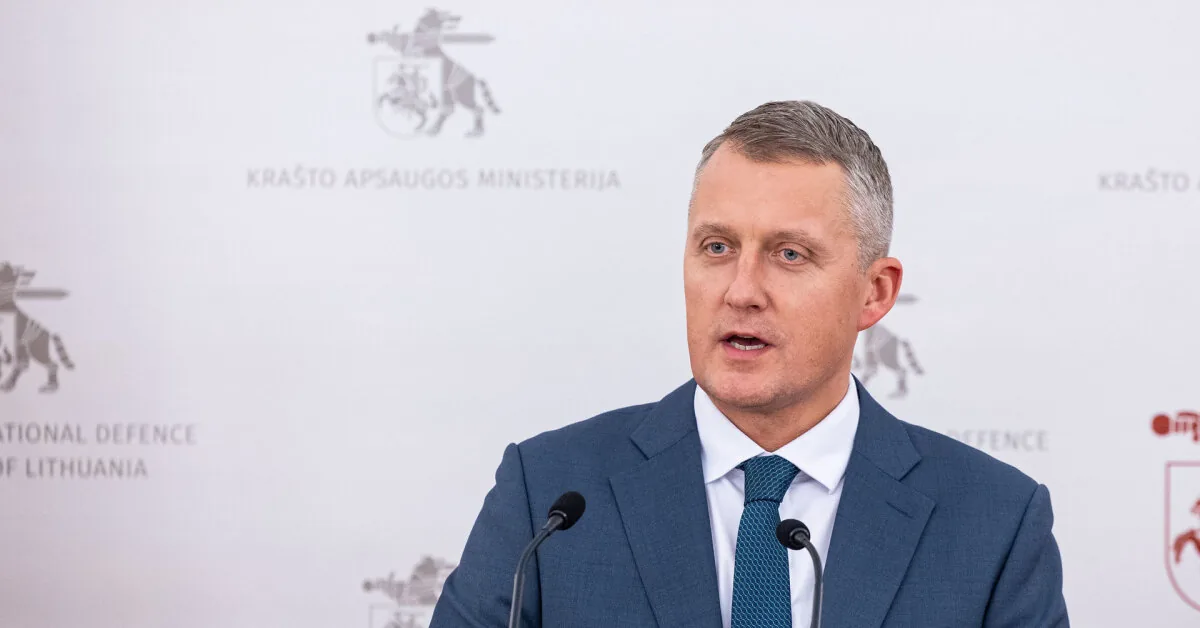
The minister in an interview with BNS insists that the difficulties acknowledged by both auditors and the “Ignitis Group” itself are not a matter of responsibility of its leader Darius Maikštėnas or the company – it was a poor decision by the previous government term to primarily develop power plants in the Baltic Sea without state support.
Read more Traffic jam caused by an accident on Ukmergė Street in Vilnius: one car overturned
He said this when asked if he sees D. Maikštėnas’s responsibility for the project’s increased costs and delays.
“This is not just a question of responsibility of one specific person, it is a matter of the overall political assessment at that time. We have the state-owned company ‘Ignitis’, the then Government, and at that time exactly such decisions were made – to swap these projects,” Ž. Vaičiūnas told BNS in an interview.
“There must be an analysis and justification that would leave no doubt that the project implemented by ‘Ignitis’ would be economically viable and reduce electricity prices for consumers,” the minister emphasizes.
Meanwhile, after several dismissals of heads of companies under the Ministry of Transport recently, Ž. Vaičiūnas says he trusts the leaders of the companies under his supervision.
“I really have no fundamental complaints about the heads of energy companies. There are work-related issues, of course, some tensions of one kind or another, but issues are resolved. That is the nature of the job,” the minister admits.
Asked why Rokas Masiulis, the former “Litgrid” head appointed by conservatives who successfully implemented the network synchronization project with the West, did not make it to the second stage of the new head selection, Ž. Vaičiūnas explained that the company needed renewal: “Bringing new winds into energy is definitely healthy. Probably, leaders who lead energy companies forever should not close themselves off and lack a certain dynamic.”
Other interview topics:
* electricity prices will not scare consumers in the second half of the year, a good natural gas price has been fixed for winter;
* future targeted measures due to high fuel prices – support for electric cars, solar power plants;
* in June, Poland is expected to adopt a law on taxing energy companies’ excess profits, which Lithuania could adopt by a mirror principle;
– The conflict in the Middle East continues, the International Energy Agency warned about the countries’ oil reserves being drawn down to dangerous levels. Gas storage in Europe is below the average for this period. In Lithuania, the National Energy Regulatory Council (VERT) increased public electricity and natural gas tariffs for household consumers from July. What does this whole set of circumstances tell you about the second half of the year and trends for the cold season?
– Reports related to the consequences of the fuel price crisis vary, sometimes more pessimistic, sometimes optimistic. But what is important for our people – regarding electricity prices, the state-regulated part does not change from July 1. This means that all consumers who have fixed supply plans will pay the same price as before. There is a minimal change in the public supply tariff and it is completely unrelated to the energy price crisis, but essentially due to the fact that the winter was quite extreme, cold, and electricity prices in winter were higher than forecasted.
The forecasts were too optimistic and therefore it is inevitably necessary to symbolically increase the public supply price. It increases by two cents, up to 22 cents per kilowatt-hour, and vulnerable consumers will still have it four cents lower. The public supply price itself is competitive, a few cents cheaper compared to independent suppliers’ plans. Both independent suppliers’ and public supply prices will definitely not scare our consumers in the second half of the year.
Regarding gas prices, together with “Ignitis” (the only gas supplier for household consumers – BNS) and VERT, we expanded the category of vulnerable gas consumers to essentially all household consumers. If until now only 30% of total gas consumption was fixed, after changing methodologies now 50% of household consumers’ gas prices are fixed. This means we have already fixed a fairly competitive price for household consumers for winter.
Because of this, VERT had to symbolically increase the price from July. We returned to the price level, even slightly lower, than at the end of 2025. Fixing also allows expecting to maintain that price level at the beginning of next year. But details will depend on the gas price level in global markets, because if it is extremely high, naturally the price will be adjusted slightly.
Here is the main message – although there is a global fuel and gas price crisis, our consumers will definitely not feel such a significant price increase.
– Regarding fuel prices, you proposed allowing price increases at gas stations only once a day, which would complement previously adopted decisions to release part of the fuel reserve and reduce fuel excise tax. The International Monetary Fund suggests Lithuania apply targeted support measures in the future. Are these becoming clearer and when might they be presented to the Government?
– This instrument is designed to ensure that the created monitoring system, obliging gas stations to provide daily data on fuel prices, would have the greatest positive impact on consumers, so that prices could only be reduced during the day.
Regarding targeted measures, significantly more electric cars are registered in Lithuania. Residents who can afford it are switching to electric cars, and we aim to allocate additional funds to support their purchase – both new and used. Not all parameters are agreed yet, but we are talking about people who most need this support, who could buy older electric cars using the support. Work is ongoing in this direction, but this is a joint issue of the Ministry of Transport, Finance, Energy, and Environment, and I cannot yet specify exact parameters.
All other measures that were previously under the Ministry of Energy as a green energy promotion direction remain this year. We will continue to encourage investment in solar power plants, as we plan a new support call at the beginning of June. Residents are building them quite rapidly, signals are visible, and this transformation is gradually happening.
– There were also talks about taxing “Orlen” excess profits in Poland. How advanced are the discussions on this?
– As far as I have heard, the law on partial resource regulation is planned to be completed and adopted by the end of June. We are monitoring the situation, and by a mirror principle, similar to Poland, such a law could be applied in Lithuania. That was the logic since “Orlen” operates in both Lithuanian and Polish markets, actions should be synchronized as much as possible. We are still waiting for what corrections there are, as a draft law with specific parameters was submitted. But they are still being changed because the draft law is being adjusted.
– What real effect would such a mirror project have in Lithuania for our end consumer if adopted?
– We discussed this this week. Representatives of the Lithuanian Energy Agency and the Ministry of Energy were asked to calculate what the real effect could be if such a law were applied in Lithuania.
– Assuming that the money would be specifically directed to reduce excise? Or would it still go into the general budget pot?
– First, we need to have a specific amount that we would collect if we applied a similar law as adopted in Poland. How it would have a positive effect on consumers is a second-level question, so I cannot say yet.
– “Ignitis Group” has about a month left to submit its response to the State Audit Office’s remarks. The group’s leader Darius Maikštėnas mentioned that two out of three recommendations have been implemented, the last one remains – to assess market changes and cost growth risks. You probably follow the process, so what do you see? Do you feel anxious that the company might not meet the deadline or submit unsatisfactory conclusions?
– “Ignitis” must submit an assessment and analysis by the end of June on what measures and ways these risks will be managed and whether the project could be implemented in a way that it would be commercially and economically beneficial: commercially for the company, and economically for our consumers. We are waiting for this analysis, and when it is submitted, we will evaluate and make appropriate decisions.
– Have you seen an interim version, a draft of that analysis? What impression did it make?
– I have seen the initial assumptions or, let’s say, scenarios that will be evaluated. But we are waiting for the complete final version.
– The State Auditor recently said in the Parliament that after “Ignitis” submits its response, urgent decisions from the Government will be needed regarding the project’s future. What specific conclusions would satisfy you as the Minister of Energy so that you could confidently say that the project can and should continue as it is?
– We have a project that was designed based on different assumptions and parameters. Now there must be an analysis and justification that would leave no doubt that the project implemented by “Ignitis” would be economically viable and reduce electricity prices for consumers. The project is being developed without state aid, and such projects are hard to find in Europe or the world. We are waiting for the recipes, what will be proposed.
– “Ignitis” will probably have to specifically indicate how it will improve the project’s viability.
Read more Police will ask the ministry to allocate an additional 168 million euros in next year’s budget
– Yes. Since the project’s payback period has lengthened, the key question is whether the project can still be financed during that period and what mechanisms should be applied to increase its competitiveness. We must receive the assessment, based on which we will make appropriate decisions.
First of all, of course, “Ignitis” shareholder, the Ministry of Finance, has expressed certain parameters and expectations in a letter. Also, the Ministry of Energy as the institution forming energy policy. Then decisions will follow from both the Parliament and the Government.
– Your main concern is that electricity prices for consumers are reduced?
– Yes, that is the main parameter. If electricity prices are quite competitive in summer, with a lot of renewable energy, the problem remains with winter. Last winter’s extreme cold showed that we are dependent on electricity production from gas when there is no wind and no sun in winter. In such cases, electricity is more expensive.
If projects like this offshore wind farm could reduce prices in the long term, those parameters should be evaluated positively.
– In your opinion, should D. Maikštėnas take responsibility and resign from the position of “Ignitis Group” leader if the company’s response to the State Auditor’s remarks does not satisfy you, the shareholder Ministry of Finance, and the Government, and the company does not prove that the project can pay off and reduce electricity prices for consumers? Would you support the idea and encourage the Minister of Finance to seek D. Maikštėnas’s responsibility and resignation?
– I would not want to personalize this project because it is still a state interest, a project needed by the state. The essence is to have an assessment, analysis, and project plan on how it will be further implemented. If we have a smooth plan on how to do this (ensure that the power plant park reduces electricity prices – BNS), naturally, there would probably be no questions of responsibility. If we see that the project can no longer be implemented and the development work was indeed done incurring costs, those should be addressed separately. But as I said, first we have to decide and arrange whether the project is being implemented.
This is one scenario. If it is not implemented, there would be other parameters. But that would probably be a matter of additional evaluation. We should not jump to conclusions now; let’s wait for the assessment, and if the right parameters are set, then the project can be implemented.
– Do you personally trust D. Maikštėnas? And how much responsibility do you see for him and the entire “Ignitis Group” leadership for the deteriorated conditions for this project and increased risks? Can this simply be attributed to difficult market conditions?
– I would first evaluate this project historically. As I have mentioned, the mistake was preparing to develop the project with state aid and then quickly initiating the project without it. And this was based on quite opportunistic assumptions. In 2022–2023, it might have seemed logical, but now it is clear that the market has changed and those assumptions did not materialize. This is exactly what is presented in the State Audit report.
I think this is not just a question of one person’s responsibility, it is a matter of the overall political assessment at that time. We have the state-owned company “Ignitis”, the then Government, and at that time exactly such decisions were made – to swap these projects.
Again, I can repeat that I see this as a certain mistake. But to evaluate and identify it before we have the project’s decided fate and prospects is probably not the place or time today.
– So, in your opinion, the main responsibility lies with the former Government and the Ministry of Energy for that short-sightedness?
– I evaluate the project swap itself as a mistake. Whose responsibility it was and how much was the responsibility of the “Ignitis” leader, the company itself, or the then political leadership, I would not dare to decide.
– To your knowledge, what physical works are currently underway developing the first offshore wind farm?
– Preparatory works are completed, some of the more important ones – seabed surveys, bird monitoring, environmental impact assessment. The project is essentially in a suspended state. No active project development work is currently being done.
– If “Ignitis” conclusions were favorable, positive, how soon could those works resume?
– Now we have to wait for the report itself, review the main parameters, and finally decide. I really would not want to speculate, but it is probably a matter of months.
– Five heads of companies controlled by the Ministry of Transport have left or been dismissed during this government term, some before their term ended. You, as the head of the ministry overseeing companies critical to national security, how do you assess such leadership changes?
– I think the Minister of Transport had certain criteria for making those decisions. I really could not evaluate those company heads, their competence, and work done.
Regarding energy companies, their leaders always have specific goals, and new selections are made after terms end. We have had quite a turnover of energy company leaders recently, precisely after terms ended and boards organized selections. Generally, the best answers to all questions come from the boards, which are meant to ensure optimal company management and convey the minister’s expectations.
If projects are being done and an ambitious program is being implemented, naturally, trust in company leaders decreases. But selection and dismissal of leaders are primarily organized through boards. Boards are responsible for ensuring that the ministry’s and government’s expectations are properly implemented.
– Let me ask about some leaders under your supervision. For example, Mindaugas Keizeris, head of “Epso-G”, was appointed while the conservative minister Dainius Kreivys was in office in 2022. How do you assess his work, do you trust him, especially now when “Epso-G” participates in important state projects, such as the construction of the “Rheinmetall” factory?
– There is an energy part, and there are energy and defense issues where “Epso-G” definitely has many commitments and many works, which are proceeding smoothly. M. Keizeris is a long-time energy company leader; I worked with him in the previous term (when Ž. Vaičiūnas was minister 2016–2020 – BNS), he was the head of ESO. He is an experienced competent person overseeing two most important companies – “Litgrid” and “AmberGrid”, and smaller companies like “Baltpool”. I really have no fundamental complaints about this leader because he has great experience, communication is good, and work is successfully carried out.
– How do you assess the work of other company leaders – Nemunas Biknius of “Amber Grid” and Darius Šilenskis of “KN Energies”?
– We are not yet at the end of the term to write reports on specific leaders, but I have worked with some company leaders in the previous term. Some have changed, and this is not a matter of personal issues. There are specific tasks we have. There are three main things – electricity and gas prices, supply reliability including our system’s resilience, and all international activities. I primarily evaluate all company leaders’ work according to these criteria and really have no fundamental complaints about energy company leaders.
There are work-related issues, of course, some tensions of one kind or another, but issues are resolved. That is the nature of the job.
– Still, for the second term, the very experienced R. Masiulis, who led “Litgrid”, and Rimvydas Štilinis, former head of “Energy Cells”, were not reappointed. They did not even make it to the second stage of selection. Why were they not suitable?
– Both leaders definitely have huge competence and experience in the energy sector. But their role was essential during the period when synchronization projects were implemented, R. Štilinis – implementing the accumulator system in Lithuania, the first such battery park in the European Union at that time.
But those works were done, it is a different era, different criteria are set regarding “Litgrid”. And the selection was conducted by the board, which selected the best candidates. We trust the board; in both cases, those were their decisions.
I think some renewal, bringing new winds into energy, is definitely healthy. Probably, leaders who lead energy companies forever should not close themselves off and lack a certain dynamic. I am pleased with the competence of new leaders and the changes they have brought.
– For example, Andrius Šemeškevičius, coming from “Telia”, has more experience with digitalization processes, which are more needed by “Litgrid” and was a better candidate>
– That is one of the criteria. He is also not new to energy; he worked for some time on the “Litgrid” board, so those projects were quite familiar to him. In both cases, when the boards made choices, yes, I had final interviews with the candidates and they definitely made a good impression.
– Thank you for the conversation.