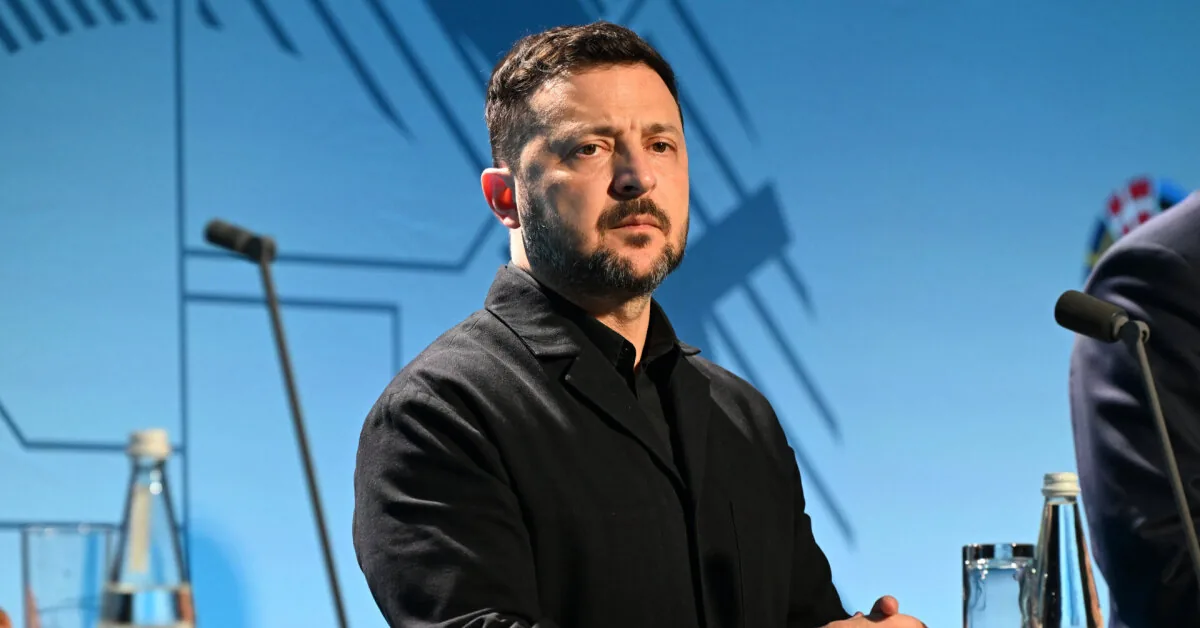
Nothing of the sort – the president undoubtedly did so for convenience, but he did not violate anything. For environmental reasons, the EU has indeed introduced a requirement that the cap remains attached to the bottle even after opening, but this only applies to manufacturers.
Consumers can act as they see fit – leave the cap attached, detach it, or even dispose of it separately immediately, the important thing is not to leave it somewhere on the ground.
Even considered a crime
The video was also shared on July 15 by a Facebook user from Lithuania.
Next to it, unable to refrain from insults, he wrote: “At the military parade in France, Zelensky struggled to tear off the bottle cap, sparking heated discussions on social media.
The problem is that he publicly violated the EU Single-Use Plastics Directive, which stipulates that bottle caps must remain attached to the bottle even after opening, to reduce marine litter. Otherwise, a fine is imposed.
In comparison, law-abiding (French President Emmanuel) Macron and his wife drank from the same bottle, strictly adhering to this rule, while the evil führer struggled with the bottle.
Thus, the clown failed the EU accession test, not meeting local standards.”
His post was immediately shared on other Facebook accounts and groups. “What now? Zelensky did not comply with sacred EU directives, not even having joined the union… (language unedited – ed. note),” – commented one internet user, spicing up his words with a Russian swear word.
Another explained that internet users’ claims about V. Zelensky’s alleged “serious crime” are “an ironic reference to European regulations requiring plastic caps to remain attached to bottles to reduce plastic waste.”
Understand instantly
A study revealed that an attached cap is not a problem for many people
A video with Zelensky is spreading massively – one of his actions caused a real stir
Similar comments accompanied the video in other countries. It was also presented by some media outlets, and there were more erroneous interpretations – allegedly the situation was captured during an EU or NATO summit, more precisely – during a press conference.
The Facebook page “BRICS News” also reported that EU caps must remain attached to plastic bottles. This acronym refers to an informal intergovernmental organization founded in 2009 by Brazil, Russia, India, and China, soon joined by South Africa, and recently by several other states.
In a few clip descriptions, alongside the reminder that EU plastic bottle caps must be attached, it was explained that this only applies to manufacturers.
Attached cap not always mandatory
Internet users were confused about where V. Zelensky drank water. Using a freeze-frame and keywords, it is easy to find out that he was filmed in Paris on July 14 during a parade held on Bastille Day.
This is confirmed by the frame visible at the 4:37 min. mark in this video – “fighting” with the cap, he sat among the same people who stood next to him at the event.
This means that the president indeed received a water package with an attached cap, as he was in an EU country. But it is not true that the cap is not allowed to be separated from the bottle or Tetra Pak (the Ukrainian leader drank water precisely from the latter).
VIDEO: Bastille Day Parade in Paris
Bastille Day Parade in Paris
There is no law, EU directive, or regulation that prohibits or provides for a fine for tearing off, cutting off, or snipping off a cap if it hinders drinking. Internet users misunderstood the requirement to attach caps to packaging.
Article 6 of the Single-Use Plastics Directive (Directive (EU) 2019/904) states that single-use beverage containers with a capacity not exceeding 3 liters “may be placed on the market only if [plastic] caps and lids remain attached to the containers throughout the intended use phase of the products.” This requirement entered into force on July 3, 2024, and is legally binding throughout the EU.
A regular cap can be unscrewed and, after taking a sip, screwed back on, thrown away, or lost. An attached cap should ideally remain “stuck” to the packaging throughout its use – this is ensured by a special design that prevents the cap from completely detaching from the ring surrounding the opening.
This is how bottles and carton packages with plastic caps for mineral and plain drinking water, carbonated soft drinks, juices, milk and its liquid products, sports drinks, and functional beverages are sealed.
This requirement does not apply to reusable and glass bottles, metal containers, special stoppers (which are sometimes attached by themselves), and containers intended for special medical purpose products.
Can be torn off, but not recommended to lose
But the new rule applies to manufacturers, not consumers. The directive does not state that the cap must remain attached to the bottle or Tetra Pak after it has been opened. If desired, it can be detached and then screwed back on like a traditional cap, disposed of separately with plastic waste, or, if environmental protection is not a concern, anywhere else. No penalties are foreseen for such behavior.
Even the Environmental Protection Department (AAD) acknowledged that caps can be removed but urged proper disposal.
“For some residents, it is inconvenient to drink a beverage directly from the package or pour it out when the lid or cap is attached, so they tear or cut them off.
In such a case, it is necessary to ensure that the lids or caps are not lost, are properly sorted together with beverage containers – either returned to deposit machines or thrown into containers designated for plastic,” – states the press release, which was distributed as soon as the novelty came into force.
Collected 10 thousand caps
The same AAD press release mentioned a study commissioned by the European Commission before the directive was adopted in 2019. It showed that caps and lids are among the ten most common types of litter found on beaches, coastlines, and in the sea in EU countries. When unscrewed, they often fall off and get lost, and the aforementioned beverage containers can be returned to deposit machines even without lids or caps, so people are not in a hurry to collect them.
Caps are among the five most common pollutants near the North and Black Seas, and among the top three on the coasts of the Baltic and Mediterranean Seas. The organization “Stichting De Noordzee” announced that it found between 20 and 128 caps per kilometer on the Dutch North Sea coast. More than 80% of the 10,004 collected caps were from food and beverage packaging.
The goal of the new regulation is not only to prevent loose caps from becoming litter but also to ensure they enter the recycling system, which is best achieved by simply not losing them.
As Saulė Deveikytė, Senior Advisor of the Waste Policy Group at the Ministry of Environment, told LRT radio in the autumn of 2023, the chosen requirement for caps is the least impactful on both the market and consumers. This is because there was no obligation to replace them with another material; they only needed to be attached.
15min verdict: lacking context. Volodymyr Zelensky tore off a plastic cap attached to a Tetra Pak, as required by the EU directive, but violated nothing – this rule applies only to manufacturers, not consumers.
The publication was prepared by 15min in cooperation with “Meta”, aiming to curb the spread of misleading news on the social network. More about the program and its rules – here