The film viewer does not stay in one position here. Sometimes they embody the main heroine, see through her eyes, touch with her hands, and sometimes observe everything from the outside.
Read more „Rally Elektrėnai 2026“: what changes for spectators?
„The Eyes of Shame“ is a joint production project of the Lithuanian studio „Afterimage“, the French studio „Insomniak“, and the Croatian studio „Minya Film and Animation“. The film will have its world premiere at the Venice Film Festival. It will be shown from September 2–12, and later presented to Lithuanian audiences as well.
The film’s director, screenwriter, and producer Tomas Tamošaitis talks about the film’s themes, inspirations, and the creative process behind the scenes.
– You worked on the film „The Eyes of Shame“ for almost 10 years. Has your perception of what shame is changed after so much time?
– I am interested in how strongly shame can affect us without us even noticing. It’s as if we know what shame is, yet often we do not realize how deeply it is rooted, how strongly it shapes our choices and lives, and how hard it is to get rid of it.
The world of a person living in the shadow of shame is full of eyes watching them. There is nowhere to escape from them. You carry the weight of those eyes’ gaze with you all the time.
Someone says something bad about you – you can repeat it in your mind for years, unfortunately, sometimes it even becomes part of your identity. A person starts to think that it is their own voice. But is it really?
– In this film, the viewer looks at the environment from the perspective of the main heroine Beakė. Should we believe her version of events?
– You should not. Beakė is confused. She does not understand herself. She is searching for herself. Something inside constantly forces her to learn to doubt everything around her, to doubt herself, to ask questions.
To me, that is the essence of the film: to provoke doubt, to start asking questions. And the first thing to doubt and question should be the film itself.

– Still, the viewer is not always identified with Beakė. Sometimes we observe her from the outside. Why?
– I did not want to lock the viewer in one position. The viewer is as if inside Beakė’s mind, and then they are pulled back and can observe the situation from the outside. This way, the same situation can be seen from different perspectives.
At first, I thought the viewer’s position would change much more variably. But then the film would have become very complicated, so we finally decided to limit ourselves to two perspectives: being inside Beakė’s mind or observing her from the outside.
– How does a work like „The Eyes of Shame“ come about?
– I “throw” myself into a specific situation. And stay in it. After some time, I start to see what could come out of it. Usually, it is just something that attracts me. I do not necessarily understand why.
Since childhood, I have been creating various catalogs in my head. Of people. Situations. Stories. Sounds. Movements. Fragments. I just collect all this without knowing where I will use it, or if I will use it at all.
All those fragments, situations are like puzzle pieces in my mind. And when needed, they come to the surface. A phrase someone said. A specific movement. For example, how my mother brushed hair from her face when she was upset. Or how the light fell in a terrifying nightmare I had when I was five.
While working on „The Eyes of Shame“, I felt as if I was holding hundreds of such puzzle pieces in my hands and had to find a way to put them together into a coherent picture.
– How did that puzzle become virtual reality?
– I wanted to see certain moments through the eyes of the film’s characters. A reality as it existed for them. Not from the outside, but from their thoughts. How did the room look to Beakė before something happened and after? How did she see the window? The lamp? The refrigerator? Were they still the same after the event? What changed?
What happens in a person’s mind at the moment they make a decision whose consequences will last much longer than the moment itself? How do they see themselves at that time?
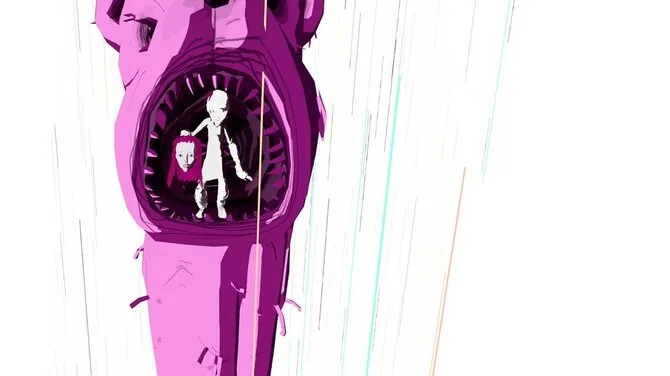
Usually, we evaluate decisions after everything, as observers from the outside. We already know what happened, see the consequences, explain, evaluate. I wanted to find a way to get into someone’s mind before that. To see how the decision was made. What was the beginning of it all. Virtual reality allowed exploring this impossible idea.
Read more New housing market in August: decline in one big city, surge in another
However, this situation is very ambiguous. The reality I so desperately try to see is at the same time just a fantasy of mine and the co-author of the script Emmanuel Rouglan.
– You volunteered for more than a decade at a hospital for troubled teenagers. Did „The Eyes of Shame“ start there?
– At first, I did not plan to make a film about that. I wanted to do something concrete, something useful. At that time, it seemed that I needed those places even more than they needed me.
The idea for the film came much later. The hospital was just the first layer. An impulse. I considered making a documentary, but at some point I realized that documentary would narrow my possibilities rather than expand them. I did not want to document what happens in the hospital. I wanted to find a way to get into someone’s mind and try to see the world through another person’s eyes. With fiction, I could get closer to that. And animation gave me freedom in searching for ways of expression.
– What stuck with you the most from that time in the teenagers’ hospital?
– I remember reading children’s files and thinking: I could have been one of them.
In the hospital, I led animation classes. I was very struck by the children’s preconceived belief that they could not do anything well. They would say: “I can’t draw.” But I tried to prove otherwise, to encourage them to try. We would start drawing a circle. Two dots – eyes. A few lines – hair. And here a character appears. After two or three hours, we would have created a simple two-minute animated film by the children themselves.
I also remember how someone from the staff, seeing me with the children, would keep saying: “Don’t try so hard, don’t struggle with them, they are kind of special here.” As if nothing dramatic, insignificant adult remarks. But said in front of the children, as if they did not hear. If people talk about you like that constantly, you unconsciously start to perceive yourself that way.
– The film talks about social problems, the reality we live in, but there is also a lot of surrealism and character transformations that are probably only possible in animation?
– Our thoughts are surreal. You think about one thing, some thought spins, and suddenly another one bursts in, a fragment of a memory from ten years ago, and completely takes over your consciousness. Then another thought pops up, now about the future, about something you imagined would happen tomorrow. Thoughts that have nothing to do with each other exist in parallel, constantly intertwining. They change, deform. Often we cannot even express in words what is happening in our minds.
Have you ever tried to control your thoughts? It is incredibly difficult. They are uncontrollable. So surrealism in the film appeared almost by itself, naturally.
– You mentioned that you did not like 3D graphics much before. How did it happen that you still used this medium for your film?
– Yes. I only liked 2D animation. Everything drawn by hand, as little computerized as possible. When I first saw the drawn characters of „The Eyes of Shame“ in a virtual reality environment, I thought – what now? Everything looked very artificial, like plastic.
So a big part of the search for the film’s visual language was an attempt to bring back imperfections that are usually characteristic of hand-drawn 2D animation. It looks more alive, more human.
I was very lucky to work with Skirmanta Jakaite – the film’s art director and main animator, and 3D character and environment modeler Arminas Didžiokas. Together with them and the film’s main programmer Loic Allart, we gradually found a way to visually bring the 3D aesthetic as close as possible to the style of adult comics, which would resemble hand-drawn rather than conventional 3D animation.
– How did you select the animators, what was most important when choosing them?
– It was important to me that the animator be sensitive. Sensitive in the sense that they can properly convey acting. Characters are not live actors, so all acting must be precisely drawn and expressed. „The Eyes of Shame“ is a large-scale, 40-minute, complex animation project. There are very few animators in Lithuania, so we had to look for them in other countries as well.
When we started working, I had to send notes and comments to different countries – one animator lived in Tokyo, another in Mexico, others in Portugal, Croatia, Serbia. All in different time zones – it was difficult to manage the project.
– Is it true that almost no one who worked on the film „The Eyes of Shame“ read the entire script? Why?
– I wanted the people we worked with to be as little influenced by preconceived notions as possible. If you haven’t read the script, there is no preconception that something can only be one way or another. Preconceptions limit, do not allow seeing all possibilities. As soon as I start judging that this is possible and that is not, this fits here and that does not, I am not open, I no longer see all possibilities. I do not even try many things because I am already convinced that it is not done that way, that nothing will come of it.
As long as I have no preconceptions – without doubt or fear, I can go in any direction.
The world premiere of the film „The Eyes of Shame“, directed by Tomas Tamošaitis, will take place at the Venice Film Festival. It will be shown there from September 2–12, and later presented to Lithuanian audiences as well.
Read more When the JAV Secretary of Energy arrived in Caracas, Washington defended the oil deal