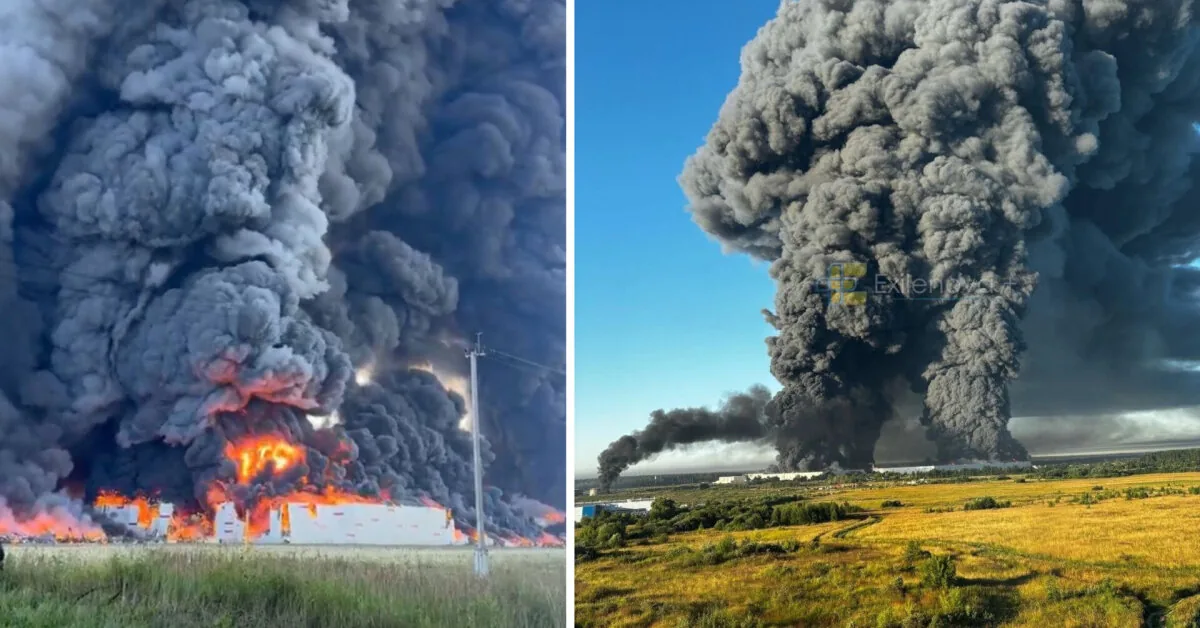
It is noted that the technical success of Ukraine’s campaign is beyond doubt. At the peak of the campaign, strikes disabled more than a third of all Russian oil refining capacities.
Attacks on ships in the Sea of Azov – in July alone, 236 ships were damaged – severely restricted commercial shipping in this vital waterway. Shipping traffic decreased by about three quarters.
Recently, Ukraine has focused on facilities belonging to the company “Wildberries.” More than a dozen large company warehouses and logistics centers were attacked, damaging or destroying about 20% of all its storage capacities.
Since most of the goods in these warehouses were stored by sellers – from private entrepreneurs to large companies – the damage affected many businesses. According to one estimate, the total damage so far exceeds 280 billion rubles.
“Hopes that large-scale attacks could paralyze the Russian economy seem unfounded. Revenues from oil and gas have increased due to the ongoing crisis in the Persian Gulf. Although baseline revenues have decreased by about a fifth since the start of the campaign, they are now stabilizing. Similarly, Wildberries promises limited compensation to sellers while aiming to move stock to safer warehouses in neighboring Kazakhstan,” the article states.
Mood in Russia
It is important that Ukraine has limited drone and missile stocks. It was forced to divert some resources allocated for the campaign against oil refineries to strikes against Wildberries, giving the Russians time to repair damaged facilities. Long queues at gas stations, which caused inconvenience to the Kremlin last month, are now shortening or disappearing altogether.
“However, this is not only an economic but also a political campaign aimed at bringing war to the Russian people. This has undoubtedly succeeded: for most of last month, the attacks were on the front pages of newspapers,” the journalists write.
According to polling company Levada, last month the share of Russians who believe the war is going successfully fell to a record low of 50% – 19 percentage points less than at the same time last year.
Meanwhile, only 28% of respondents said they thought the war was going badly. The rest were unsure.
Sociologists also recorded a decline in Vladimir Putin’s personal popularity rating. Although these figures remain artificially inflated due to the lack of significant opposition, his support has nevertheless dropped to 74% – the lowest level since the start of the invasion of Ukraine.
It is noted that dissatisfaction is also growing in Russia, but it is directed less against Putin and more against Ukraine. While most support freezing the conflict and starting negotiations, there is a significant minority who believe that aggression against Ukraine should be further intensified.
What does Putin want?
First of all, the increasing number of civilian casualties in Russia benefits hardline supporters. The new readiness of Russian state media to report on people dying inside the country shows an attempt to convince the public that Russians are victims, not aggressors.
The article states:
“Putin’s goal is to legitimize the war and any future escalation of it. Initially, his implied promise was that Russians would not be forced to fight unless they voluntarily chose to do so. Later, he tried to present his ‘special military operation’ as an existential necessity. Despite a massive propaganda campaign, this line never worked.
A new, cynical, revenge-based approach may prove more effective in strengthening support for the regime and justifying unpopular measures, such as mobilizing reservists to compensate for the current shortage of conscripts.”
Russia is already responding fire with fire. The large port complex of Odesa has been attacked multiple times, causing most shipping in the region to be halted.
Read more Benjamin Netanyahu rejected the US plan for the Gaza Strip
With Ukraine having exhausted all available Patriot missiles needed to intercept Russian ballistic and hypersonic missiles, there is concern that with the onset of winter, Moscow will renew its campaign against energy infrastructure, which is already operating at less than a third of its pre-war capacity.
Ukraine’s goal
At the end of June, President Volodymyr Zelensky launched a 40-day campaign of deep strikes against Russia, aiming to “force it to end the war” before winter.
This was a risky but perhaps necessary step. Zelensky needed to show Ukraine’s Western allies, especially the skeptical President Donald Trump, that he had “trump cards.”
It is noted that at the same time, some circles in Kyiv actually believed that the simmering dissatisfaction within the Russian elite could be brought to the surface by striking highly visible economic targets deep inside Russian territory.
The journalists write:
“Attempts to demoralize the nation and force it to ask for peace through air strikes may succeed, but only if such strikes can cause truly devastating damage. During World War II, atomic bombs dropped on Hiroshima and Nagasaki forced Japan to surrender, but Blitz bombings only strengthened Britain’s resolve. So far, Ukraine has not achieved such an effect.”
In their assessment, deep strikes undoubtedly reduce confidence in Putin and weaken the economy, and thus Russia’s war machine. They also encourage the pragmatic and technocratic elite to more loudly call for restraint and an end to hostilities.
However, the “hawks” use this campaign as a pretext to push Putin into an even more brutal and escalated phase of the war, attempting to quickly end the war on favorable terms.
The “warehouse war” inevitably means strikes on residential areas and nearby locations, increasing civilian casualties on both sides. Moreover, Putin may now believe he has more grounds to mobilize additional troops for the autumn campaign and less fear of public protests.
Ten days ago, a Russian missile that went off course entered Polish airspace, and on Wednesday, an explosives-laden drone was found at Leipzig/Halle Airport in Germany, believed to have been aimed at a Ukrainian cargo plane carrying weapons, which may be a warning of what lies ahead.
“The calculated risk by Ukraine may prompt Putin to take an even more dangerous gamble,” the analysts added.
Strikes on Russia
Ukraine’s defense forces destroyed the Russian electronic warfare system “Volna Kupol Garant” in Russia, in Gelendzhik, on the territory of military unit No. 2156.
This was reported by OSINT analyst Harbuz from “Dnipro Osint,” who published satellite images from August 7.
He explained that this complex creates directional radio interference towards the satellite, preventing it from receiving signals from ground terminals.
Read more Do you know these 10 seas of the world?