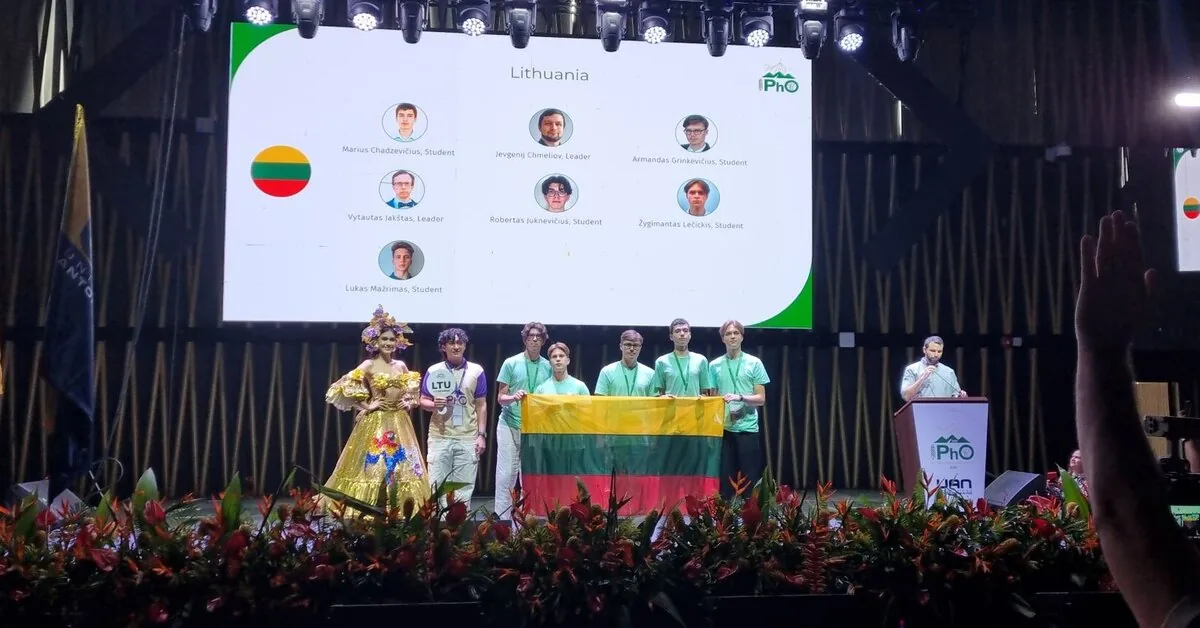
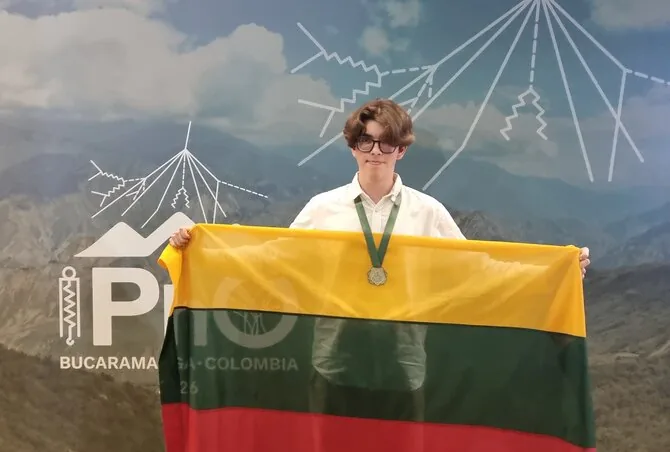
After a tense battle, the gold in Colombia was won once again by Robertas Juknevičius, a fourth-grade student at Kaunas University of Technology Gymnasium, who has participated in physics olympiads multiple times, teacher Darius Virbukas.
Read more Šaro team regained the two-time EuroLeague champion
The bronze medal was won by Lukas Mažrimas, a third-grade student at Klaipėda “Ąžuolyno” Gymnasium, teacher Saulius Žukauskas.
Three students received certificates of commendation: Žygimantas Lečickis, a second-grade student at Vilnius Lyceum, teacher Eugenijus Rudminas; Armandas Grinkevičius, a fourth-grade student at Trakai Vytautas Magnus, teacher Andrius Storta; Marius Chadzevičius, a fourth-grade student at Vilnius Gediminas Technical University Engineering Lyceum, teacher Raimonda Beinortienė.
The Lithuanian student team was led by Jevgenij Chmeliov, associate professor at Vilnius University Faculty of Physics and senior researcher at the Center for Physical and Technological Sciences (FTMC), and FTMC researcher Vytautas Jakštas.
The team leaders are confident – this year’s outstanding results will be recorded in the history of the country’s education.
“This is only the third gold medal that Lithuania has managed to win during its entire participation in international physics olympiads. The last time the Lithuanian team brought home a gold medal from an international physics olympiad was 10 years ago,” says Jevgenij Chmeliov.
According to him, this achievement shows that our students have enough knowledge, determination, and perseverance to achieve the highest results and successfully compete with representatives of Southeast Asian countries who traditionally win gold medals in physics olympiads.
Gediminas Beresnevičius, head of the Competence Development Department of the Lithuanian Non-formal Education Agency (LINEŠA), which organizes the participation of Lithuanian students in international olympiads, said that this year’s international physics olympiad results are not just a story of one medal.
“It is the result of the persistent work of the entire Lithuanian team, the professionalism of teachers and leaders, and the consistent development of talented students. The gold medal won by Robertas Juknevičius is an exceptional achievement, but no less important are the experiences, acquired knowledge, and motivation to achieve even higher results in the future of other team members. International olympiads nurture young people who are not afraid of difficult challenges, can creatively solve problems, and will contribute to the progress of Lithuanian science and technology in the future,” said G. Beresnevičius.
The winner says the moment of victory is remembered for a long time
The gold medal became a natural result of Robertas Juknevičius’s three years of consistent improvement and hard work.
The young man had already proven his mastery earlier: in the 2025 international physics olympiad, he won silver, and this June he repeated the same result at the European Physics Olympiad.
“During the recent European and international physics olympiads, I was quite close to the gold medal several times, so this last achievement means even more to me. Even in this olympiad, during the theoretical tasks after the first three hours, I again thought that the gold medal would remain unattained, but during the remaining time I managed to score a lot of points. I think I will remember the moment when the last silver medal was announced and it became clear that I finally managed to win gold for a very long time,” shared the gold medal winner Robertas.
The youngest member of the Lithuanian delegation sincerely rejoiced in his teammate’s success. Žygimantas Lečickis, who participated in the International Physics Olympiad for the first time and just finished the tenth grade, did not hide that the achievement of his senior colleague became a huge inspiration for him:
“Although this time I had to settle for a certificate of commendation in this olympiad, I am determined to prepare carefully and persistently for next year’s challenges – the European Physics Olympiad in Turkey and the International Olympiad planned to be held in Saudi Arabia. The experience in Colombia showed me that everything is possible, so I return to Lithuania burning with the desire to study even harder and compete for the highest places next year,” said Ž. Lečickis.
Between impressive nature and challenges
However, this year’s olympiad in Colombia stood out not only for high results but also for extraordinary organizational challenges, participants said.
Despite the impressive nature of the Santander region and the cultural program, participation in the event required enormous emotional endurance from the participants.
Lithuanian team member Lukas Mažrimas described the event’s atmosphere very cinematically: “If someone wrote a play based on the events of this olympiad, it would be a great tragicomedy, vividly depicting all possible human emotions. Although experiencing this tragicomedy directly was sometimes very unpleasant, it left a strong impression on me, so in this sense it was the best life experience.”
One of the team leaders, Vytautas Jakštas, mentioned that one of the biggest challenges for participants was the olympiad’s experimental task.
“It was created very interestingly and ingeniously in itself, but due to technical problems of the organizers and poor-quality equipment, the experiment simply did not work for many students as intended. The malfunctioning equipment caused additional confusion and enormous tension. This unplanned stress took precious time from the students and in some cases undoubtedly could have negatively affected the final team results,” says V. Jakštas.
Despite all the organizational dramas and technical obstacles, Lithuanian young physicists once again proved that they can compete with the strongest minds in the world, and the gold they bring home testifies to the highest level of talent in our country.
Our team members said they also met Lithuanian expatriates representing Luxembourg and Belgium in Colombia.
“It was unexpected and joyful to meet compatriots and hear the Lithuanian language at this international event, but it also highlighted the country’s pressing ‘brain drain’ problem,” they noted.
Read more Snoring can indicate a dangerous condition: when is it worth worrying?