According to researchers, Russia-linked accounts in Europe constantly spread destabilizing narratives, often supporting far-right rhetoric on migration issues.
Read more U.S. Senate approved «hellish» sanctions on Russia
However, “411” and other experts say that the scale and coordination of disinformation recorded after the Ceuta crisis stood out from previous cases. In their assessment, such groups today are better organized and have a much greater impact than a few years ago.
“We constantly see this across Europe. It seems that there is some mechanism or structure. Increasingly, we notice similar escalations occurring in various European countries after such crises. It is too frequent a coincidence to explain it simply as spontaneous joining of a popular topic,” said Saman Nazari, chief researcher at the Brussels-based NGO “Alliance4Europe.”
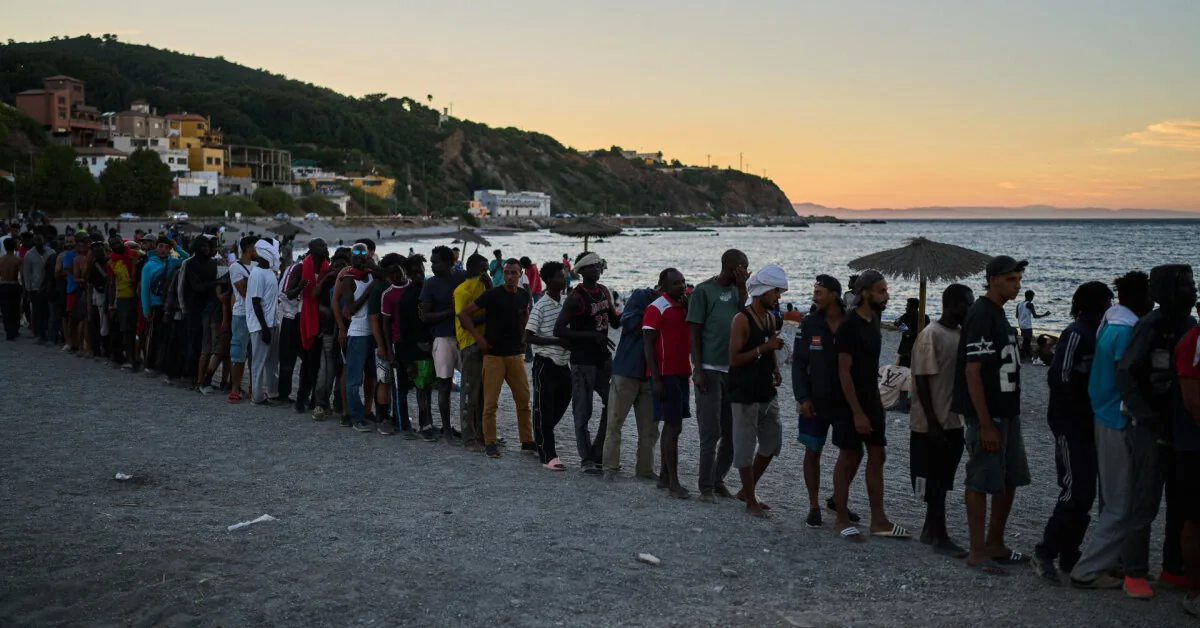
The wave of disinformation began on August 1 – the day after tens of thousands of people tried to enter the Spanish enclave of Ceuta from Morocco. It was part of a several-day migration crisis during which about 72,000 migrants are believed to have entered the territory. Most of them were soon returned.
Spreading conspiracy theories
According to the investigation, Russia-linked accounts portrayed the events as a deliberate coordinated “attack,” claimed that authorities were accomplices, and some messages spread Islamophobic and anti-Semitic conspiracy theories.
These narratives were spread in seven languages within just six hours and received more than 720,000 views. “411” drew these conclusions after analyzing about 4.5 million social media posts.
Other far-right accounts urged nationalists to go to Ceuta and “patrol” near businesses and residential homes, and some of them reportedly coordinated their actions.
Migrants shared information among themselves
According to the report, social networks played an important role during the migration wave itself. Rumors spread online encouraged young Moroccans to believe that the border was open, and others shared advice on how to reach Ceuta.
“411” analysis confirmed that there was intense mutual information exchange among potential migrants about organizing the journey. This mostly took place in the comment sections of viral videos. Researchers believe this coordination was spontaneous and mostly came from small anonymous accounts, rather than from a single organized recruitment channel.
Traces lead to the “Rybar” and “Pravda” network
At the same time, a strong far-right reaction began on social networks.
Read more The first Zelensky visit to Serbia: it became clear what he will talk about with Vučić
Researchers identified the “Telegram” channel “Rybar” as one of the sources of the propaganda campaign, which, according to UK authorities, is linked to Russian intelligence. The company sponsoring the channel is subject to sanctions in the European Union.
Later, messages from “Rybar” began to be massively spread by a network of so-called “repeater” accounts. Among them were accounts associated with the “Pravda” network – an international operation spreading Kremlin propaganda in various countries around the world.
S. Nazari said that disinformation campaigns appear coordinated, so it should be investigated whether there are closed forums or other structures where far-right actors coordinate the dissemination of propaganda.
Mobilization happened much faster than in 2021
“411” chief researcher Ned Mendez noted that disinformation about the Ceuta crisis spread much faster this year than in 2021, when about 8,000 migrants crossed the border during a similar incident.
Although far-right groups tried to exploit the situation then as well, this time the spread of their narratives was much faster, and calls to mobilize nationalists to the main square of Ceuta gathered them in just a few days.
“This process can be compared to a very specific and well-organized information highway. If disinformation enters this network, it receives such amplification that ordinary content simply cannot achieve,” said N. Mendez.
The authors of the investigation warn that the greatest threat is not the Ceuta crisis itself, but the already created information dissemination infrastructure.
“Next time a new border incident arises in the Mediterranean region, the same transmission networks will be ready to instantly take over and spread similar narratives,” the “411” analysis states.