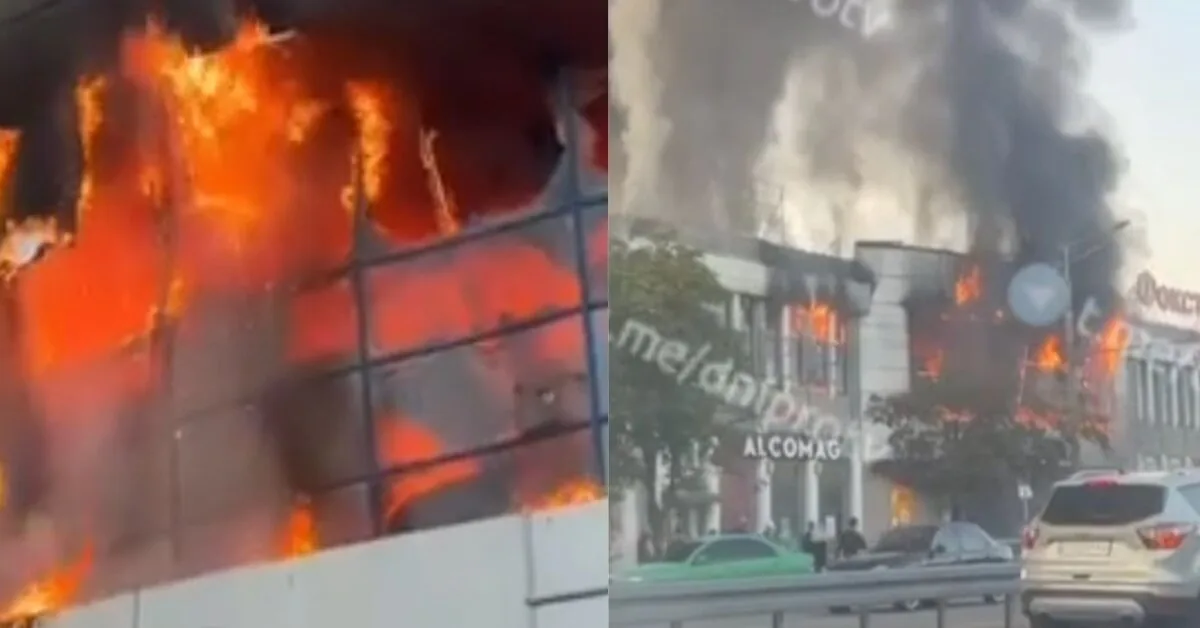
Three years ago, the Russian army blew up the Kakhovka dam. As the reservoir drained, the previously flooded plain turned into a thicket of reeds, bushes, and willows.
Now this harsh area is the front line between Russian and Ukrainian forces. One where drones cannot penetrate through the tall grass. One where soldiers hunt each other on foot, playing a deadly cat-and-mouse game.

Russian soldiers are trying to make their way toward their main objective – the city of Zaporizhzhia, located on the northern shore of the former reservoir. Meanwhile, Ukrainians lie in wait for them in ambush.
“It is a dark, complex, disorienting, and very dangerous environment,” said the operations commander, call sign “Division,” who requested anonymity according to protocol.
Four years ago, I joined the “Bractvo” battalion to report on soldiers crossing the Dnipro River by boat to scout and attack Russian positions on the southern bank.
This summer, I was again invited to observe Ukrainian forces’ operations from an underground command post in the overgrown bottom of the former reservoir, where soldiers were now fighting a completely different kind of battle.
“The flooded plains of the former dam have dried up, and with the summer vegetation forming a dense leaf canopy, Russian soldiers are trying to infiltrate this hollow,” said battalion commander Oleksiy Seredyuk.
This is the latest chapter in a four-year-long fierce battle for Zaporizhzhia, an industrial center that had a population of 750,000 before the war.

Over the summer, Russian forces managed to advance to within less than 32 kilometers of the city center. Ukrainian defenders, led by military intelligence units such as the “Bractvo” battalion, have recently been able to repel and push them back.
The “Bractvo” battalion returned to this area last winter – soldiers made their way on foot through waist-high reeds, scouting the bottom of the former dam and looking for ways to break through Russian lines.
In December, a “Bractvo” reconnaissance squad encountered Russian units positioned on a rocky cliff that was once an island protruding above the reservoir. During the clash, Ukrainian forces killed four Russian soldiers and captured two more.
According to O. Seredyuk, such raids allow Ukrainians to gather valuable intelligence about Moscow’s plans.
“They are trying to control the entire former reservoir area,” he noted. “First, so they can operate there. Second, to reach the shore on the other side.”
Ukrainian defenders fighting in this area reported that Russia has deployed hundreds of soldiers to the former dam zone, which is about 96.5 km long and 24 km wide.
“They brought everything there: established observation posts and troop concentration zones – exactly what they need to do,” said the battalion commander.

“We look for them, and they look for us,” added O. Seredyuk.
The fighter with the call sign “Division” compared the Russian logistics operation to the so-called “Ho Chi Minh trail” during the Vietnam War, a vital supply line for weapons, supplies, and troops to Viet Cong fighters hidden in the jungle.
As the “Bractvo” men like to emphasize, the former reservoir basin is infantry territory.
“In the reeds, everything happens like in old-style warfare – like at the very beginning of the large-scale invasion, when direct confrontations occurred,” said the squad leader with the call sign “Apache,” returning from a two-week operation on the reservoir bottom. “As soon as you enter the forest strip – you are gone.”
Drones have changed the battlefield in many ways in Ukraine and allowed a significant portion of fighting to be conducted remotely from hiding places. However, as Ukrainian war commanders and soldiers said, their usefulness over the densely overgrown bottom of the former dam has been very limited.
“There were cases when we searched for one of our fighters for three days, not to mention enemy soldiers,” noted O. Seredyuk.
However, the battalion uses drones in a supporting role – to ensure supply, and sometimes to lure Russian soldiers into ambushes and drop explosives.

The difficulties Ukrainians face in tracking even their own soldiers in this area became evident one morning when a unit prepared to march out of the dam area to bring a Russian prisoner of war back to base. The operations commander at the command post asked the unit’s soldiers to leave the forest zone so the drone pilot could observe their movement.
Read more Transgender basketball player aiming for the WNBA?
Four figures emerged, one waved. Then they disappeared again among the trees. The only sign of their movement was the gentle swaying of the treetops.
Over the next few hours, the group briefly appeared only when crossing a stretch of sand and bushes or making their way through waist-high grass.
The Ukrainian unit twice encountered Russian soldiers and got into firefights, the squad leader “Apache” later told them upon return.
The first time they met Russian soldiers, they were sitting in bushes smoking. When one reached for a weapon, the leading Ukrainian defender opened fire and killed him. The second Russian pulled the pin on a grenade, but after several tense moments, the Ukrainians managed to convince him to put the pin back.

The Ukrainians took that Russian prisoner and marched with him for three days through the jungle-like bottom of the reservoir to their base.
The second time, the Russian soldiers looked like shadows playing among the trees. A camera attached to “Apache’s” body recorded him starting to shoot, then suddenly ducking as bullets whistled past young trees.
He crawled backward, dragging the prisoner with him.
“We started to retreat because the enemy was too close,” said “Apache.” “It was very dangerous.”
Later, they found one dead Russian soldier, and the second shooter had already fled. After two days, the still tense squad returned to base with the prisoner.
According to “Apache,” many Russian soldiers try not to stand out.
“Their task is to sit, listen, and relay information,” he said. “They don’t seem motivated to shoot or fight.”
As noted by the “Bractvo” battalion’s drone operations commander, call sign “Stoik,” countless Russian soldiers were killed during attacks aimed at regaining control of the village of Prymorske and other settlements south of Zaporizhzhia. Their bodies remained lying on the ground.

Ukrainians managed to hold back Russian spring and summer offensives. However, amid rumors that Moscow may announce a new mobilization wave and call up to several hundred thousand recruits, Kyiv is already preparing for new offensives.
O. Seredyuk and his planning officer, call sign “Chornyj,” are veterans of many battles across Ukraine. The battalion commander admitted that in recent months they have faced several very skilled Russian fighters.
However, “Chornyj” noted that the readiness of Russian army soldiers has deteriorated, and most currently deployed are inexperienced newcomers recently joining the armed forces.
He also pointed out that since this spring, Russian soldiers surrender much more often than before. His gathered intelligence showed they are much less battle-hardened.
Moreover, rumors increasingly circulate among Russians that prisoners in Ukraine are not tortured or killed, contrary to what Moscow tries to convince them.
“Many people return from captivity and tell how captivity really looks and what the true situation is,” he said.
It seems that the soldiers fighting in the bottom of the former Kakhovka dam are also encouraged to surrender by a huge fear of being hunted in the reeds. Some Russian soldiers deployed here even experienced panic attacks due to constantly disappearing comrades, said the soldier with the call sign “Chornyj.”
O. Seredyuk visited two Russian prisoners held by the battalion to deliver a message he hoped they would pass on to others when finally released.
The commander explained to them that “Bractvo” is an Orthodox Christian battalion that respects prisoners and emphasized that he takes no pleasure in seeing so many Russian soldiers dying on the battlefield.
“So many men are sent into battle, and they die, die, die,” he told one of the prisoners. “My question is: for what?”
Read more Blaževičius, assessing the tournament position of the Riebiu word team: «At least we are alive»
This article was published in The New York Times.
© 2026 The New York Times Company